Sign up for the daily CJR newsletter.
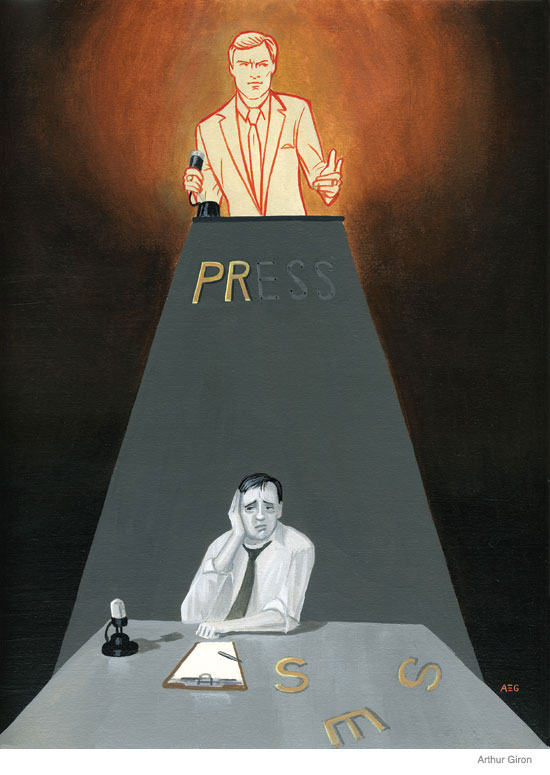
The Gulf oil spill was 2010’s biggest story, so when David Barstow walked into a Houston hotel for last December’s hearings on the disaster, he wasn’t surprised to see that the conference room was packed. Calling the hearing to order, Coast Guard Captain Hung Nguyen cautioned the throng, “We will continue to allow full media coverage as long as it does not interfere with the rights of the parties to a fair hearing and does not unduly distract from the solem-nity, decorum, and dignity of the proceedings.” It’s a stock warning that every judge gives before an important trial, intended to protect witnesses from a hounding press. But Nguyen might have been worrying too much. Because as Barstow realized as he glanced across the crowd, most of the people busily scribbling notes in the room were not there to ask questions. They were there to answer them.
“You would go into these hearings and there would be more PR people representing these big players than there were reporters, sometimes by a factor of two or three,” Barstow said. “There were platoons of PR people.”
An investigative reporter for The New York Times, Barstow has written several big stories about the shoving match between the media and public relations in what eventually becomes the national dialogue. As the crowd at the hearing clearly showed, the game has been changing.
“The muscles of journalism are weakening and the muscles of public relations are bulking up—as if they were on steroids,” he says.
In their recent book, The Death and Life of American Journalism, Robert McChesney and John Nichols tracked the number of people working in journalism since 1980 and compared it to the numbers for public relations. Using data from the US Bureau of Labor Statistics, they found that the number of journalists has fallen drastically while public relations people have multiplied at an even faster rate. In 1980, there were about 45 PR workers per one hundred thousand population compared with 36 journalists. In 2008, there were 90 PR people per one hundred thousand compared to 25 journalists.* That’s a ratio of more than three-to-one, better equipped, better financed.
How much better?
The researcher who worked with McChesney and Nichols, R. Jamil Jonna, used census data to track revenues at public relations agencies between 1997 and 2007. He found that revenues went from $3.5 billion to $8.75 billion. Over the same period, paid employees at the agencies went from 38,735 to 50,499, a healthy 30 percent growth in jobs. And those figures include only independent public relations agencies—they don’t include PR people who work for big companies, lobbying outfits, advertising agencies, non-profits, or government.
Traditional journalism, of course, has been headed in the opposite direction. The Newspaper Association of America reported that newspaper advertising revenue dropped from an all-time high of $49 billion in 2000 to $22 billion in 2009. That’s right—more than half. A lot of that loss is due to the recession. But even the most upbeat news executive has to admit that many of those dollars are not coming back soon. Six major newspaper companies have sought bankruptcy protection in recent years.
Less money means fewer reporters and editors. The American Society of News Editors found the number of newspaper reporters and editors hit a high of 56,900 in 1990. By 2011, the numbers had dropped to 41,600. Much of that loss has occurred since 2007. Network news did not fare any better—the Pew Research Center’s Project for Excellence in Journalism estimates that employment there is less than half of what it was in the peak period of the 1980s.
“I don’t know anyone who can look at that calculus and see a very good outcome,” said McChesney, a communications professor at the University of Illinois.
The dangers are clear. As PR becomes ascendant, private and government interests become more able to generate, filter, distort, and dominate the public debate, and to do so without the public knowing it. “What we are seeing now is the demise of journalism at the same time we have an increasing level of public relations and propaganda,” McChesney said. “We are entering a zone that has never been seen before in this country.”
The First Modern PR Man
Modern public relations was born from a train wreck.
Michael Schudson, a journalism professor at Columbia University, cjr contributor, and author of Discovering the News, said modern public relations started when Ivy Lee, a minister’s son and a former reporter at the New York World, tipped reporters to an accident on the Pennsylvania Railroad. Before then, railroads had done everything they could to cover up accidents. But Lee figured that crashes, which tend to leave visible wreckage, were hard to hide. So it was better to get out in front of the inevitable story.
The press release was born. Schudson said the rise of the “publicity agent” created deep concern among the nation’s leaders, who distrusted a middleman inserting itself and shaping messages between government and the public. Congress was so concerned that it attached amendments to bills in 1908 and 1913 that said no money could be appropriated for preparing newspaper articles or hiring publicity agents.
But World War I pushed those concerns to the side. The government needed to rally the public behind a deeply unpopular war. Suddenly, publicity agents did not seem so bad. Woodrow Wilson picked a former newspaperman, George Creel, to head his new Committee on Public Information in 1917. The group cranked out thousands of press releases in support of the war and started a speakers bureau that eventually grew to 75,000 people, all giving morale-boosting talks across the country.
“After the war, PR becomes a very big deal,” Schudson said. “It was partly stimulated by the war and the idea of journalists and others being employed by the government as propagandists.”
Many who worked for the massive wartime propaganda apparatus found an easy transition into civilian life. Samuel Insull, president of Chicago Edison and an early radio magnate, launched a campaign on behalf of electric utilities, which, according to Schudson, was the most far-reaching public relations effort of the era. It prompted an investigation by the Federal Trade Commission and a new raft of angry reports about the increasing power of PR.
People “became more conscious that they were not getting direct access, that it was being screened for them by somebody else,” Schudson said.
But there was no turning back. PR had become a fixture of public life. Concern about the invisible filter of public relations became a steady drumbeat in the press. From the classic 1971
CBS documentary, The Selling of the Pentagon, warning that the military was using public relations tricks to sell a bigger defense budget, to reports that PR wizards had ginned up testimony about horrors in Kuwait before the first Gulf War, the theme was that spin doctors were pulling the strings.
Gary McCormick, former chairman of the Public Relations Society of America, said that was unfair. McCormick acknowledged that there have been PR abuses, but he said most public relations people try to steer clear of falsehood. And he makes a pretty logical argument: lying does not work, because you are almost always going to get caught. And when you do, it makes it worse for your client.
“If I burn you, I am out of business,” said McCormick, whose organization has a membership of twenty-one thousand. He concedes that can be a tough message to relay to a client facing bad press. “The problem is when you get caught up with a client, and the business drives you to tell a message differently than you would advise,” McCormick said.
McCormick is right: lies are not ubiquitous, and they are not the heart of the matter. The problem is that there is a large gray zone between the truth and a lie.
Eric Alterman, a professor at Brooklyn College and a columnist at The Nation, said skillful PR people can exploit this zone to great effect. “They are able to provide data that for journalistic purposes is entirely credible,” he said. “The information is true enough. It is slanted. It is propagandistic. But it is not false.”
PR Up—Journalism Down
So what has changed? Isn’t this article yet another in a long line of complaints, starting with Silas Bent’s counting of stories generated by publicity agents in one day’s issue of The New York Times in 1926 (174) or Peter Odegard’s 1930 lament that “reporters today are little more than intellectual mendicants who go from one publicity agent or press bureau to another seeking ‘handouts'”? It is, in a way. But the context has changed. Journalism, the counterweight to corporate and government PR, is shrinking.
“We are coming out of a period when news organizations were extraordinarily prosperous and able to insulate themselves from a lot of pressures,” said Paul Starr, a sociology professor at Princeton University and author of The Creation of the Media. “The balance of power has shifted.”
When public relations began its ascent in the early twentieth century, journalism was rising alongside it. The period saw the ferocious work of the muckrakers, the development of the great newspaper chains, and the dawn of radio and, later, television. Journalism of the day was not perfect; sometimes it was not even good. But it was an era of expansion that eventually led to the powerful press of the mid to late century.
Now, during a second rise of public relations, we are in an era of massive contraction in traditional journalism. Bureaus have closed, thousands of reporters have been laid off, once-great newspapers like the Rocky Mountain News have died.
The Pew Center took a look at the impact of these changes last year in a study of the Baltimore news market. The report, “How News Happens,” found that while new online outlets had increased the demand for news, the number of original stories spread out among those outlets had declined. In one example, Pew found that area newspapers wrote one-third the number of stories about state budget cuts as they did the last time the state made similar cuts in 1991. In 2009, Pew said, The Baltimore Sun produced 32 percent fewer stories than it did in 1999.
Moreover, even original reporting often bore the fingerprints of government and private public relations. Mark Jurkowitz, associate director the Pew Center, said the Baltimore report concentrated on six major story lines: state budget cuts, shootings of police officers, the University of Maryland’s efforts to develop a vaccine, the auction of the Senator Theater, the installation of listening devices on public busses, and developments in juvenile justice. It found that 63 percent of the news about those subjects was generated by the government, 23 percent came from interest groups or public relations, and 14 percent started with reporters.
An example: when the University of Maryland announced on July 22, 2009 that it would test the new swine flu vaccine, the university press release read this way: “The research is a first step toward the US government’s stated goal of developing a safe and effective vaccine.”
The Daily Record newspaper in Maryland, Pew said, was first out with the story: “Research on the vaccine is the first step toward the US government’s aggressive goal of developing a vaccine for the virus.”
Tom Linthicum, executive editor of The Daily Record, said that first story reflected the reality of the Internet age. “It’s kind of like working for the wire services in the old days,” he said. “You write the short lede to get it up there first. You come back the next day and flesh it out.”
Linthicum said the vaccine story, while important, was not really in The Daily Record’s typical coverage area—the paper is more business-oriented. “We came back and fleshed it out some; frankly, we did not flesh it out a lot,” he said. “I think we did with it about what we could given our other priorities.”
This is not terrible. It is a decision that editors make every day. But, as Pew points out, it does hand a lot of control over the narrative to the institution that is peddling the story.
Of the nineteen stories Pew reviewed that covered the development of the vaccine, three contained significant new information, another three had new details, and the rest either repeated the same basic facts as the press release or were identical stories appearing on a different platform. “One of the key findings of the study was that as the press scales back, dissemination of other people’s work becomes a more important part of the news system,” Jurkowitz said. “There is also a greater emphasis on time, on speed, on getting the first bit of information up quickly. Often that first bit of information is coming from government agencies or public relations.”
Of course, in the modern world, news does not stay in one place for long. Stories may begin on a newspaper blog or a TV website, but they soon ripple across the Internet like a splash in a pond. Tom Rosenstiel, Pew’s director, said that ripple effect makes the original story that hits the web—and the source of information it is based on—even more important.
“The nature of digital technology is that it is distributive,” he said. “A story would be grabbed and distributed and when the original story is later updated, other versions out there might not be. It all depends on when someone grabs it.”
Some experts have argued that in the digital age, new forms of reporting will eventually fill the void left by traditional newsrooms. But few would argue that such a point has arrived, or is close to arriving. “There is the overwhelming sense that the void that is created by the collapse of traditional journalism is not being filled by new media, but by public relations,” said John Nichols, a Nation correspondent and McChesney’s co-author. Nichols said reporters usually make some calls and check facts. But the ability of government or private public relations to generate stories grows as reporters have less time to seek out stories on their own. That gives outside groups more power to set the agenda.
PR Goes Direct
Leonard Downie Jr., who was executive editor of The Washington Post for seventeen years, does not believe that reporters working for reputable organizations are going to let PR people dictate their stories, no matter how busy they get.
“Observing our own newsroom” at the Post, “I don’t see a difference in the way people are working,” said Downie, who is now a professor at Arizona State University and vice president at large of the Post. “In addition to talking to PR people, both in government and in business, our reporters want to talk to principals all the time. I don’t see a change in that relationship.”
What Downie does see is a change in the relationship between PR and the public itself. The Internet makes it easy for public relations people to reach out directly to the audience and bypass the press, via websites and blogs, social media and videos on YouTube, and targeted e-mail.
“Let’s take a hypothetical situation in which there had been no reduction in the media; at the same time, there still would be growth in the ability of public relations people to directly reach the public,” Downie said. “They are filling a space that has been created digitally.”
Some quick examples: in the academic world, the website Futurity regularly offers polished stories from research universities across the country like “Gems Clear Drug Resistance Hurdle” (Northwestern University) and “Algae Spew Mucus to Alter Sea Ice” (University of Washington); on the business front, Toyota used satellite press conferences and video feeds on its website to respond to allegations about sudden acceleration in its cars last year, and published transcripts on its website of a long interview with reporters at the Los Angeles Times; and in the realm of political advocacy, Media Matters for America led a battle across the Internet for the past several months with the anti-abortion group Live Action over a videotaped sting that Live Action did on Planned Parenthood.
In a vacuum, none of this is bad. Schools need to publicize their research, corporations defend their products, and political groups stake their positions. But without the filter provided by journalists, it is hard to divide facts from slant.
It’s also getting tougher to know when a storyline originates with a self-interested party producing its own story. In 2005 and 2006, The New York Times and the advocacy group PR Watch did separate reports detailing how television news was airing video news releases prepared by corporate or government PR offices, working them into stories as part of their newscasts. PR Watch listed seventy-seven stations which aired the reports, some of them broadcast nearly verbatim.
Stacey Woelfel, the past-chairman of the Radio Television Digital News Association, said when his group looked into the issue after it was raised by the reports, it was troubled by how widespread the use of the releases had become. “Some stations were running video news releases all the time, sometimes packages from corporate interests,” he said.
There is evidence that it has not stopped. James Rainey, the Los Angeles Times media columnist, recently won Penn State’s Bart Richards Award for Media Criticism for columns last year that showed how local television stations were running paid content in their news programs. “There’s a good chance that your small screen expert has taken cash to sell, sell, sell,” Rainey wrote in a September 15 column.
In 2008, The New York Times again returned to the issue of hidden public relations agendas with a series of stories in which Barstow showed how the Pentagon was using retired military officers to deliver the military’s message on the war in Iraq and its counterterrorism efforts. Barstow described how the officers were presented on the news programs as independent consultants offering unvarnished opinions.
After being stonewalled by the Pentagon for two years, the Times eventually sued to obtain records about the Defense Department’s use of retired military officers. Barstow found evidence that the officers’ appearances on television were not happenstance, but a carefully coordinated effort of what the Pentagon called “message force multipliers.”
Barstow was struck by the sophistication of the operation. “In a world saturated with spin, viewers tend to tune out official spokespeople and journalists,” he said. “Where they are influenced is when they see people who are perceived to be experts in the subject matter but independent of the government and the media.”
Front Groups Obscure Special Interests
Hiding the PR agenda is not a new tactic, but one that seems to be rising to new levels. One form it takes is front groups, supporting this cause or that, this candidate or that, this product or that, without revealing their ties to the cause, candidate, or product.
Jane Mayer focused national attention on such groups in an encyclopedic article about the Koch brothers last summer in The New Yorker. The article described how the Kochs had funded groups to promote their conservative political philosophy and oppose “so many Obama Administration policies—from heath-care reform to the economic-stimulus program—that, in political circles, their ideological network is known as the Kochtopus.”
Mayer said one of the most difficult tasks in reporting the story was finding the connections between the groups and their funders. Many people and organizations besides the Kochs fund advocacy groups, and from both ends of the political spectrum. Mayer said it takes so much effort to find out what group is connected with what organization that it is difficult for reporters to keep up.
“You never know what you don’t know—it is getting harder and harder to find out who is behind those front groups,” she said. That is no accident, according to Wendell Potter, a former vice president for corporate communications at CIGNA, the insurance company.
Potter, who has since become a vocal critic of corporate public relations, particularly related to the health-care debate, said PR’s influence has become deliberately more opaque as viewers become more attuned to its influence. During the debate over the Clinton health-care plan in 1993 and 1994, Potter said, the health-insurance industry’s trade group openly opposed the measure. In a series of ads featuring Harry and Louise, the fictional married couple, the industry warned that the Clinton plan would mire health care in tangled bureaucracy. The industry’s role in the ad, he said, “was very visible, very vocal.”
The industry’s opposition to the bill reflected the public’s concern at the time about government interference in health care, Potter said. But by 2007, public opinion had changed and polls showed that a majority of Americans felt that some degree of government involvement was needed.
Thus, Potter said, the industry no longer wanted to be closely linked to lobbying on the issue. So instead of directly running ads, it farmed a lot of the work out, obscuring its role.
“You really want someone that seems to be an ordinary person. That gives you credibility and the perception that the public is on your side,” he said.
The health-insurance industry’s trade group, America’s Health Insurance Plans or AHIP, declined to speak for this story. But executives with the public relations firm APCO Worldwide, which has worked for the health-care industry, said that when their agency sets up a group to fight for an issue, they don’t try to hide their association. B. Jay Cooper, APCO’s managing director, said in the recent health-care fight APCO managed such a group, but every reporter who covered the issue knew who APCO represented. That doesn’t mean the link was always reported to the public.
Indeed, it is often difficult for reporters to find the connection. It took Drew Armstrong, a health-care reporter for Bloomberg, months to nail stories showing how the health-insurance industry had funded efforts by the US Chamber of Commerce to fight against changing the health system.
Armstrong dug into tax records to show what had previously been hidden—that AHIP contributed a whopping $86.2 million to the Chamber to fight against the Obama health- care plan. “I was shocked by the amount,” Armstrong said. “It was 40 percent of the Chamber’s budget.”
The problem for Armstrong was that neither organization’s filings proved a link. There was no definite proof that it was the same money. The IRS forms filed by the groups are pretty scanty—they require organizations to list donations but not the donor—and Armstrong had to work with sources to confirm the connection.
It took a while for Armstrong to establish the link, but he did so in a November 17, 2010, story. Neither group would confirm that it was the same money—the Chamber still won’t—but no one called for a correction.
“Giving money to the Chamber lets you have it both ways,” Armstrong said. “You can sit with the Democrats, lobby for your position, and have your phone calls returned. At the same time, you have someone like the Chamber out there, running ads, doing the public relations campaign.”
After his first story, Armstrong looked into how the Chamber used the money. He found that it set up a sophisticated operation to oppose the law, particularly in swing states. The Chamber paid for ads that ran in twenty-one states beginning in August of 2009. The ads warned that the government-proposed plan would lead to tax increases, swell the deficit, and expand “government control over your health.”
Bill Vickery, who Bloomberg said was paid by the Chamber to help run the opposition in Arkansas, told Armstrong that he organized about fifty events targeting incumbent Senator Blanche Lincoln, a Democrat who was a key supporter of the health-care law. Lincoln lost by 21 percent in last November’s midterm elections.
“I talked to a lot of consultants, pollsters,” Armstrong said. “They said this was one of the most sophisticated operations, akin to a presidential campaign, that they had ever worked on.”
Steve Patterson, the Lincoln campaign manager, said most of the ad money for the health-care fight actually hit the state the year before the midterm election while the battle over the Democratic plan was in full cry. “Most of it was educational in nature,” he said. “Call Senator Lincoln and tell her to vote no.”
But Patterson knew early on that the heath-care fight was likely to be the defining issue of the Senate race, and many of the ads were already targeting Lincoln’s position in favor of change to the health-care system. So he asked the campaign’s ad buyer to track the spending. They found $6 million in issue advertising was spent during the period—a very large amount in a small media market state.
From October to early December, Lincoln’s buyer found that the US Chamber of Commerce spent $2 million in advertising. Americans for Stable Healthcare—a coalition of liberal groups, the pharmaceutical industry, and unions in favor of the plan—spent $1.2 million. And the 60 Plus Association, a conservative senior citizen group opposed to the plan, spent $650,000.
“I think it was the critical issue that turned voters against Senator Lincoln,” he said. “Her numbers started turning when this process began.”
Tom Collamore, who ran Fred Thompson’s presidential campaign before becoming senior vice president of communications and strategy at the US Chamber of Commerce, likened a modern issue campaign to a presidential race. “There are all the elements,” he said. “You test the message and then you push the message out through all the outlets.”
“If you are really serious about something you have to make a big investment,” Collamore continued. “It involves research and focus groups and proper messaging that will lead to highlighting things that resonate.”
In the heath-care battle, the Chamber created a web hub, healthreformimpacts.com, to continue the fight. It set up coalition groups like Employers for a Healthy Economy. Collamore said much of the effort also involved old-fashioned PR work as well. “We did a lot of online pushing of the message through stories, columns,” he said. “A lot of interaction with the press, a lot of interviews.”
Although the fight over health care was larger than most campaigns, Collamore said it was not fundamentally different than several other public relations efforts the Chamber is working on.
One of the largest is the Chamber’s $100 million “Campaign for Free Enterprise,” an effort to fight government involvement in business matters. Besides the traditional effort of advertising, press releases, and position papers, the Chamber has set up groups like Students in Free Enterprise and the Extreme Entrepreneurship Tour to target college campuses.
It’s also making an online push. The Chamber kicked off part of the campaign with $100,000 in prize money for a video contest on its Facebook page. The campaign received one hundred thousand views, recorded ten thousand votes, and collected four thousand e-mail addresses to add to the Chamber’s database. Right now, it has 146,000 fans—not Lady Gaga level (more than thirty million at press time) but not bad for a business group.
“The news cycle never ends. There is a lot of space, there is a lot of competition for people’s attention,” Collamore said. “It’s not just press releases anymore.”
This article has been co-published with ProPublica.
Correction: In John Sullivan’s “True Enough: The second age of PR,” the author picked up a set of decimal-place errors from the book The Death and Life of American Journalism (which the book will correct in the next edition). The piece should have said, “In 1980, there were about 45 PR workers per one hundred thousand population compared with 36 journalists. In 2008, there were 90 PR people compared to 25 journalists”—instead of the figures .45 and .36 for 1980 and .90 and .25 for 2008. The ratios remain the same. We regret the error.
Has America ever needed a media defender more than now? Help us by joining CJR today.