Sign up for the daily CJR newsletter.
Five days before Christmas, on the night Congress deadlocked on payroll tax rates and unemployment benefits affecting more than 160 million Americans, the first story on World News, the flagship evening broadcast of ABC News, was about a blizzard. “Wicked weather” had people in the east “bracing for a storm that could threaten holiday travel plans for millions.” The CBS Evening News began with two pieces on the Washington stalemate, including a blistering analysis by Bob Schieffer, the veteran chief Washington correspondent, who called the Congress “totally dysfunctional.” The legislators, he said, had put up a “neon sign” that reminded people why Congress had a nine percent favorable rating.
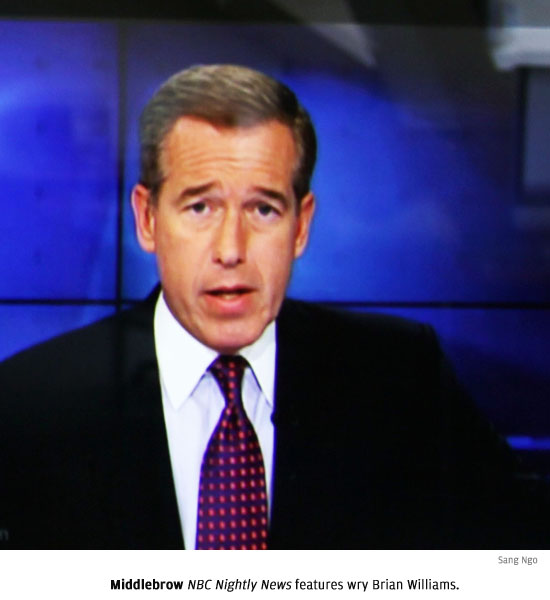
NBC Nightly News, as it so often does, took a middle-of-the-road approach, leading with a piece on the standoff in Congress, softened by the kind of introduction that anchor Brian Williams likes to use to make the news more accessible:
Tonight people are on the move and mall parking lots are full amid the stress of everyday life in the week running up to Christmas. The nation’s elected representatives are fighting and are again deadlocked…. And while it’s important legislation … it’s the business of Washington and it’s the fight that is coming through loud and clear, and the closer you get to the Capitol, the louder it becomes.
On the day late in February when Bashar al-Assad’s tanks and artillery killed more than 70 civilians in Homs—including Marie Colvin, the American-born correspondent—ABC World News began with a report that gas prices were “rising before our eyes” and “fed-up drivers are fighting back” and “venting their anger.” It was the second time in three days that World News began with the gas-price story, and the change in the average price per gallon between the first time and the second was two cents. ABC aired its Syrian story, narrated by correspondent Christiane Amanpour in the New York studio, more than 10 minutes into the broadcast, at the end of the first segment. The coverage ran under 3 minutes.
That evening, CBS Evening News began with nearly six minutes of coverage of what anchor Scott Pelley called “the massacre,” and what the US government called “shameless brutality.” NBC Nightly News, in the middle again, began with almost four minutes about what Williams called “bona fide atrocities,” and what his chief foreign correspondent (reporting from the region) described as “indiscriminate shelling” of civilians.

ABC’s choices on these two newscasts were driven less by traditional news values than by a desire to be different—to distinguish ABC from the competition. One participant in the decision to start with the winter weather story in December said, “We knew CBS would lead big with Congress, because it’s their kind of thing, and we were pretty sure NBC would. So we went for the snow pictures, and the possibility bad weather would spread across the country.” In fact, however, weather for holiday travel was nearly perfect across the country. That’s one of the problems with searching for a “different” lead—sometimes you wind up looking trivial or too far off the news. But at ABC News it has been a preoccupation of the anchor and producers to look for what they call the “insurgent lead.” Ben Sherwood introduced the term when he took over as President of ABC News at the beginning of 2011, and wanted his staff to understand the change he hoped to see.
“Insurgent is a word that means to rise up against the established order,” Sherwood says. “And so part of what I wanted to do was to rise up against the established order of choosing things—the established, traditional view—and say what is an alternative to the established order of picking things, so that we’re all not identical. Because if we’re all identical at 6:30, then the established order will prevail. And the established order is that Brian is in first, and we’re in second, and CBS is in third.”
ABC is not alone in wanting to distinguish itself. For the first time in the history of the iconic evening network news broadcasts, all three are trying to present clear choices, built around the very different identities of their anchors. ABC emphasizes stories it considers most relevant to its viewers’ lives, plus lighter news and features, in a program built around the dramatic (some say melodramatic) delivery of Diane Sawyer. CBS delivers a serious program on steroids, in harmony with Pelley’s buttoned-down personality. And the ratings leader, NBC, has staked out the middle ground, with an anchor, Williams, who has news credibility but no aversion to feature stories, and who loves to show off his wry sense of humor.
There’s a lot at stake. The three network newscasts have lost enormous chunks of their audience in recent years, due to harsh demographic realities: Their viewers are dying off, and younger consumers haven’t established the same news habits as their elders. Then there’s the fractionalization of the marketplace, brought about by the proliferation of cable news outlets, on-demand Internet news sites, and social media optimized for quick, mobile consumption. Where news consumers once had only a handful of options, their choices now are virtually unlimited, and they can mix and match the news they want to see. Even so, network news remains formidable. Together, the three network newscasts still attract more than 23 million viewers every weeknight—almost a third of the people watching television at 6:30 in the evening. Each broadcast has an audience bigger than any other single source of news.
In fact, with all the attention given to cable news, it’s worth noting that even the lowest-rated network newscast alone has an audience more than two-and-a-half million people larger than the combined audiences of the 6:30 news programs at Fox News, CNN, HLN, MSNBC, and CNBC. The problem is that, according to network research, more than 80 percent of their viewers say they have “seen the news” (on cable, on local television, on the Web, via social media, in newspapers) before the network newscasts air. If they are to keep viewers, or gain new ones, the network newscasts cannot afford to be seen as “more of the same.” They must offer more than a recitation of the day’s events, which viewers may feel they already “know.”
In the golden age of network newscasts, 90 percent of the people watching television at 6:30 p.m. were watching “the news.” With virtually no news competition, and working in the tradition of serious newspapers and radio broadcasters, all three TV networks aired broadcasts that dealt with “important news,” lightened only by a “kicker” at the end. There was little hesitation about forcing viewers to “eat their spinach,” and not much debate about whether viewers should be given what they “needed to know” or what they wanted (which was presumed to be less important). Producers and editors spent a lot of time worrying about whether their selection of stories would match up to the next morning’s New York Times. Which newscast you watched depended almost entirely on which local television station you were watching when the news came on, and whether you liked Walter Cronkite better than Chet Huntley and David Brinkley, or Peter Jennings better than Dan Rather or Tom Brokaw. Until relatively recently, it was possible to complain that all three networks were doing essentially the same broadcast.
Brian Williams remembers it as “the kind of groupthink image that for years we all know existed, where you looked at all three monitors and sometimes shot for shot, stride for stride, it’s as if we Xeroxed the first bloc and sent it across town and said, ‘Okay, so we’re in agreement this is what we’re going to do tonight.’ ”
Actually, the groupthink started at the beginning of television news, in the late 1940s and early 1950s. Its earliest practitioners admired serious newspapers and radio news, and their corporate leaders were under pressure from Congress to broadcast “in the public interest.” So they wanted the evening newscasts (along with documentaries and political convention and election coverage) produced by their news departments to be demonstrations of sober intent, as opposed to the comedies and variety hours produced by the entertainment departments. (Reuven Frank, the innovator responsible for the Huntley-Brinkley Report and later the president of NBC News, used to say, “A lot of newspapers have comics sections. The networks are comics with newspaper sections.”) As long as the three networks operated in a universe of enormous audiences and limited competition, they could afford to feed viewers the spinach of “important” news. If it all looked the same, it didn’t matter. The networks were delivering the news—generally the same stories in the same order, giving them similar weight.
But the news has changed. now it’s a rare night when all three networks cover the same stories. As Williams put it, “It’s audibles. It’s electives. It’s some brands trying to be different. Distinguish themselves. Stand out.”
It is still true that the anchors are, for most viewers, what makes one program stand out from another, perhaps more than ever. “These newscasts are almost entirely a function of the anchors,” Sherwood says. “And it’s misplaced to over-interpret the changes that producers are making.”
Beyond their personalities, the anchors impose their news sensibilities on the programs; it’s not by accident that they are called managing editors. Good producers—and good news division presidents—make sure the story content, the presentation, and the overall style of the program match the anchor’s sensibilities. It’s difficult to imagine Sawyer fronting the current CBS broadcast, or Pelley anchoring on ABC.
No one is trying harder to stand out than Sawyer and ABC World News, and it’s more than the drive to find the “insurgent lead.” Many nights, traditional news stories are treated as quickly as possible to make more time for warm and fuzzy features, health and consumer stories, and “news you can use”—the kinds of content you used to find mostly on the magazine programs and morning shows. Which is, of course, where Sawyer has spent most of her professional life.
Sometimes, that experience has honed an instinct that results in great work. Her continuing “Made in America” series, about how more Americans could have jobs if more American-made products were bought, has turned a spotlight on a major aspect of the nation’s unemployment crisis. Putting aside some examples of outrageously contrived video, these pieces have dramatically illustrated the problem and gone on to suggest solutions. That’s rare in television news. Apart from that series, Sawyer encourages investigative work, pursuing the “bad guys,” seeking unrehearsed answers and holding leaders responsible for their actions—whether it’s the Justice Department spending $16 a muffin at its conferences or major banks charging hefty new fees. That kind of “on-your-side” journalism is all too rare (Sherwood says Sawyer picks stories that “empower people to change their lives”). Sawyer also succeeds with a useful technique for providing background and analysis on complicated stories: She frames the questions she wants answered, and has correspondents answer them. And when an indisputably big story breaks, Sawyer and her correspondents provide coverage that’s as good as anyone’s.
But the emphasis is on finding and highlighting the most interesting and popular stories, not necessarily the most important, and infusing them with Sawyer’s dramatic approach and delivery and “hot” writing. Developments are “seismic” and “incredible.” There’s medical news that “could put us all at greater risk.” The “Made in America team” is “back in action.” The White House correspondent “took the allegations straight to the White House.” There’s new technology that might mean “20 seconds could save your life.” Tonight, “we have an outrage and an action.” Meanwhile, Sawyer reserves time for more news-lite—the staff calls the segments “Diane pages”—that she and her audience can enjoy: a new ketchup package (“for any of us who have ever squirted ourselves and everyone else around us with these little packages of ketchup, hooray—a small victory!”); the plane that landed with a baby boy born in flight; viewers’ nominations for “the saddest movie ever.”
In the age of social media, she encourages viewers to communicate, and she uses precious airtime to broadcast what they say. When Sawyer travels to cover royal weddings, floods, tornadoes, or political events, they become settings for her. See her touch children; see her stride along Main Street in search of political opinions; see her on the prow of a boat, braving snake-infested rivers; see her comfort the afflicted. Few correspondents’ reports run without being followed by a personal observation from Sawyer. (On the number of people in mortgage trouble: “11 million. What a number!” Or a new vaccine recommendation: “Such a wake-up call.”) It is all a far cry from the days when anchors prided themselves on staying out of the story, and it is delivered with a repertoire of dramatic aids: the breathless voice, the urgent tone, the tilt of the head, the narrowing of the eyes, calculated to make an emotional connection with viewers.

The approach at CBS could not be more different. They’re betting they can win viewers by emphasizing the old-fashioned virtues of reporting and analysis of important news. The Evening News newsroom setting, the minimalist graphics, and the content of the broadcast—all evoke Cronkite. Pelley and his producers focus on the reporters, find spare seconds to jam in more news items, and describe even the most elementary observations as “insights” you don’t get elsewhere.
In Pelley, CBS has probably the most well-qualified and proven television journalist ever to ascend to the anchor job; he has filed breaking news pieces from around the nation and the world, covered the White House, and compiled an impressive body of work for 60 Minutes. His no-nonsense (some would say stiff) style is well matched to the style of the program. The closest he comes to hyperbole is when he refers to CBS News resources “around the world” (the reality is that CBS, like the other networks, has drastically cut back its foreign coverage resources, dropping most of its correspondents, producers, crews, and bureaus overseas) and touts added information provided by “our research department” (which amounts to three full-time employees). He is less likely to comment on a correspondent’s report than to be found on camera as the report ends, gazing thoughtfully at the monitor, his eyeglasses and his chin in his hand.
Pelley and his producers spend more time on foreign news, Washington news, and politics—the traditional fare of the network evening news broadcast. They air pieces aimed at providing background and perspective. Warm and fuzzy stories are hard to find. So are any signs of feeling—even a smile—from the anchor. While ABC’s broadcast seems finely tuned to audience research and the techniques that have built ratings on local newscasts around the nation (go hard on weather stories; never pass up a story featuring animals), CBS seems to seek merit badges for lofty intentions. Jeff Fager, the chairman of CBS News, is supremely confident: “I don’t look at the research. I don’t believe in it. You do what you do well. You cover what you think is important or interesting. It’s news. It’s journalism.”
NBC’s Williams describes the CBS Evening News as “a serious endeavor.” That’s as far as he will go, but it’s clear his program aims at a sweet spot between lofty and light. Williams remembers his predecessor, Tom Brokaw, “reminding everybody about the back-fence principle espoused by Charles Kuralt and Walter Cronkite….You can’t be above what two people choose to talk about that evening. You have to note that you live in this world.”
In its mix of content and in its style, Nightly News tries to achieve that feeling of neighbors chatting to each other. While a viewer can rely on the program’s first segment not to shy from the day’s traditional news budget, the mix also includes soft feel-good features like “Making A Difference,” “Sign of the Times,” and “Road to Retirement.” The Williams writing style—the opposite of hot ABC copy—approximates that back-fence conversation. His introductions to pieces meander more than broadcast writing conventions would dictate, but the technique may help viewers understand what they’re about to see. And his choices of filler items seem to facilitate folksy story-telling: a guy shot in “the backside” by a dog (“the dog is not talking”), a fire alarm set off by a squirrel living in the school kitchen (the bad news is “those weren’t raisins on the rice pudding”), missing moon rocks (“check your sock drawer”), a coming lunar eclipse (“consult your local listings”), and two newly discovered planets (“the bummer here” is they’re too hot to live on). Like Sawyer, Williams often uses “we,” “you,” and “our” to edge closer to the audience. He likes informalities like “the Feds.” Even the way Williams closes his broadcast is right down the comfortable middle: He’ll “look for you” tomorrow night. No ponderous thank you from all those CBS folks around the world; no earnest call to rejoin Diane tomorrow.
The differences are clear. Sawyer and World News search for the popular stories (Sherwood prefers to call them “relevant”) and try for emotional connections with the audience; Pelley and the Evening News take an approach more serious than any in memory; and Williams and the Nightly News remain in the traditional mainstream, though with softer edges. The questions are whether all this matters in the ratings competition, and whether it will have an impact on the future of television network news.
There are people at all three networks who worry that Sawyer and Sherwood are taking their flagship network newscast downmarket, and even tabloid, in an effort to win the ratings war at any cost. They fear that if ABC is successful, it will put pressure on the other networks to lower their standards. Sherwood rejects that kind of criticism—from people he calls “the high priests of news”—and he says he is mindful of both the “great heritage and tradition of ABC News” and the “desire to win the future.” He argues that all the evening newscasts have used a mix of hard and soft stories and “news you can use” for many years. “Every editor in America is involved in a daily debate over what to put on Page One or what to put on the homepage of the website or to put on the broadcast,” he says. “Every editor in America is engaged in a dialectic over how to deliver what’s important and what’s interesting.”
Williams refuses to criticize his competitors. But he is fully aware that Sawyer’s ratings got closer than ever to his when she began her program one night with a report on the trial of Michael Jackson’s doctor, while NBC was leading with the economy and politics.
“Hasn’t that always been the dirty little secret that we know that third rail is there?,” Williams says. “We all know exactly where it is and sometimes you have to walk real close to it. I happen to think people don’t tune into the Nightly News to see the Michael Jackson story. There’s a lot we won’t do.”
But if one broadcast “went tabloid” night after night, would it win? “Probably,” Williams sighs. “It’s sitting out there for the taking. Anyone wants to do it, they can do it. And if it results in what everyone fears—a tabloid juggernaut—we’ll be the happiest second-place newscast in the country.”
At CBS, Fager believes “the country is so sick of all the celebrity stuff, which we’re completely drowning in. The same thing with crime; it starts to look the same. If someone said to me, ‘Look Jeff, you have to go downmarket,’ I’d say, ‘Find someone else to do it.’”
No such drama seems imminent. News ratings tend to change slowly, but it appears the ratings race is getting tighter. Season averages (September 2010-May 2011 versus September 2011-May 2012) show that in the first year of head-to-head competition with the current anchors, the CBS Evening News gained 236,000 viewers (+4 percent), while NBC Nightly News lost 429,000 (-5 percent) and ABC World News lost 390,000 (-5 percent). Because NBC lost more viewers than ABC, the gap between them (about a million viewers) is a bit smaller. As a result of its gains and the others’ losses, CBS moved closer to NBC and ABC by more than 600,00 viewers. And executives at ABC see what they hope are signs of a trend that would make the race tighter: Toward the end of the season, World News cut the gap with Nightly News to about half a million viewers in some weeks, and actually beat Nightly News on two nights.
Williams and his program are reliable and credible, and Williams has the advantage of having anchored the evening broadcast the longest. At ABC, words like “downmarket” and “tabloid” seem less relevant than “most watchable.” Many nights, Sawyer offers a satisfying mix of traditional news, soft features, news you can use, and the kind of “guilty pleasure” items that even news snobs are most likely to talk about—whether it’s over that back fence or over cocktails on Manhattan’s Upper East Side.
Sawyer is a star; the unknowable issue is whether, over the long haul, her style is too over the top for viewers, or whether it’s appealing in the context of a “news lite” broadcast. At CBS, Pelley remains in last place, but he’s gaining back many of the viewers (especially men) who were turned off by Katie Couric.
“What’s exciting right now is that the game’s on,” Sherwood says. “For the first time in a really long time the game’s on.”
As long as the game is on, and the three broadcasts are seen as viable alternatives, there is some protection from the biggest threat to the evening newscasts: being closed down by their corporate parents. The news divisions are understandably skeptical about assurances from their parent companies that news is loved and respected; budget cuts imposed on the news divisions over the last 10 years have left them battered. The corporate argument goes this way: “This is a business, and it makes no business sense to broadcast a program that costs so much money, attracts an audience too small to produce enough revenue, and doesn’t provide anything unique.”
It is no secret that at both ABC and CBS, corporate management has pushed news management to make deals with CNN that would get them out from under the very high costs and—in some years—the losses involved in maintaining the highly paid staffs and expensive facilities needed to produce the evening newscasts. So far, the talks have come to nothing because the networks have union contracts and CNN doesn’t, and that makes it nearly impossible to share resources. One alternative that has been discussed is to get around the union barriers by licensing CNN to produce an evening newscast for a network, for a fee that would be less than what the network spends to maintain its own staff and facilities.
Another alternative is to simply abandon the evening news business, while continuing to produce magazine programs and possibly the morning program, for a decent profit. It doesn’t require a big, expensive news gathering infrastructure to implement that option.
Neither of these alternatives has been palatable up to now, in large part because no corporate boss looks forward to losing prestige and risking a public-relations beating. But a corporate business decision to gut the evening newscast becomes even less likely if the three broadcasts continue to differentiate themselves, maintain or expand their audiences, and draw closer to each other in the ratings race—so that none of them is an easy target.
That’s good news. Does it justify some measure of optimism, over the long term?
After years of sharp audience declines, the total audience for the three broadcasts went up by more than 600,000 viewers last year. Still, that increase is being eroded (and could even be wiped out) this year. And while the demographic group that has always been most likely to watch the network newscasts—those over 55—is growing faster than any other age group, it’s also possible to make the conventional argument that the older audience doesn’t matter, and that the evening newscasts are ultimately doomed because younger generations are not watching—that they are comfortable getting the news they want from the Web and various mobile technologies.
But young people never watched the evening news in large numbers, even when the total evening news audience was much bigger. The hope always was, and is, that as they age into the fast-growing pool of older viewers, some of them will appreciate the credibility and convenience of the evening news—just like some of their parents and grandparents. That will help maintain the size and commercial viability of the evening news audience, which is much underappreciated by those who predict the demise of the evening broadcasts.
The truth is, no one knows. for now, the three newscasts are more tightly bunched in the competition for an audience that is still substantial. But the evening broadcasts are no longer a protected species, and they are doing what they need to do to survive. And at a time when all established news organizations face unprecedented challenges, and anyone with access to the Web can claim to be delivering news, the survival of institutions with traditions of excellence is a good thing.
Has America ever needed a media defender more than now? Help us by joining CJR today.