Sign up for the daily CJR newsletter.
Winners: New York Times economics columnist David Leonhardt and President Barack Obama for a splendidly substantive interview in The New York Times Magazine about the democratization of finance, the future of education and health care, and what the economy might look like “on the other side of the so-called Great Recession.” FCP is always astonished by the unusual experience of reading the words of a president who actually seems to know what he’s talking about. So we asked Leonhardt whether he had ever interviewed any other non-economist in public office who was as knowledgeable about these issues as Obama is.
“Yes,” Leonhardt replied. “One person who I would put in the same category is Hillary Clinton. She’s thought a lot about these things. And, like Obama, when I interviewed her during the primary campaign, the thing that struck me about it was, she really engaged with the questions.
Neither Clinton nor Obama tried to take a question and then run to an answer they’d given a hundred times before. That doesn’t mean their answer was always going to be right, or that they weren’t underestimating the political difficulties. But it was part of the reason I found it so surprising when she called for a suspension of the gas tax during the primaries. And then she went further and said, ‘I don’t want to listen to the opinion of economists.’ Because anyone who talks to her knows that she does listen to economists. She doesn’t always agree with them, but she takes their ideas really seriously.”
Winner: Elisabeth Bumiller, the Pentagon correspondent for The New York Times, who wisely decided that West Point was the best place to go to find out how current and future military men and women feel about the prospect of gays serving openly in the military. The story that resulted from that decision was thorough, sophisticated and balanced—in stark contrast to the last two Times efforts on this subject.
Sinner: Gwen Ifill, for filling her Washington Week program with journalists who almost invariably agree with each other instead of actually debating the issues of the week. Most recently, this was obvious in a discussion of torture in which the only issue the panelists identified was how the Obama administration should deal with the political fallout from the demands for a full-scale investigation and/or prosecution of the officials responsible for American torture. Which prompted this e-mail exchange between FCP and Ifill:
To: Gwen Ifill
Subject: balance
Gwen–
Would it ruin the discussion to have one person who believes that a full investigation of American torture and prosecutions of those responsible for it are the only way to rescue the honor of America? Believe it or not, not everyone who holds that opinion is on the “left.” Your program was not remotely balanced on this subject this evening.
Charles
To: Charles Kaiser
Charles,
Opinion? You were watching the wrong program if that’s what you were looking for
Thanks for the feedback.
Gwen
To: Gwen Ifill:
Gwen,
Everyone at that table obviously believed that investigating and/or prosecuting torture was a political problem for the Obama administration, and nothing more.
That is an opinion, Gwen. The fact that all of you shared it doesn’t make it anything else. It does mean you were incapable of acknowledging any other point of view.
This is why we call it “the Washington bubble.”
I’m sorry Shepard Smith understands this one better than you do.
Charles
To: Charles Kaiser
Feel better now?
To: Gwen Ifill:
Because you obviously don’t get the point?
To: Charles Kaiser
Email is so uncivil. If you ever want to talk rather than insult, feel free to call me during working hours. You know how.
Gwen
FCP thought a friendly telephone discussion about this subject with Ifill was a splendid idea. Unfortunately, after three more e-mail requests for an interview, and four voicemails left for Ifill and her two producers over two weeks, the anchorwoman never managed to return any of our phone calls.
This was her last message yesterday:
To: Charles Kaiser
Traveling all day. Back in DC tmw
FCP recommends that Ifill investigate the possibility of buying one of those new-fangled cell phones, which apparently work even when their owners are on the road.
Sinner: New York Times public editor Clark Hoyt, for another mindless column defending his point of view that the Times’s news department is correct in never describing American torture as “torture” in its news columns—because ex-Bush officials say that wouldn’t be right. Note to Hoyt: the first duty of a journalist is to describe an activity accurately, regardless of the way its practitioners choose to characterize it. That’s why The New York Times’s editorial page always calls it by its proper name: torture.
FCP was fascinated to learn from that same column that Times reporter Scott Shane actually tried to describe the methods used inside the CIA’s network of secret prisons as practices “widely denounced as illegal torture.” Unfortunately, Shane was overruled by his editor, Doug Jehl, who changed that to the “harshest interrogation methods” since the September 11 attacks.
Sinner: Garrison Keillor, for joining the chorus led by David Broder against the prosecution of the people responsible for American torture in Salon:
Rather than square off in a bloody battle over war crimes, let’s return decent train service to the Midwest and test out the German maglev (magnetic levitation) system—the 360 mph trains—and connect Chicago and St. Paul-Minneapolis, Cleveland, Detroit, Omaha, Kansas City. Let’s restore education to the public schools so that our kids get a chance to hear Mozart and learn French.
Winners: Frank Rich and Diane McWhorter, who actually understand this issue.
Rich in The New York Times:
President Obama can talk all he wants about not looking back, but this grotesque past is bigger than even he is. It won’t vanish into a memory hole any more than Andersonville, World War II internment camps or My Lai. The White House, Congress and politicians of both parties should get out of the way. We don’t need another commission. We don’t need any Capitol Hill witch hunts. What we must have are fair trials that at long last uphold and reclaim our nation’s commitment to the rule of law.
McWhorter in USA Today:
An African American “smeared” as an Islamic alien should be acutely aware of how America’s old color line has been reanimated against Muslims and Arabs. For the mechanism by which the country largely condoned the torture of suspects in the “war on terror”—as a prerogative of American purity and superiority—mirrors the way that white supremacy justified the dehumanization of American blacks.
Winner: Jonathan Chait, for reminding us in The New Republic that while the Wall Street Journal editorial page is a fierce opponent of the prosecution of Bush administration officials—on the grounds that such prosecution would represent tawdry political retribution—it had a strikingly different point of view in 2001:
Remember the Rule of Law? In the late 1990s, it was all the rage in conservative circles. Having maneuvered Bill Clinton into a position where he could either lie under oath or suffer massive personal and political embarrassment, conservatives reasoned that Clinton must be held accountable for perjury or the basic underpinnings of democracy would be shattered. The Republican sensibility was best reflected by the Wall Street Journal editorial page, which not only crusaded for impeachment but demanded, in 2001, that Bill Clinton be indicted even after leaving office. The Journal rejected the logic of promoting healing and insisted that a post-presidency indictment would uphold “the principle that even Presidents and ex-Presidents are not above the law.
Because lying about fellatio is so much worse than committing a war crime.
Sinners: New York Times publisher Arthur Sulzberger Jr. and the editors of Time magazine, who selected Sulzberger to write 237 fawning words about Carlos Slim for Time’s issue about the hundred most important people in the world. Slim, of course, has just thrown Sulzberger a lifesaver in the form of a $250 million loan—at 14 percent interest.
Sulzberger’s oh-so-objective reaction to Slim’s generosity:
I recently had the great pleasure of meeting Carlos Slim. He had decided to invest in the New York Times Co. and thought it would be a good idea to get to know me and my senior colleagues. It was obvious from the moment we met that he was a true Times loyalist.
Presumably, Sulzberger felt obliged to write this to make up for the far more accurate profile of Slim written last winter by New York Times reporter Marc Lacey, who noted, “when the news media focus their spotlight on him, he sometimes gives the impression that he wants to be left alone to make more money in peace.”
However, this wasn’t nearly as offensive as Time’s decision to get the great Glenn Beck to celebrate his hero, Rush Limbaugh, in the same issue. “His consistency, insight and honesty have earned him a level of trust with his listeners that politicians can only dream of.”
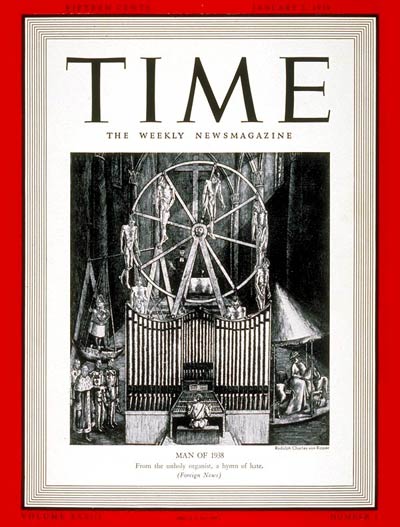
If only Time could have gotten Mussolini to make a similar contribution to its Man of the Year cover story in 1938:
Has America ever needed a media defender more than now? Help us by joining CJR today.