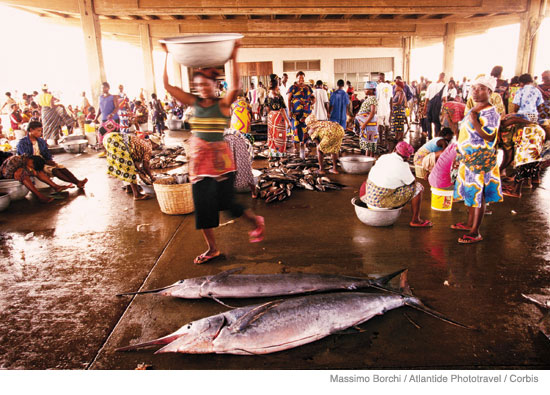
And now for some good news out of Africa. Poverty rates throughout the continent have been falling steadily and much faster than previously thought, according to the National Bureau of Economic Research. The death rate of children under five years of age is dropping, with “clear evidence of accelerating rates of decline,” according to The Lancet. Perhaps most encouragingly, Africa is “among the world’s most rapidly growing economic regions,” according to the McKinsey Quarterly.
Yet US journalism continues to portray a continent of unending horrors. Last June, for example, Time magazine published graphic pictures of a naked woman from Sierra Leone dying in childbirth. Not long after, CNN did a story about two young Kenyan boys whose family is so poor they are forced to work delivering goats to a slaughterhouse for less than a penny per goat. Reinforcing the sense of economic misery, between May and September 2010 the ten most-read US newspapers and magazines carried 245 articles mentioning poverty in Africa, but only five mentioning gross domestic product growth.
Reporters’ attraction to certain kinds of Africa stories has a lot to do with the frames of reference they arrive with. Nineteenth century New York Herald correspondent Henry M. Stanley wrote that he was prepared to find Zanzibar “populated by ignorant blacks, with great thick lips, whose general appearance might be compared to Du Chaillu’s gorillas.” Since the Biafran War, a cause célèbre in the West, helped give rise in the late 1960s to the new field of human rights, Western reporters have closely tracked issues like traditional female circumcision. In the 1980s, a famine in Ethiopia that, in fact, had as much to do with politics as with drought, set a pattern of stories about “starving Africans” that not only hasn’t been abandoned, but continues to grow: according to a 2004 study done by Steven S. Ross, then a Columbia journalism professor, between 1998 and 2002 the number of stories about famine in Africa tripled. In Kenya, where I was a Peace Corps volunteer in the late 1960s and where I returned to live four years ago, The New York Times description of post-election violence in 2007 as a manifestation of “atavistic” tribalism carried echoes of Stanley and other early Western visitors.
But the main reason for the continued dominance of such negative stereotypes, I have come to believe, may well be the influence of Western-based non-governmental organizations (NGOs) and international aid groups like United Nations agencies. These organizations understandably tend to focus not on what has been accomplished but on convincing people how much remains to be done. As a practical matter, they also need to attract funding. Together, these pressures create incentives to present as gloomy a picture of Africa as possible in order to keep attention and money flowing, and to enlist journalists in disseminating that picture.
Africans themselves readily concede that there continues to be terrible conflict and human suffering on the continent. But what’s lacking, say media observers like Sunny Bindra, a Kenyan management consultant, is context and breadth of coverage so that outsiders can see the continent whole—its potential and successes along with its very real challenges. “There are famines; they’re not made up,” Bindra says. “There are arrogant leaders. But most of the journalism that’s done doesn’t challenge anyone’s thinking.”
Over the past thirty years, NGOs have come to play an increasingly important role in aid to Africa. A major reason is that Western donors, worried about government corruption, have channelled more funds through them. In the mid-1970s, less than half a dozen NGOs (like the Red Cross or CARE) might operate in a typical African country, according to Nicolas van de Walle, a professor of government at Cornell, but now the same country will likely have 250.
This is a terrific, necessary piece. But one quibble with the headline: There is no "real Africa," just as there is no "real America." To suggest such an ideal nearly trafficks in the same odd Victorian purities we all agree should no longer frame our stories of the continent.
I don't know why journalists don't interview local government sources; I generally do (though wouldn't we all say that?) -- but very few of those quotes end up in my final copy. African government officials have perfected a development vocabulary, aimed at Western donors, but that doesn't usually work well in a story.
#1 Posted by jina moore, CJR on Thu 17 Mar 2011 at 12:50 PM
I agree that this is a "terrific, necessary piece". At the same time, I might add some context from the perspective of having lived and worked back in the U.S. since working for an NGO in Kenya in 2007-08, and as a consumer of U.S. journalism from Africa.
First, the basic issues of depth and nuance are in no way unique to coverage of Africa in U.S. journalism, so we shouldn't take your solid point too far.
Especially in regard to international coverage, I suspect that research might also find certain "paradigms" into which coverage of some other parts of the world tend to fall. For instance, stories from some other regions might tend to focus on, say, terrorism or finance. And perhaps for the related reason that resources are readily available from people who want journalists to tell those stories for them.
On a positive note I will say that I think investors are following the extensive business coverage from Africa from Bloomberg and reading the new Wall Street Journal Africa business section, as well as proprietary reporting, so the story in the McKinsey report is being told in a different forum.
The other side of the coin, of course, is that, as with most stereotypes, there is an underlying truth. As a continent, or a conveniently aggregated geographic region, Africa is conspicuous for the degree of economic disfunction relative to other regions, at least during the lifetime of myself or the Peace Corp (or President Obama). As Kenyan politicians like to say "we could have been a Malaysia".
And, of course, the suffering is in fact very real, even if widely overgeneralized or statistically overstated in certain instances.
At the end of the day, though, journalists can only do so much, based on the "demand side" of the market. My sense is that most Americans lack the basic geographic and historical background or interest to engage with much nuance or detail about specific places and events in Africa, but can be "grabbed" by the human interest in suffering.
#2 Posted by Ken Flottman, CJR on Fri 18 Mar 2011 at 07:08 PM
http://www.mamahope.org/Unlock-the-potential-.html
#3 Posted by John Maro, CJR on Sun 20 Mar 2011 at 07:35 AM
Very good article. Clearly there are a number of agencies promoting the bad picture and "use" journalists to that effect. It is also clear that there are media houses that thrive on such reports. Tell me which journalist who wouldn't love that scoop. I have also seen them come with a pre-empted angle.. Meanwhile everyone in the Humanitarian world is blatantly aware that unless you scream emergency there is no money to get. Try to do some real development and the money dries up in a second yet that is what in most places is needed. I work in such an area. Within the "agency" we are scaling down rapidly as we mainly work in emergencies. Unfortunately there becomes a vaccum of moving into development. Focus on the bad always win over focus on the good.... somehow. Unless there is a royal wedding...
#4 Posted by Mats, CJR on Sun 20 Mar 2011 at 09:50 AM
This is a very interesting debate that has been brought up. The dreaded "CNN effect", or the theory that the media affects U.S. foreign policy because of what they show the public, and then what the public becomes both aware and enraged by, is evident here in this debate. If NGOs are in need of fundraising, they have to have a cause to show for it. From a realist stance, it is natural for NGOs to want to exploit only the negative occurring, specifically in Africa, in order to increase awareness. It said it right when alluding to the fact that Africans who are doing their part to take ownership and to help themselves out of poverty aren’t getting either the recognition or the right support to continue in their efforts. So what can we do to change this way of reporting? Surely the general public should be aware that reporting has always been from the standpoint that “blood sells” meaning the more negative and dramatic a news story is the more attention it will obtain, but I hope that those people who are interested in investing their time or money to help NGOs do their own independent research for the real story (as ironic as that has to by these days). Personally, the more and more I hear of devastation and lack of a positive difference in a nation, the more likely in my mind I am to give up on whatever the cause is until a new one is presented with hopes of bringing about change. If I hear the positive effects of the specific initiatives performed by NGOs and other aid agencies in a developing nation, and the differences they are making, I may be willing to give my attention to that cause since I see that it is making an actual impact.
#5 Posted by Tracy, CJR on Sun 20 Mar 2011 at 04:54 PM
A couple of points are important to be wary about, perhaps a major paradigm of writers and readers would be helpful. Basically, of course, Africa is today comprised around 52 - 53 independent nations. much too often, stories may be properly crafted to reflect he true reality of this oft overlooked geographical and political fact, yet it seems many writers are so "western" minded,. that their word implications and association seems to suggest Africa is a country - one location, one minded, one overall popular dream and aspiration for all groups, tribes, actual nationalities. Now, the actual "article" thrust we discuss here is, again, rather misleading and unclear in it's attempt to clarify an issue of journalistic thrust. An example may prove enlightening. Let us assume I, a working journalist, am given the task of writing a piece about rape. Now, I go to a village, wherein there are a bout 500 females, of which there has been reported (by others) that there is a high percentage of rape of women. Then, THOSE women, those witnessed in this loss (to the women, their families, the entire community) becomes one of the MAIN points of my story, as I establish the "reported" amount of victims. My "filter" becomes a comparative place, usually in the (reader familiar) western world, as I make a comparative nalysis.
Now, that may be criticized as being "negative reporting".\, or even written in a condescending nature about these African women - but, is it really? This entire issue, the thrust of the storyline we are all asked to comment about, is actually deceptive in it's first hand appearing to be a simplistic issue, you see.
In the end, all seems to be rather "Catch-22", if you see where I'm going with this? Do some regions NEED aid, are suffering, might even benefit from stories of the citizenry's anguish? Yes. Does that make them (the stories) to be exaggerations, or dramatizations? Perhaps. In my hypothetical story example above, only about 50 of 500 females had been raped (my proposed way of telling that story). But, compared to, say Kansas, USA a 10% incidence of rape is quite outrageous. Those people in Kansas, USA (and similar readers), are those who I wish to most affect, to call to action on this issue. To them, a 10% incidence of rape is totally untenable, wherein (while unacceptable by the residents of the village I write about, it may indeed be a "tolerable" amount.
WHO, then, is my INTENDED audience? WHO, again, am I wishing to mobilize for assistance? WHO, might be possibly able to bring about a reduction in the rapes?
So it is with stories about hunger, housing, overcrowding, infant death, HIV/AIDS, poor health facilities, etc.
Finally, an appropriate comparison of reporting vis-a-vis (the) actual public response, and positive CHANGE in a disaster situation might be made between the Haitian earthquake a little over 1 year ago compared to the recent 9.0 (it's been upgraded .1 Richter point) Sendai, Japan earthquake. Neither nations' governments have not been fully candid with the outside world, although Haiti appears to be the more corrupt of the two. A recent update to the on-going Haitian situation reveals increased ravaging of the still wounded population by armed gangs - that prospect seems unlikely in Japan's earthquake devastated areas. Current world opinions of the future of each society, suggests Japan seems more likely to make a complete, timely rebuilding and recovery.
What could/should be the role and "center-point" of the media coverage of each nation? Does (the) media assume a pose of selectively telling the stories? Should the NGO operations in each torn area be graphic, descriptive, bordering on poor taste? Should the Japanese people be sympathized with evn more, as they are former atomic bombing victims of the US in WWII in Hiroshima and Nagasaki? What of the Haitians, the poorly educated descendants of former African slaves who successfully fought their wa
#6 Posted by Amir Chela - Photographer, former WPFW (Pacifica) host-Producer, retired TV cameraman., CJR on Sun 20 Mar 2011 at 07:17 PM
A couple of points are important to be wary about, perhaps a major paradigm of writers and readers would be helpful. Basically, of course, Africa is today comprised around 52 - 53 independent nations. much too often, stories may be properly crafted to reflect he true reality of this oft overlooked geographical and political fact, yet it seems many writers are so "western" minded,. that their word implications and association seems to suggest Africa is a country - one location, one minded, one overall popular dream and aspiration for all groups, tribes, actual nationalities. Now, the actual "article" thrust we discuss here is, again, rather misleading and unclear in it's attempt to clarify an issue of journalistic thrust. An example may prove enlightening. Let us assume I, a working journalist, am given the task of writing a piece about rape. Now, I go to a village, wherein there are a bout 500 females, of which there has been reported (by others) that there is a high percentage of rape of women. Then, THOSE women, those witnessed in this loss (to the women, their families, the entire community) becomes one of the MAIN points of my story, as I establish the "reported" amount of victims. My "filter" becomes a comparative place, usually in the (reader familiar) western world, as I make a comparative nalysis.
Now, that may be criticized as being "negative reporting".\, or even written in a condescending nature about these African women - but, is it really? This entire issue, the thrust of the storyline we are all asked to comment about, is actually deceptive in it's first hand appearing to be a simplistic issue, you see.
In the end, all seems to be rather "Catch-22", if you see where I'm going with this? Do some regions NEED aid, are suffering, might even benefit from stories of the citizenry's anguish? Yes. Does that make them (the stories) to be exaggerations, or dramatizations? Perhaps. In my hypothetical story example above, only about 50 of 500 females had been raped (my proposed way of telling that story). But, compared to, say Kansas, USA a 10% incidence of rape is quite outrageous. Those people in Kansas, USA (and similar readers), are those who I wish to most affect, to call to action on this issue. To them, a 10% incidence of rape is totally untenable, wherein (while unacceptable by the residents of the village I write about, it may indeed be a "tolerable" amount.
WHO, then, is my INTENDED audience? WHO, again, am I wishing to mobilize for assistance? WHO, might be possibly able to bring about a reduction in the rapes?
So it is with stories about hunger, housing, overcrowding, infant death, HIV/AIDS, poor health facilities, etc.
Finally, an appropriate comparison of reporting vis-a-vis (the) actual public response, and positive CHANGE in a disaster situation might be made between the Haitian earthquake a little over 1 year ago compared to the recent 9.0 (it's been upgraded .1 Richter point) Sendai, Japan earthquake. Neither nations' governments have not been fully candid with the outside world, although Haiti appears to be the more corrupt of the two. A recent update to the on-going Haitian situation reveals increased ravaging of the still wounded population by armed gangs - that prospect seems unlikely in Japan's earthquake devastated areas. Current world opinions of the future of each society, suggests Japan seems more likely to make a complete, timely rebuilding and recovery.
What could/should be the role and "center-point" of the media coverage of each nation? Does (the) media assume a pose of selectively telling the stories? Should the NGO operations in each torn area be graphic, descriptive, bordering on poor taste? Should the Japanese people be sympathized with evn more, as they are former atomic bombing victims of the US in WWII in Hiroshima and Nagasaki? What of the Haitians, the poorly educated descendants of former African slaves who successfully fought their wa
#7 Posted by Amir Chela - Photographer, former WPFW (Pacifica) host-Producer, retired TV cameraman., CJR on Sun 20 Mar 2011 at 07:20 PM
This articles says many things right and long overdue. in our profession there are different views about Africa and how to help tackling development or protection problems.
It is important to notice that people with many years in Africa and experience with NGOs, tend to agree with the views of the author. That usually media and information campaigns are left in the hands of young and relatively inexperienced people, recently graduated and that have not yet grasp the reality of the place and that do not understand Africa, in fact they believe they know it better than Africans and this is shameful.
I hope the media was more responsible, that will be the beginning of the end of this deformation of a continent that has a lot to offer, and to aim for. Through our work, though limited, we have been trying to denounce this negative and simplistic vision of so many realities, countries and cultures. So Many thanks to the author and the journal to pointing it out and please be aware that not all NGOs practice this, it will be unfair for those who try not to.
Victor Africa Siglo 21 (http://www.21africa.org/)
#8 Posted by victorts, CJR on Mon 21 Mar 2011 at 05:48 AM
I recommend the following book for insider facts about what is currently considered development aid to Africa and the role of NGOs and the United Nations in particular. It is important to grasp that aid is a well contended business which is not necessarily primarly aimed at helping the poor. "U.N. a Cosa Nostra" on sales at Amazon.com should help understanding what are the issues at stake and how Africa's issues can best be adressed
#9 Posted by Keija, CJR on Mon 21 Mar 2011 at 06:25 PM
Which "good news" stories win the Pulitzer Prize for International Reporting?
#10 Posted by TO, CJR on Tue 22 Mar 2011 at 01:43 AM
Hi Karen thank you for your piece. I met you and your husband when you guys were in Nairobi, we went out to dinner together. I greatly enjoyed that evening.
In regards to your article, I enjoyed it. I'm in no way an expert, journalist, etc on Africa though I studied African History in Stanford. What I've come to learn is that whatever I learnt in 'school' was one thing, great but nothing beats the experience of being in a situation. Hence I would not dare comment on Africa as whole, Kibera, however, is something near and dear to my experiences. Having worked there for almost 6 years, seeing it before Post Election, after Post election, times when no one came, times when Muzungus crowded the streets, through good times, through bad times... I've seen and experienced alot. I never meant to work there that long, i simply intended to shoot my film Kibera Kid and then leave. But the people, their desire to tell their own stories, make their own films and tell it as they see it, kept me coming back.
I've seen alot, good and bad. One thing I remember very clearly was the day of the national census in Kenya. I was personally surveyed, a census take came to our apartment. i also remember being in Kibera that day, watching census takers walk along the Railway line, which cuts through the slum, and looking down on the shanties below. Some COUNTED people from that high vantage point. They DIDN'T go house to house. I was indifferent at the time to this. Who cares right? It's just the Kenyan government. Then this 200,000 number comes out, and it becomes a huge trojan horse for everyone who wants to discredit charitable assistance in Kibera. It's like the people of Kibera have been helped 'too much.' Then another really inflated figure of 6,000 ngos comes out... what? This number flies in the face of reason, walk one day through Kibera and point out these 6,000 NGOS. Also you should state clearly what is an NGO, what is a CBO, what is a trust. NGOs must be registered in Kenya with the NGO board, and there are simply no records of 6000 NGOs working in Kibera. An interesting blog entry by Brian Ekdale looks at this point, you can read it here http://www.brianekdale.com/?p=119
These numbers seem to be part of a way to discredit what is being done in Kibera, I don't agree with much of the aid, but some does help. And there are people doing good work like, ourselves I hope, and TEDxKibera etc. These are not NGOs, not registered as such, but trying to bring knowledge and new ideas to the community. Isn't what is needed? Or are people using these numbers more interested in focusing on the negative about charitable / training work so as to dismiss it....
My point is not to say that 1 million live in Kibera, I think that is inflated, but I'm not a statistician nor claim to be. Just my informed experience. But 200k is also 'deflated' and uses the same logic (after all what is the bias of the Government of Kenya, ranked near the bottom by Transparency International, these are the people you believe? the ones who let Kibera be as it is for 30 years?). Having lived in Kibera, you experience how in a 'house' many people live there yet they live in 'shifts'. The people who work at night, sleep during the day, the ones who work during the day, sleep at night. During week days kibera is half empty or more, on Sundays its more congested than Times Square on new years (figuratively speaking). Not accounting for this, as I can tell you from first hand witness of the Kenyan census takers that they did not, makes another bias creep in. So much is wrong in what we read about Kibera. Having seen it first hand.
I strongly agree with what you are trying to say, just be careful that you are also not using the same faulty logic / reverse bias that lead to the problem in the first place!
The issue is nuanced, and I think a moving target. Kibera is still a humanitarian
#11 Posted by Nathan Collett, CJR on Tue 22 Mar 2011 at 06:06 PM
Karen Rothmyer's article is a good start - but it is in a rather obscure, precious, intellectual place - it would be good if some other widely-read rags would publish it on the front page.
As my son so aptly put it, in Africa "we are living our lives without waking up feeling that there is something wrong with us" and that is what Western journalism ignores. He goes on: "It's so hard to talk to Westerners about Africa, they get all mushy and start blubbering about saving the children and their moral duty to help and all that, you can't actually have a discussion with them about a part of the world that has a daily life." He is a history student at the University of Toronto where he is yet to meet a non-African who even wants to hear his views - he is viewed suspicioulsy, as some anti-development reactionary, or as a racist because he happens to be white. Rather sad in such an august institution where academic debate is supposed to engender exploration of all views.
The fact that he is acutely aware of and angered by the corruption, ineptitude and poverty of ideas of his own goverment and of the Western donors; and on the other hand is forever heartened by the zest for life, ingenuity, simplicity, humour and amazing achievements of his fellow Africans, is irrelevant in this discourse because he is not relying on statistics, or "expert, Western" opinions, or market-driven, consumerist measures - he is merely relying on the reality which is complex and nuanced and un-sound-bitable.
So Western journalism has a duty to change this perspective in the West, this tunnel vision, or just stop reporting, if Western intervention is going to contribute - if the West is not listening to or hearing Africa, because the Western journalists are not, what is the point? Well, therein lies the rub, as Karen astutely points out - donor aid in whatever form (institutional, inter-governmental, NGO) is just big business, jobs for the boys and girls back home - and sadly jobs for a number of elite and educated Africans in their home countries and as part of the donor machinery internationally, who also want this party to go on and on, so they learn the donor-speak and put out the begging bowl.
The begging-bowl mentaility is abhored by so many Africans who do not want aid or charity, but rather respect and recognition. But so many Africans also know nothing else because they have grown up with that, they depend on it - and the Western media they are increasingly exposed to just perpetuates the cycle. So Western journalists have an obligation to Africans as well.
Dambisa Moyo's book "Dead Aid" was hailed as a whole new approach because she apparently blamed Africa's governments for a change, not just the West - but she then went on to blame the West for enabling the corrpution she identified as key to Africa's travails and thereby denigarted her own people and continent, making them victims yet again, implying they have no internal morailty, no spine - yet a walk through any shanty town of Africa will show you more spine and morality than one can imagine, as well as more disadvantage and injustice than one can conceive. But make no mistake - the shanty town dwellers see all that as well. The resignation and hope living side-by-side may be difficult to digest - but they have hope, they have dreams, they have meaning, something missing in the West which seems to just have "entitlement".
Stop being so patronising and arrogant; forget the statistics; accept the complexities and nuances; and demand more from Africa (and from Western donors although I think they should pack up and go home). And stop intellectualising and start doing.
I would imagine most of you think this is some white South African or Zimbabwean or Kenyan rant - no, we are Africans from somewhere less newsworthy, less riven by "apartheid" or land-conflict angst - Zambia. An interesting statistic to end with - the ratio of girls to
#12 Posted by Sue Clayton, CJR on Sat 26 Mar 2011 at 12:36 PM
Think we are currently confused growth and poverty, because despite its growth, yet Africa remains a continent desperately poor, stricken by poverty, epidemics and conflict. Sub-Saharan Africa has the highest level of illiteracy in the world.
Incomes remain very low - even in South Africa is the only emerging economy in Africa, GDP at current price is below 4000 U.S. dollars per head. Moreover, incomes are even lower, even negligible, and most do not rise in real terms since 1990.
But these comparisons based on GDP alone is misleading: in Zimbabwe, halving income poverty means to reduce poverty, which affected 36% of the population in 1990 to 18% in 2015, but 2% to 1% in Morocco .
Now we know that in many African countries the population continues to die from malaria remains the leading cause of death in Africa to AIDS and other diseases. In some regions diseases such as leprosy, tuberculosis ... is very much alive, epidemics of cholera, and polio are momentary.
In some hospitals patients are dying for lack of money and care, lack of pharmaceutical products and our daily health centers.
Although located in the Congo Basin, the population lacks safe drinking water and saw almost no electricity. In addition to repeated flooding in the rainy season even in large cities.
Much of Africa's population live below a dollar. There is evidence that poverty is the daily life of Africa.
So I believe with the American print and broadcast media continues to hammer on African poverty and its attendant misery.
#13 Posted by Thierry BOCKONDAS, CJR on Wed 30 Mar 2011 at 03:36 AM
This is very enlightening. If you get to lay your eyes on some reports sent back to their countries by the so called seconded technical experts or missionaries, you will weep tears of pain. Distortions are the rule, lies are the norm and negativity and cynicism is the practice. Sadly, some local civil society organizations have taken cue and painting a dire picture just to attract funding and remain relevant is what they do.
I always ask, when will Africans emancipate their minds are discover that salvation will never come from the west. When will we embrace a work culture and abhor corruption and dependence? No country has ever developed on aid and dependence on the west and certainly, African countries are not going to be the first.
#14 Posted by Jeff Muthomi, CJR on Wed 30 Mar 2011 at 10:42 AM
This is the most balanced article have ever read on Africa. It reminds of Facebook comment on BBC Africa link where someone just quoted how Africans are poor before it was rightly pointed that not all Africans are poor.
Africa has been written in atavistic awe like Karen Blixen's 'Out of Africa', in pessimistic terms like Blaine Harden's 'Africa: Dispatches from a fragile continent', ignorant terms like Joseph Conrad's "Heart of Darkens" or slightly balanced like Martin Meredith's 'State of Africa'.
But with African emerging writers of the continent like Nobel price winner Prof Wangari Maathai in 'Challenge for Africa' things will look better.
#15 Posted by Manuel Odeny, CJR on Wed 30 Mar 2011 at 02:09 PM
I wholeheartedly agree with the writer of this article. As an Indian in the West, I rarely come across a Westerner who can buy into the notion of us having a decent daily non-newsworthy life. Even a cricket match against Pakistan is portrayed as some sort of faux-nuclear-holocaust-threatening war game between two frenzied rivals by supposedly esteemed outlets like the New York Times and the Asia Society! Do the writers (and by inference readers) of these things really think that we are stupid enough to nuke each other or go to war over a frigging cricket game? Thanks to the prevalence of such misinformed writing, it is extremely hard to have a decent conversation and exchange of views with most people who are on a regular diet of this sort of newsy propaganda. Kudos for calling attention to this.
#16 Posted by Pritam Kumar Das, CJR on Wed 30 Mar 2011 at 10:39 PM
i like this article not much for its content but more for its thematic choice. africa developement and the role , motives and reporting by intervening agencies. there are several issues that have to be made clear here. in my humble opinion, the zooming into the situation in africa and how to get it walking up and stright along the developmental path is as complex as are the motives of the people engaged in this effort.
the problematic in my opinion would be , africa seen through the eyes of different and mutually supporting or at time antagonsing forces. for the purposes of this article, i will categorise them here as afro pessimists, afro optimists, afro realists, afro-sympathisers, afro-evangelizers, and afro-mediafillers and afro-reapers. anyone who intervenes for and with africans comes from one or all of these background. the modes of intervention, research, fund raising and reporting will be greatly influnced by these background.
the situation in africa: as one comment rightly puts it, africa is diverse and not like a small kitchen where you can see and comment on the spoons and the cups just like that. but what whave to agree is that to develop a policy to be acted upon as a response to the diverse sitution in africa, we cant avoid creating some broad themes that will rightly place some africans challnges into the same clauster , diffrent and nuanced as they might be on the ground . the situation in kibera and soweto could be diffrent, i agree but we are speaking about shelter , congestion and saniation etc. these would the major themes that cuts across diffrent situations. consequently in my opinion , there are really genuine issues to be addressed in africa but care must be taken to decipher the placenment of the intervention agency in our motive categories.
truth be told, there are real challenges regarding security, education, water, food, sanitation , housing , gender imbalance , refugees and internally diplaced persons, small arms, governance and the list can stretch ad infinitum but what gets into my nerves is the reasons for motivation.
we start with afro-reapers. this are the people both local and foreign to whom african challenges real or imagined is an investiment. and their stories will want to build on this motive; how can we present africa to our would be finaciers in such away that we can reap something substantial as to make us earn a descent living as well as to show them that we are doing something . lets agree that intervention has become not only a way of helping but also employment . you will have spoken your voice hoarse before you get me half convinced that all the people who have paid school fees and got certificates on peace studies was principaly because they just want peace. no, there is a gruop that knows that it pays well to act as a peace builder. the employment factor is true for both westerners and africans themselves. the media, faith groups , civil socieities and even the locals are benefiaries of afro-reaping thanks to efforts aimed at adressing these problems. therefore there are few people who would ventures in this area without the motive of gaining something . to be honest, there are few mother teresa's here who really have the poor as thier alpha and omega. for african-reapers, programmes are tailored with an eye on the source of the funding vis a vis my needs. while reaping would come in terms financial gains , it would also come in terms of reputation. that brings media into focus. reports , documetaries, photos, are as great as the opportunity they can reap for me and my household. i dont report just because it is worth reportig but because the name of our firm or journalists will gain currency. is africa the motivation of the subject? no! i am , my firm, is the subject of the reportand the situation in africa the conduit through which i and my firm gain prominence. this will dictate my positioning and editing of the
#17 Posted by omondi nicholas , CJR on Tue 19 Apr 2011 at 05:59 AM
You need to see this from the perspective of the NGOs. All NGOs fight for a limited pool of funds, and unfortunately they use the lazy media as a battleground.
I blogged about this http://pcsa.michaelwsherman.com/2011/04/aid-workers-jobs-shocking/
Sorry for the link
#18 Posted by Michael W. Sherman, CJR on Tue 19 Apr 2011 at 02:22 PM
Very interesting piece. Indeed, negative stories are the most commercial ones for journalists and sometimes, readers and audience is looking for that kind of stories too.Or, this might be how media educated them. But things can change, of course, when working for an NGO or project, seems as if you want to sell out the positive things and indeed, there are incredible things that we need to work on, that needs to be sold out but where are the media to cover them?
Former journalist, now communication officer for a USAID project i n Madagascar
#19 Posted by Fanja Saholiarisoa, CJR on Fri 27 May 2011 at 05:38 AM
Felt really good reading everything written above, I must appreciate you and your mindset great work done I also need your contact number please chicken biryani recipe l la fitness
#20 Posted by david, CJR on Mon 3 Oct 2011 at 11:43 AM
Whatever happened to the fucking governments that are supposed to run their country and be responsible for their people?
robert
teunissenr@gmail.com
#21 Posted by Robert, CJR on Sat 15 Oct 2011 at 06:50 AM
Very interesting piece. Indeed, negative stories are the most commercial ones for journalists and sometimes, readers and audience is looking for that kind of stories too.
Dog Canine Training
#22 Posted by Jesus Castillo - Dog Canine Training, CJR on Tue 1 Nov 2011 at 01:01 PM