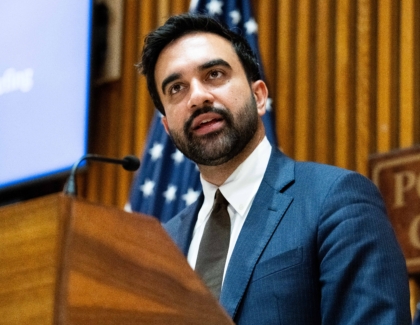
Bill Black goes on CNBC and shreds Maria Bartiromo and Bethany McLean on whether Goldman Sachs (and others) could and should have been prosecuted for fraud related to the financial crisis:
If there’s damage in the green room, I’d like to imagine it’s from Black banging his head on the wall afterward, yelling repeatedly, “No it’s not a great point—it’s a terrible point!”
(h/t Capitalism Without Failure)
— The Los Angeles Times has the best news analysis I’ve seen of Paul Ryan’s budget now that he’s on the Republican ticket:
Under Ryan’s plan, which has passed the Republican-controlled House twice in slightly different versions, the Internal Revenue Service would tax the wealthiest Americans less, but many of the poorest ones more; Medicare would be transformed; Medicaid would be cut by about a third; and all functions of government other than those health programs, Social Security and the military would shrink to levels not seen since the 1930s…
The Ryan plan would not balance the federal budget for another 28 years at least, according to an analysis by the nonpartisan Congressional Budget Office. That means the federal debt would continue to rise. That’s partly because the tax cuts take effect right away while the Medicare cuts kick in later, as people now 55 hit retirement age. It’s also partly because Ryan’s proposed tax cuts considerably outweigh even his ambitious spending reductions…
In the more than two years since his budget was unveiled, Ryan has not specified any tax breaks he would eliminate. Independent analyses have shown that offsetting the tax cuts would require changing things such as the mortgage interest deduction, the tax exclusion for employer-financed health insurance or other popular tax preferences widely used by middle-income households.
Ryan would also raise military spending by hundreds of billions of dollars over the next decade.
— The New York Times’s Jessica Silver-Greenberg has a nice piece on the credit-card debt collection industry’s practices, which look to be a scandal like mortgage robosigning:
Lenders, the judges said, are churning out lawsuits without regard for accuracy, and improperly collecting debts from consumers. The concerns echo a recent abuse in the foreclosure system, a practice known as robo-signing in which banks produced similar documents for different homeowners and did not review them.
“I would say that roughly 90 percent of the credit card lawsuits are flawed and can’t prove the person owes the debt,” said Noach Dear, a civil court judge in Brooklyn, who said he presided over as many as 100 such cases a day.
One woman is suing Discover card, saying they fraudulently inflated her balance owed:
After the suit was filed, Ms. Gregory, a 41-year-old child care assistant, asked Discover for proof of the balance. The resulting documents, which were reviewed by The New York Times, have inconsistencies. One statement, for example, says it was produced in 2004, but advertisements on the bottom of the document bear a 2010 date.

Wow!!! Bill Black is a fearless God that walks the planet. When it all comes down people like Bill Black and Matt Taibbi will long be remembered for how they stood up to the madness.
#1 Posted by Paul Hamer, CJR on Thu 16 Aug 2012 at 10:42 AM
Beth McLean wrote an interesting story about Enron that one time circa 2001. She's pretty too. And now she knows nothing at all about any high level frauds.
Man, she must be really rich now and (as long as she continues to not see any systemic, high level fraud) set to get a lot richer.
Bill Black, meanwhile, has an office in some midwest college somewhere.
Heed the lesson, budding financial journalists.
#2 Posted by Edward Ericson Jr., CJR on Thu 16 Aug 2012 at 11:27 AM
Bethany McLean is usually very good on these issues.
She's aware of the lying and dishonesty and is trying to make the case that it doesn't rise to the level of fraud because, hey, these people half believed their own bs.
And, hey, if the regulators weren't saying it was wrong and the everybody else was saying it was right, then who's to say what's really wrong or right?
But the problem with that is that the profit model was based on an unregulated sector of the financial environment and the spread of fundamental misunderstandings of financial realities.
When the subprime vendors started giving loans, based on fraudulent lender information (often filled in by the broker to guarantee the loan issuance), with terms that would make it impossible for the lender to repay that weren't made clear to the borrower, they were taking advantage of the borrower's ignorance.
When Wall Street banks bought these products, they were aware that their quality wasn't great WHICH WAS KEY. More risk justifies the higher interest rate. The only way this model works is if the risk wasn't really a risk.
To this end they bought insurance from a unregulated market, the CDS. The sale of insurance required the ignorance of the insurance seller as to the quality of the products being insured. When this happened, the banks had a can't lose prospect. The borrower makes his impossible payments? Win! The borrower defaults? The CDS pays out. Win! Once you've taken out the risk of a transaction, your incentive is to maximize throughput and keep printing the money.
But that wasn't enough though. You could make more money selling these high interest contracts to securities buyers. Problem? The securities buyers needed to be convinced that the risk wasn't really a risk... and they needed a rating to prove it. This is where the CDO comes in, where the risk is per tranche and the higher the risk, the higher the rate of return. The rating companies began giving out their highest ratings to the upper tranches of these CDO's at first out of ignorance, later out of fear of losing major business. The revenue of the banks was dependent on the ignorance of their customers, the securities buyers.
And the reason why ignorance is so profitable is because you can lie about the value of what you offer vs the price of what you charge. The lying is fraud.
And Bill Black was right, it doesn't matter that these companies all lost money because the employees and the corporate executives were not making their fortunes off of the long term viability of their enterprise. They were making their fortunes of the throughput based on lies.
And they were all waiting for the horrific day the ignorant they were fleecing were going to wake up. AIG woke up and that meant guys like Morgan Stanley had to buy CDS from themselves to keep the machine going. Hedge funds woke up and started buying positions against the housing market. Goldman Sachs could see the investors waking up and "reduced its exposure" by selling off its risk to investors.
How is this not fraud?
http://www.bloomberg.com/news/2010-04-27/goldman-sachs-armed-salespeople-to-dump-mortgage-assets-e-mails-show.html
http://dealbook.nytimes.com/2011/06/15/misdirection-in-goldman-sachss-housing-short/
Cont.
#3 Posted by Thimbles, CJR on Thu 16 Aug 2012 at 01:35 PM
How?
http://www.mcclatchydc.com/2009/11/01/77791/how-goldman-secretly-bet-on-the.html
Investors woke up and the market for MBS packaged in CDO's dried up. House buyers and borrowers woke up and the demand for housing crashed.
But by then, the bonuses had been paid. IBGYBG.
That is how accounting control fraud works.
When regulators weren't being absorbed into bank offices and then appointed back to regulators as administrations shifted, when wallstreet funding wasn't a bi-partisan issue, when press like Maria Bartiromo's CNBC weren't unashamedly asleep in the run up and aftermath of such crisises, we could see a window - a potential for some accountability for the 'profit from lies' business model.
But Bethany worked for Goldman, as did Erin Burnett. Bartiromo's husband is a wallstreet trader. These people have a hard time seeing participating in a system as a crime, even when the basis of the system is criminal.
The business model of wallstreet today is to make promises to the ignorant and take their money. If the world collapses, take a taxpayer bailout. A casino is at least up front about the chances of getting a jackpot, these guys are supposed to be investment managers and instead they act like pigs at the trough. YOU ARE SUPPOSED TO MAKE MONEY FOR YOUR CLIENTS, NOT TAKE IT YOU BUNCH OF GRIFTERS.
Accountability free finance should be like an oxymoron or something. This is not a good foundation for a stable country's economy.
#4 Posted by Thimbles, CJR on Thu 16 Aug 2012 at 02:03 PM
Oh, and there's this to thnk about:
http://www.money.cnn.com/2012/08/13/news/companies/financial-crisis-prosecution/index.htm
#5 Posted by Thimbles, CJR on Thu 16 Aug 2012 at 02:10 PM
The problem with the interview is that it did not have someone of Black's stature discussing the issue with Black. McLean's husband would have been a better choice.
When you're talking about cooked books, you need two chefs discussing the issue, not a chef and a menu writer.
#6 Posted by MRW, CJR on Sat 18 Aug 2012 at 12:14 AM
Good for Bill Black to have a strong opinion, but he could have made his case a lot better. His mantra "we don't know" would have been strengthened by a few phone calls before going live. Was there a grand jury? It can't be that hard to find out.
Also, what's with the wardrobe? He looks like the Unabomber.
#7 Posted by JLD, CJR on Sat 18 Aug 2012 at 06:47 AM
If you read Bill Black, he cites a lot of numbers and data from transcripts, reports, publications so it's not a question that he doesn't know. The people he was discussing with were asserting things to be true that they don't know. As he said, there's no way this administration could officially know since he knows the people the administration should have called if they were interesting in establishing a case. Their phones weren't ringing.
And that's just bad considering the S&L crisis wiped out a lot less wealth, required a lot less bailouts, and yet the government put multiples of the resources used in this crisis to find out what happened and secure convictions.
This crisis is no different, except in scale, and yet nobody can bring a case to court. This is a lack of will, or, as Taibbi puts it:
http://www.rollingstone.com/politics/blogs/taibblog/ag-eric-holder-has-no-balls-20120815
#8 Posted by Thimbles, CJR on Sat 18 Aug 2012 at 07:59 AM
It would be difficult to find someone of "Bill Black's stature" who would argue against Bill Black. The only people who challenge Black are failed ideologues. Black is not an ideologue or a talking head. He is an experienced regulator, attorney, economist, and criminologist. If you want to educate yourself, listen to Bill Black. If you want to entertain yourself, watch shows like this one. If you are interested in actually learning about the complex issues at play, you can start with these Bill Black videos:
http://www.capitalismwithoutfailure.com/2012/03/bill-black-usa-exports-flawed-economic.html
http://www.capitalismwithoutfailure.com/2012/04/bill-black-fraud-recipe-for-ceos-why.html
http://www.capitalismwithoutfailure.com/2011/10/bill-black-interviewed-on-democracy-now.html
#9 Posted by Jaime, CJR on Sat 18 Aug 2012 at 10:03 AM
Hey from the UK.
It's a sad fact but it's fraud from the top all the way down. In my country banks were pushing loans to people, hell anyone with a pulse, and if you questioned the policy from management, if you didn't fill your quota, you were soon pushed out. If there's sharp practice at this low level, is anyone surprised that it might, just might, be going on where the really big numbers are?
In my youth I used to be something of a romantic revolutionary, now I'm just disillusioned because it looks so bad that it's revolution or fascism. I don't want to live in interesting times...I just want to live in an honest society. Why is that so difficult?
#10 Posted by PhilJoMar, CJR on Sat 18 Aug 2012 at 07:43 PM
Phil wrote: ".I just want to live in an honest society. Why is that so difficult?"
padikiller responds: Because regulations foster dishonesty and remove accountability, and because western governments have stupidly intervened to attempt to control markets instead of prosecuting criminals.
Ponzi went to jail.
Corzine won't.
Ponzi stole about a fifth the money (in inflation-adjusted dollars) that Corzine stole (morally, if not legally).
So why is Corzine not only not going to be prosecuted, but is indeed planning his next greatest scheme?
Because Ponzi's scheme was illegal fraud in a unregulated market, while Corzine's scheme was legal fraud in a tightly regulated market.
Regulations bring loopholes and amnesty, because in contrast to criminal statutes, regulations are designed to foster the regulated industries. Therefore, any restrictions they place on the industry must be tempered with incentives or workarounds.
Furthermore, regulation lulls laymen into a false sense of security - which criminals like Bernie Madoff exploit like crazy, Indeed, regulators were provided incontrovertible mathematical proof of Madoff's fraud in the Clinton administration, but failed to act... Which brings me to my final point, which is...
Regulators are never proactive and are rarely accountable. What incentive exists for any regulator to rock the boat or seek reform? As for accountability, the SEC sat on the$12 billion Madoff scandal for years, and what was the outcome? Reprimands. Eight of them. Not a single regulator canned. Indeed, USA Today reported that the federal employee stands a greater chance of dying than being fired.
#11 Posted by padikiller, CJR on Sat 18 Aug 2012 at 08:11 PM
Phil, its not regulations that cause these frauds, and these are most certainly frauds, regardless of regulations. Corzine stole money from customer accounts. He is not being prosecuted, but its not because regulations made his theft legal, its because the prosecutors are conflicted and don't work for the government -- they work for the banks and firms that will hire them once they do their jobs by not doing their jobs. If you look back at banking pre-regulation (pre-1930s) the fraud and theft was endemic and constant. And we had long and terrible recessions coupled with short weak growth spurts. It wasn't until we developed strong regulations, and the strong bodies to enforce those regulations, and enforce the laws, that the middle class developed, stability reigned, and banking became safe and boring. Once we removed Glass-Steagall and the other laws that kept us safe from the criminal element in banking, everything began falling off a cliff. It took 8-10 years from the repeal of the final New Deal era regulations for everything to fall apart. So, in short, no. Regulation is not the enemy. The enemy is the enemy. And the enemy is a criminal element that has taken over our financial system and taken over our regulators.
#12 Posted by YankeeFrank, CJR on Mon 20 Aug 2012 at 06:01 AM
Regulations don't cause frauds.
Fraudsters cause frauds.
Regulations facilitate frauds, however.
You find any scandal.. Enron, MCI, Madoff, Lehman Brothers, etc.. And you will find (i) regulations that were in place that were designed to prevent the fraud that lead to each scandal, and (ii) regulators who were asleep on the job.
I do not say that regulation is unnecessary, however it is oppressive and inefficient and should, like any use of government force, be limited to protect property rights and preserve order.
And regulation, like any use of government force, is designed to either (i) make people do things they don't want to do, or (ii) prevent people from doing things they would otherwise do. It is a restriction of freedom and liberty, and its use should be restricted to the minimum extent necessary to protect third parties from the collateral damage of free market transactions.
Regulations that purport to protect parties to voluntary transactions are not only inefficient, but doomed to make things worse. Witness the Indian reservation payday loans and offshore internet payday lenders who subvert regulation and succeed in screwing over borrowers even more than they were screwed before the regulations.
People who want to make a deal happen will work around regulations or simply ignore them.
How did Bernie Madoff succeed? By thumbing his nose at the SEC for 20 years and by simultaneously hammering away at the message to his victims that SEC supervision guaranteed the safety of their "investments" in his Ponzi operation. That's how.
There were plenty of SEC regs in place to stop Maddoff. There were plenty of SEC regulators who were directly informed of mathematical proof of the fraud. These regulators had the power to act, but simply didn't.
Why didn't they?
Why should they have acted? Why should a GS-14 in Boston stick his neck on a block to make a case against a billionaire? What is the incentive? What is the sanction if the regulator doesn't ac't?
There is neither any incentive for any bureaucrat to be proactive nor is there any repercussion for failing to act.
And this lack of incentive and accountability is inherent in any process based on politics instead of profit and so any government program is inherently inefficient and ineffective. Why? Because any effective use of power ultimately requires the exercise of discretion - effectively meaning tossing the rule book out the window and using common sense to make a decision. In the government, however, discretion is anathema. Any exercise of discretion is perceived to be an unjust and arbitrary abuse of power, and so the entire function of any bureaucracy becomes clamping down on discretion by attempting to abstract every regulated activity to set of rules and procedures. Contrast this with the private sector, where owners and managers exercise discretion on a daily basis ( E.g. "No, Jim, you can't take off early today, even though Steve took off early yesterday, because I need you to get this order out tonight")
And therein lies the genesis of the loopholes and exceptions that voluntary market participants will exploit to subvert or evade the regulation.
For example, health care "reform" becomes a 3000 page statute and will engender millions of pages of regulations, many of them contradictory, ambiguous or vague. And so we'll end up seeing the people who exploit these loopholes buying private jets, perfectly legally, on our dime.
#13 Posted by padikiller, CJR on Mon 20 Aug 2012 at 08:27 AM
Regulation doesn't cause fraud, but it certainly facilitates it.
Government is inherently inefficient and ineffective when it comes to regulating voluntary transactions.
Why?
Because efficiency requires discretion - tossing the procedures out the window - and government abhors discretion above all else. Any act of discretion is perceived as unjust and arbitrary.
In the private sector, which is the sum total of voluntary market transaction, discretion is exercised routinely to adapt to changing conditions (E.g., "No, Jim, you can't have the afternoon off, even though I gave Suzie the afternoon off yesterday, because we need to get this order out"). This is why the private sector is inherently more efficient than Gubmint regulation can ever be.
This exercise of discretion doesn't fly in the realm of politics and so bureaucracy attempts to thwart it by reducing regulated activity to an abstraction of policies and procedures. This, of course, is impossible to do completely - the real world can't be shoehorned into a policy and procedure manual - and the Gubmint's attempts to do so invariably result in omissions, ambiguities and vagueness - loopholes.
For example... Health care "reform". A 3000 page statute that will engender millions of pages in regulations and thousands of loopholes that will be exploited in legal acts of thievery and fraud by ambitious entrepreneurs. People will soon be buying private jets on the Gubmint's dime through exploitation of these loopholes.
Look at Bernie Madoff or any other scam (Enron, MCI, Lehman Brothers, etc) and what do you see? Regulations were in place that should have prevented the frauds that led to each scandal and regulators were in place with the power necessary to prevent the fraud, but failed to act.
And why should any regulator act? Why should a GS-14 go up against a billionaire? What is the reward for doing so? And what is the punishment for refusing to do so?
None, in either case.
Bernie Madoff stole at least $12 billion by (i) dodging regulators for 20 years even after the regulators had incontrovertible mathematical proof of the Ponzi scheme and (ii) by luring new investors with the false assurance that the Gubmint was protecting them.
Despite all of this... Despite the plain and abject failure of regulation.. The leftists always insist we need more of it. That's always the answer. If only we had more complicated regulations full of loopholes and more bureaucrats, then all would be fine.
I'm not saying regulation isn't necessary to protect the public from the abuses of unbridled free market capitalism. It certainly is.
But, like any government action, it is a forceful restraint upon liberty and therefore a necessary evil, and it should be constrained to operate to the minimum extent possible and to only the minimum extent necessary to protect the public.
Regulation has no place in voluntary transactions between parties unless there is a danger to the public at large.
#14 Posted by padikiller, CJR on Mon 20 Aug 2012 at 11:46 AM
YF, padi knows this. We've been over the fraud thing a few times and each time she tries to slither out of responsibility by blaming borrowers and government institutions and unenforced law instead of bank executives who saw a path to a bonus and took it, purging any obstacle in their way from internal fraud investigators to state regulatory authorities.
It's her shtick.
#15 Posted by Thimbles, CJR on Mon 20 Aug 2012 at 12:36 PM
Thimbles is wrong as she usually is.
I have clearly not only blamed those who commit fraud for their crimes, but I have also consistently maintained that these people should be prosecuted.
However,regulations are exploited by thieves and fraudsters in both legal and illegal ways. They just are.
The problem, in terms of losses, isn't the criminals so much. Witness Corzine, who just took $1.2 billion from his investors without their knowledge and who did not commit any crime. The biggest problem is the people like Corzine who are making perfectly legal fortunes by exploiting government regulations and
like the orthodontist in Texas who's making his Learjet payments with money gets from Medicaid for slamming braces (perfectly legally) into kids mouths on the Gubmint's dime.
Or the "nonprofit" University of Chicago Medical Center that came up with more than $300,000 a year to pay Michelle Obama to schmooze, all the while sucking up Medicare and Medicaid money left and right.
Regulations are inefficient and do not substitute for criminal prosecution. Regulations should not be used in lieu of criminal statutes.
If you can't tolerate something, criminalize it.
Regulation, with its attendant political influence and industry collusion is suited to guide risky, but necessary or otherwise beneficial, activity. And it's only legitimate function is protect nonparties from danger.
#16 Posted by padikiller, CJR on Mon 20 Aug 2012 at 01:01 PM
Please don't libel people in comments, MTS. Your comments has been deleted.
#17 Posted by Ryan Chittum, CJR on Mon 20 Aug 2012 at 01:08 PM
"Witness Corzine, who just took $1.2 billion from his investors without their knowledge and who did not commit any crime."
Wrong. You don't know that, you can't state that. As Taibbi alluded to in his piece:
http://m.rollingstone.com/?redirurl=/politics/blogs/taibblog/jon-corzine-is-the-original-george-zimmerman-20120424
just because there's a law that says "it's not a crime to stand your ground" that doesn't mean you can get a pass for chasing down somebody and murdering them.
When that happens, one has to question the judgement of the enforcement, not the validity of law. Because of your stupid bias against all rules, you claim it's the code's fault that liars and murders can do criminal acts without penalty.
If the police and prosecutors botch the case, refuse to bring the case since it's less risky to make a deal clearing all parties of wrongdoing, or just flatly ignore the case that does not mean the accused has done no crime and commited no wrong.
It's not because of loopholes that the executives of the worst offending banks of 2003-2008 are getting off scot free. It's because of an enforcement system that is rewarded for its light touch and gets its budget cut + agents fired for being too hard on offenders. It's because of a political system which requires private funds to conduct elections.
As William Black would say, if a junkyard is constantly getting robbed at night because the dogs are too busy sleeping to bark, that's the fault of the dogs and the guy keeping the dogs, not the policy of using dogs to protect the yard.
If you're corcerned about stealing, you put out better breeds of dogs than a weiner dog and you put up other forms of security to reinforce it. What you and others advocate is a muzzling of the dog while tearing down of the fence.
http://neweconomicperspectives.org/2012/08/the-dangerous-myth-that-financial-regulation-is-unrelated-to-financial-crime.html
That ain't going to fix the incentives which motivate crimes like Corzine's, Mozilo's, or the scrap guy stealing from the junkyard.
#18 Posted by Thimbles, CJR on Mon 20 Aug 2012 at 03:14 PM
Black could have made his point better, however, Eliot Spitzer presented the best reason for prosecuting Goldman Sachs: Broken Windows:
http://www.youtube.com/watch?v=L_Mg6YOxjTg
#19 Posted by Brett Blake, CJR on Wed 22 Aug 2012 at 08:22 PM
A followup:
http://www.rollingstone.com/politics/blogs/taibblog/matt-taibbi-eliot-spitzer-discuss-eric-holders-failure-20120822
"[Taibbi] Got a chance to talk with Eliot Spitzer last night about Eric Holder's decision not to prosecute Goldman Sachs for the offenses laid out in the Levin report."
"A good prosecutor should look down the barrel of a bunch of millionaire lawyers at Davis Polk or White and Case and feel turned on by the challenge of combat. Making a deal with any devil should burn him at the core, keep him awake at night.
But that's exactly who Eric Holder and Lanny Breuer haven't been, exactly who Bob Khuzami at the SEC hasn't been. Instead of being fighters, they've been dealmakers and plea-bargainers. They've dealt out every major financial scandal, from Abacus to the Muni-bid-rigging cases (they prosecuted a few low-level guys at GE but let the big players at the big banks skate) to the Citigroup fraud settlement that was so bad a judge threw it back at the govenment's face. In that latter case, amazingly, the govenment is now fighting not for its constituents, but for its right to give out crappy deals to repeat-offender banks without judicial review.
They're Tom Cruise in the beginning of A Few Good Men – lawyers who hate courtrooms."
#20 Posted by Thimbles, CJR on Sat 25 Aug 2012 at 12:44 AM