Sign up for the daily CJR newsletter.
A Credit to Gretchen Morgenson of The New York Times for something she declined to take credit for herself.
Morgenson’s reported Tuesday that a Senate subcommittee will examine the extent to which mortgage lenders have extended their sleazeball tactics even into bankrucpty court.
As the mortgage crisis has spread, an army of law firms, loan servicers and foreclosure management companies has developed a highly profitable business by assessing legal fees and other charges on imperiled borrowers, calculating what they owe and drawing up the documents required to remove them from their homes.
What Morgenson doesn’t say is that Morgenson herself, in story after story, drew Congress’s attention to the issue by digging up and linking together U.S. Trustee investigations and bankruptcy court decisions around the country.
Like a watchdog sinking its teeth into a burglar’s thigh, she gets hold of a great story and won’t let go (until the federales rally a posse to take over). See articles just in the last six months like: “Dubious Fees Hit Borrowers In Foreclosures,” “Foreclosure Charges By Lender Investigated,” “Countrywide Subpoenaed By Illinois,” “Lender Tells Judge It ‘Recreated’ Letters,” “U.S. Seeks Sanctions Against Lender,” “The Foreclosure Machine” (with Jonathan D. Glater), and “Piling On: Borrowers Buried By Fees.”
The Audit can only tip its green eyeshade.
A WSJ tale worthy of Dickens
A Credit to The Wall Street Journal for a harrowing front-page piece by Barbara Martinez on how hospitals are requiring extremely ill patients to pay before they’ll treat them. Like $105,000 in cash from a chemo patient whose insurance the hospital, M.D. Anderson in Houston, wouldn’t take.
The scenes in this story are harrowing and seem hard to believe, even in the disaster that is our healthcare system. Martinez also deftly whacks the hospital industry’s argument that it’s members are defending themselves against a surge in unpaid bills by taking a look at M.D. Anderson’s balance sheet and finding that it is:
among the most profitable hospitals in the U.S. Last year, it posted net income of $310 million, bringing the total value of its cash, investments and endowments to $1.88 billion. M.D. Anderson paid its president, John Mendelsohn, $1.18 million last year.
It’s a first-rate story.
Deal crazy
A Debit to The Wall Street Journal for succumbing to the sugar high provided by last week’s big candy merger.
Tuesday’s headline sets the article’s exuberant tone, announcing “Mars’s Takeover of Wrigley Creates Global Powerhouse.” And the lavish illustrations for the above-the-fold front-page story do nothing to damp it.
Deals are imporant, but the Journal’s emphasis is
so so out of whack. This story would have been played on A3 not so long ago, and deals were no less important then. This slide toward Wall Street-centrism needs some brakes or middle class readers are going to start to wonder, even more than they do now, exactly whom the business press is talking to. And it’s not just the Journal.
Fortune misses one
A Debit to Fortune for a piece on Citigroup that underplayed the institution’s leading role in making subprime lending a mainstream practice. Carol J. Loomis, a financial press legend, offers us some interesting insight into obstacles to running Citigroup, but here presents the bank as just one misguided lender among others in the subprime crisis.
Loomis tells us:
The reasons for Citi’s debacle have been cataloged in the press. Like many of its competitors, the company drank the Kool-Aid of subprimes.
But, Citigroup didn’t just drink the Kool-Aid—it brewed the pitcher and opened the biggest stand on the block. It almost singlehandledly brought subprime from the fringe into the financial-services mainstream, a point made way back in 2003 by reporter Mike Hudson in his piece “Citigroup, Wall Street and the Fleecing of the South” in
Southern Exposure and discussed by us last October. This is no fine point on Citigroup but the heart of the matter. Loomis’s perspective reflects a broader business-press blindspot on the erstwhile world’s largest bank.
Accounting accountability
A Credit to Jonathan Weil for his Bloomberg column that provides a bit of sanity and—just as important—coherence to the debate over how to improve accounting rules. One of his main targets is the accounting rule for which we Debited the Journal last week for giving skimpy space to in its otherwise good report.
Weil explains that a company can classify securities in three ways, with varying effects on its bottom line. But in one, a company can assert that certain assets aren’t for sale, allowing it to avoid updating their value to the latest prices. Weil’s common sense recommendation: treat them all the same, and count the change in value toward each quarter’s earnings.
This kind of spotlight is crucial as these accounting shadows are where companies’ misdeeds proliferate—especially in times like these.
Good food-price coverage from the Journal
A Credit to The Wall Street Journal for focusing attention on the profits heavily subsidizesd agricultural companies are raking in while the food crisis deepens. We learn from Wednesday’s front page:
On Tuesday, grain-processing giant Archer-Daniels-Midland Co. said its fiscal third-quarter profits jumped 42%, including a sevenfold increase in net income in its unit that stores, transports and trades grains such as wheat and corn, as well as soybeans.
Monsanto Co., maker of seeds and herbicides, Deere & Co., which builds tractors, combines and sprayers, and fertilizer maker Mosaic Co. all reported similar windfalls in their latest quarters.
In addition to this story on company profits, three related articles appeared: one on the public-relations challenge that sky-high profits present for energy and food companies, one on criticism of agriculture-industry lobbyists, and one on generous subsidies in the farm bill.
This is the kind of story that deserves a suite of articles.
Boosterism in Big D
A Debit to The Dallas Morning News for a puff piece on how local energy executive Phil Tonge has gone green at home.
The story reports that the exec followed a call from his boss to green up the company—surprise!—just as the company started rolling out environmentally friendly products:
The Tonges have answered the environmental altar call and are working to reduce their so-called carbon footprint. They’re upgrading ductwork, walking instead of driving and switching their traditional light bulbs to compact fluorescent lights.
It’s hard to see the news value here.
Directors calls out directors
A Credit to Directors & Boards magazine for a lead editorial in its May e-briefing that condemns Circuit City’s callous and misguided human-resources strategy where it fired “a slew” of higher-earning salespeople to replace them with cheaper workers—unless the fired folks waited a few months to apply to work for the new low pay.
Editor Jim Kristie explains his initial response:
I didn’t write about this abhorrent policy at the time. My personal response was to vow never to set foot in a Circuit City store again, and to leave it at that.
But:
I did wait for the follow-on announcement that the current board members all submitted their resignations—so as, in the spirit of their approved turnaround plan, to allow management to replace them with a newer, younger board, which would be paid a lower retainer and fees than the old directors received. Less experienced? Who cares about that? And the current board, after a cool-down period, would be allowed to reapply for their old seats, at the lower scale, of course.
Funny … I missed that announcement. Did you, too?
Tough stuff, especially for a trade magazine aimed at corporate boards.
Lapham’s long view
A Credit to Lapham’s Quarterly for devoting an entire issue to money. We get a kind of cultural history, with some original essays and a host of excerpts from Big Names like John Locke, Sigmund Freud, and W.E.B. DuBois.
Credit to Wired’s work on water…
A Credit to Wired for an article on the water shortage affecting many areas of the world:
Shortages [of water] are reaching crisis proportions in even the most highly developed regions, and they’re quickly becoming commonplace in our own backyard… Call it peak water, the point at which the renewable supply is forever outstripped by unquenchable demand.
Of course Wired is not the first national publication to notice that we are using too much water. Notably, The New York Times Magazine published an engrossing piece last year on the shortage of water in the Southwest. And water has been a regional issue in the West since cities, and citrus groves, sprouted from the desert.
But Wired builds on the Times piece by looking at the crisis globally. Extra plaudits are due Wired for publishing an important story that it could have dismissed as outside its purview.
…and MJ on energy
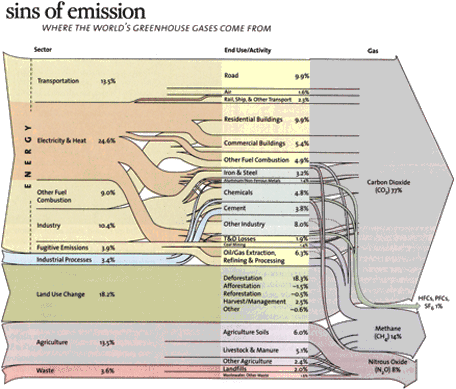
A Credit to Mother Jones for devoting an issue—and a dozen reporters—to an exploration of energy.
The report examines a variety of energy sources, from Big Oil to king coal to solar and nuclear power. And Paul Roberts opens it with a thought-provoking look at “the seven myths of energy independence.” Myth number one? That the goal of energy independence is a good thing.
We also loved this graphic:
One more
A Credit to the Financial Times for a piece by a former investment banker on problems with the culture of investment banking.
Has America ever needed a media defender more than now? Help us by joining CJR today.