Sign up for the daily CJR newsletter.
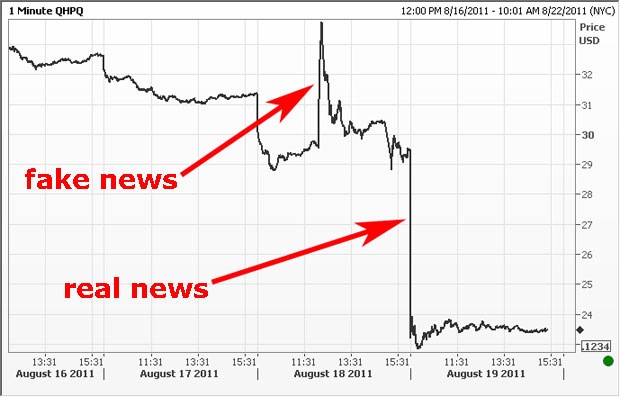
The death of the M&A scoop is going to happen slowly, but frankly it should happen as quickly as possible — and the past 24 hours in the history of Hewlett-Packard is an excellent indicator of why.
Yesterday, just after noon, Bloomberg found itself in possession of some market-moving news about HP: it was engaging in a major strategic shakeup, closing its WebOS division, buying UK company Autonomy for about $10 billion, and putting its PC business up for sale. (Bloomberg has since updated its story to reflect HP’s formal announcement, so I can’t link to the scoop itself.)
The markets, suffering through a massive down day, loved the news, in its leaked-to-Bloomberg form. HP shares were trading about $29.85 before the news came out; a few minutes later they were as high as $34. That’s a rise of 14%, or, to put it another way, an increase in market capitalization of some $8.5 billion.
One blogger, at least, was unimpressed. Zero Hedge, in an astonishingly prescient post entitled “Hewlett Packard Leaks Good News Early, To Mask Bad News Later,” explained exactly what was going on:
With less than 5 hours until the company’s official earnings release, Hewlett Packard just leaked to by Bloomberg that it would spin off its PC business and purchase British software developer Autonomy PLC. This is the oldest trick in the book to get a stock to drop from a higher level in the hopes that staggered releases of news, first good, then bad offsets each other, instead of having the good news be overwhelmed by the bad… We very much doubt this surge will sustain itself for more than a few minutes after the scam is understood. We also very much doubt that today’s earnings release will have anything good to say about the future.
By the end of the day, HP was back to its pre-report levels, in anticipation of a weak earnings report. But no one guessed just how weak the earnings would be.
HP was still spinning, though: its official news release was headlined “HP Confirms Discussions with Autonomy Corporation plc Regarding Possible Business Combination; Makes Other Announcements.” Among those “other announcements”:
FY11 GAAP diluted EPS is expected to be in the range of $3.59 to $3.70, down from its previous estimate of at least $4.27.
In English? “We’ve been telling shareholders to expect earnings of at least $4.27 per share this year. But actually we’re not going to come close. In fact, we’re not going to make more than $3.70, and we might make as little as $3.59.”
The drop from $4.27 to $3.59 is a whopping 16%—a huge miss, given that we’re already more than three quarters of the way through Hewlett Packard’s fiscal year. HP didn’t even attempt to guess what 2012 might hold in stock, perhaps because it’s likely to take most of that year to slough off the PC business it poured so much money into back in 2002.
And so when HP shares opened for trading today, they fell sharply—just as Zero Hedge predicted they would. They’re now trading at less than $24 per share—a 20% fall from the closing price yesterday and a whopping 31% fall from the post-leak knee-jerk exuberance levels of about 12:15pm or so yesterday.
We still live in a world, sadly, where it’s considered good journalism to get a scoop like Bloomberg’s and to move the market by publishing it—in the world of financial journalism, moving markets like this is the gold standard of what editors and proprietors are looking for. Even if you move them in what turns out to have been entirely the wrong direction, with a one-sided story which leaves out the most important news of the day.
It’s clear today that HP’s strategy is failing, that the big strategic moves are something of a hail-Mary pass, and that it’s massively overpaying for Autonomy. We got there in the end. But the M&A scoop which kicked off the news cycle looks like an attempt by HP to manage media coverage and to distract attention from its dreadful earnings guidance. And, at least for a few short minutes, it actually worked.
Has America ever needed a media defender more than now? Help us by joining CJR today.