Sign up for the daily CJR newsletter.
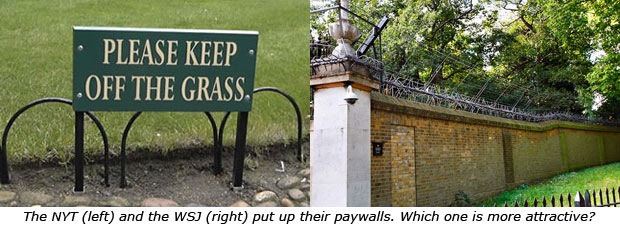
When I wrote about the success of the NYT paywall last month, I got a lot of pushback in the comments and on Twitter. Here’s a sample:
“The fact people pay speaks more people’s average techno-illiteracy/laziness about how to change a link address in their browser than anything else.”
“Add ?ref=fb to the base link of any NYT article and the paywall drops, and Felix thinks this is “working”? Huh?”
“After seeing how many ways you can get by the pay “wall” I would say it isn’t working at all.”
But of course the paywall is working—with the emphasis very much on the “pay” rather than on the “wall”.
Yes, the NYT paywall is porous—but that’s a feature, not a bug. It allows anybody, anywhere, to read any NYT article they like. That makes the NYT open and inviting—and means that I continue to be very happy to link to NYT stories. (If you follow a link to the NYT from this or any other blog, you’ll never hit the paywall.)
I’m in England right now, home to both of the sights above: the polite request to “please keep off the grass”, accompanied by tiny iron hoops; and the forbidding walls surrounding the gardens of Buckingham Palace. The former encapsulates everything which people like about England; the latter is the dark and regrettable side of things.
Now imagine that both of the gardens above were open to anybody paying an annual membership fee. The gardens on the left would have many more freeloaders—people who just saunter onto the grass and enjoy the sunshine without paying. The ones on the right would be much more effective in keeping such people out.
But here’s the thing about freeloaders: if they value what they’re getting, a lot of them will end up paying anyway. What happened when the Indianapolis Museum of Art moved to a free-admission policy? Its paid membership increased by 3%. When the Minneapolis Institute of Arts did the same thing, paid membership increased by 33%.
Sales people and business-side executes tend to believe as a matter of faith that if people can get something for free, they won’t pay for it. But all they need to do is look at their own behavior to see how that isn’t true: when they go to a restaurant in a distant town that they’ll never visit again, they still leave a 20% tip. A large segment of the population feels that it’s only proper to pay for something if you’re getting value from it—and if you invite as many people as possible onto your lawn, that’s a great way of maximizing the number of people who get value from it. Especially in a world where your own enjoyment of it doesn’t impinge on anybody else’s.
The fact is that no one subscribes to the WSJ or the FT because of their exclusivity. As a result, the smart thing for both papers to do is to maximize their paying readership by maximizing their overall readership. Instead, both have taken a scared and defensive approach to digital subscriptions, fearing that if their readers can get their content for free, then they won’t pay.
Wonderfully, the NYT seems to have disproved that idea. It’s no philanthropy: it’s a publicly-listed for-profit corporation, run for the financial benefit of its shareholders. But its paywall marks a new model and very promising in getting consumers to pay for content. It’s not a completely free pay-as-you-wish approach: the NYT nudges people quite hard to pay quite a lot of money. But I’d wager that the majority of people buying digital-only subscriptions to the NYT are doing so only after bypassing the paywall at least once or twice. If you hit the paywall on a regular basis and barge past it, eventually you start feeling a bit guilty and pay up. By contrast, if you hit the FT or WSJ paywall and can’t get past it, you simply go away and feel disappointed in your experience.
Historically, when people paid for news, they paid for a newspaper—a physical object which had value to them. That model is still highly lucrative for the NYT, WSJ, and FT. But they’re taking very different approaches when it comes to the digital world. The WSJ and FT are taking a spines-out approach, on the theory that the pain of not reading their content will force people to pay. The NYT is taking a more open-door approach, on the theory that the pleasure of reading its content will be enough to persuade a large number of people to pay. It’s a far more attractive model, and one which is much more likely to attract new young subscribers over the long term.
Nick Rizzo has collated some thoughts on the NYT paywall from people in the key demographic between 25 and 30 years old, all of whom are paying for the digital-only version of the NYT. Here’s one:
I don’t want to have to deal with the dead trees. There are easily a dozen sections in the weekend edition I don’t have any interest in. It just seems wasteful.
The New York Times is my number one source for news and I appreciate the service it provides. I don’t mean to sound like a total goody-goody, and I certainly get around paywalls when necessary, but I think $15/month is a pretty good deal for the amount of enjoyment and information I get from the Times.
If they took the paywall away completely I guess I’d stop paying. I’m not really interested in skirting it, though. I also buy a lot of music, because I like the product, understand the incentives involved, and want its production to continue.
And here’s Rizzo himself:
I’m on the Times website literally all day long. Any work-around to avoid the paywall would still cost me precious minutes. Plus, I feel that maintaining a quality NYT is immensely important to the country as a whole, and I’m happy to play my part. I subscribe to the Weekender (indeed, to the slightly cheaper Sunday-only edition), which is the cheapest possible way to give myself online access. I subscribe to the New Yorker (which has a semi-paywall) and give to WNYC (which, of course, doesn’t) for similar reasons.
It’s worth noting here the way in which people often end up paying for the NYT largely in proportion to their ability to pay. Those who can’t pay, don’t. Those who can afford only the cheapest subscription buy that. Those with comfortable incomes subscribe to the seven-day paper product. It’s a great way of maximizing both audience and goodwill.
Paying for something you value, even when you don’t need to, is a mark of a civilized society. The NYT treated its readers as mature and civilized adults, and outperformed internal expectations as a result. Meanwhile, the WSJ and FT are still treating their readers with mistrust, as though they’ll be robbed somehow if they ever let their guard down a little. It’s a sad and ultimately self-defeating stance, and I hope in future they learn from the NYT’s embrace of the open web, even in conjunction with a paywall.
Has America ever needed a media defender more than now? Help us by joining CJR today.