

The New York Times reports that newspaper advertising tanked by more than 27 percent last year, shedding $10 billion from 2008. Online advertising swooned more than 11 percent, which would largely be, I suspect, because it’s so tied to print sales via upsells.
But I have a bone to pick with this:
From its peak in 2005, newspaper ad revenue dropped 44.2 percent, from more than $49.4 billion to less than $27.6 billion last year. The last time advertisers spent less on newspapers was in 1986.
That’s nominally correct, but it’s wrong in reality. The 1986 comparison is only right if you don’t adjust for inflation. The newspaper industry did indeed take in $27 billion in 1986. But adjusting that for inflation gets you $52.9 billion in real dollars.
That means, according to these calculations I made last summer (when I estimated 2009 would hit 1965 levels), that the last time newspapers ads were lower was in 1963.
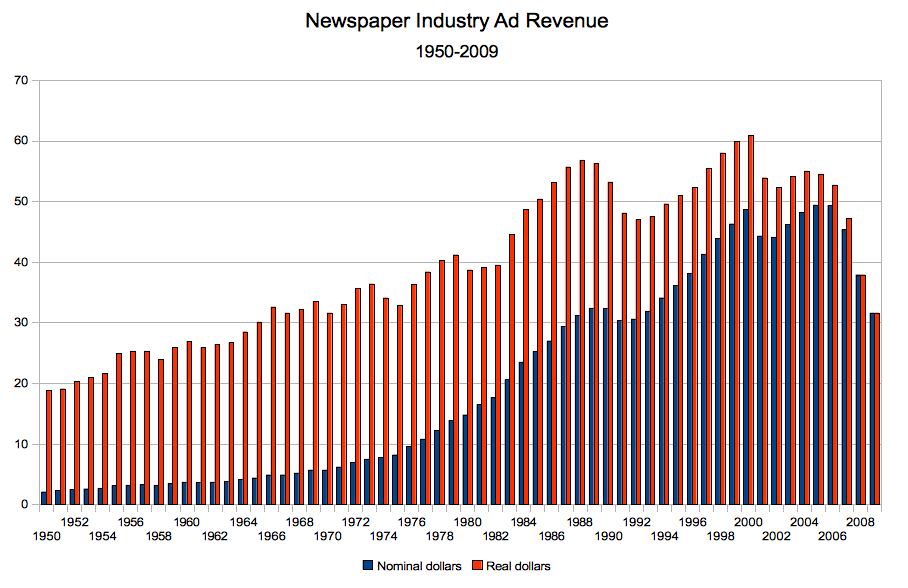
This is a good example of why journalists should always try to use real dollars, not nominal ones—especially when comparing two numbers separated by a lot of time.
If papers continue on their fourth-quarter trajectory, they’ll sink to levels last seen in the 1950s this year. Which is why stories like the Times’s own about iPad ads in high demand are so important. Too bad the paper stuffs the story inside.
Chase Sapphire, a credit card for the high-end market, has bought out The New York Times’s iPad advertising units for 60 days after the introduction…
FedEx will be the exclusive advertiser on the Reuters and Newsweek apps for 90 days after their introduction.
Now it’s great to see such demand for ads in this new format, which we’ve said before is one of the last best hopes for newspapers and magazines. But it’s not a good sign I’d say that one advertiser is able to snap up all ads in the NYT, say, for months. That would never happen in print because the demand is too broad-based and the inventory of ad pages is so deep. What does this say about the number of ads that publishers will be able to show on the iPad?
Also interesting here is the news that The Wall Street Journal will charge $17.99 a month for its iPad app. I think it’s great that a newspaper is being so aggressive in pricing its paper, and it raises questions about why the Times apparently isn’t charging from the get-go.
But the WSJ pricing doesn’t make sense. A WSJ.com subscription costs less than half as much—$8.62 a week. A print subscription delivered to your door costs just $9.92 a month. A print and online subscription costs $11.66 a month. But you’re going to charge $18 for the iPad app?
It better be good!
ADDING: The WSJ also has an iPad ad story this morning and it’s better than the Times‘s. This is interesting:
Hype over the iPad unveiling two months ago focused on selling subscriptions for the device, but no major magazines appear ready to do so yet, according to people familiar with the matter. That leaves titles like Time and People, Men’s Health and Hearst Corp.’s Esquire to offer weekly or monthly iPad editions of their magazines, priced at or near the cover price of a print issue.
It would have been nice to have some explanation here, because this makes no sense:
Esquire, whose iPad plans are furthest ahead in the Hearst magazine stable, is leaning toward a downloadable issue without advertisements for now, priced at $2.99, or $2 less than the physical magazine’s cover price.
But this is real money, especially for a brand-new device, one limited to a few hundred thousand or couple of million early adopters:
Six advertisers, including Coca-Cola and FedEx, have agreed to advertise with the Journal, and a four-month ad package costs $400,000, according to these people.
That would be $2.4 million over four months, presumably with no traffic minimums, or $7.2 million annualized. That seems like a pretty great start to me. Fingers are crossed here at The Audit.
UPDATE: A sharp-eyed reader writes me to question whether I misconstrued that last quoted sentence there. And it sure looks like I may have. While I thought the sentence implied that the six advertisers had signed up for $400,000 packages, it could just be juxtaposed by an unfortunate “and.” I’ll ask the WSJ for a clarification and update when I hear back.
UPDATE No. 2: I’m told that the six advertisers did indeed pay about $400,000 each for the packages.
Ryan Chittum is a former Wall Street Journal reporter, and deputy editor of The Audit, CJR’s business section. If you see notable business journalism, give him a heads-up at rc2538@columbia.edu. Follow him on Twitter at @ryanchittum.