The New York Times reports that even in a weak economy, there’s a fairly serious push for increasing the historically low minimum wage, which at the federal level grosses a full-time worker $7.25 an hour or roughly $15,000 a year.
The Times’s story is fine, but it would have been better if it had had at least one anecdote from somebody earning minimum wage or thereabouts. It’s got lots of elites talking about the merits and pitfalls of a higher minimum wage, but we don’t hear from anybody who actually earns $7.25 an hour.
They’re out there—even in New York City. The most expensive city in the country (and one of the most liberal) doesn’t set a minimum wage higher than what the federal government says you have to pay in Paducah, Kentucky.
WNET Thirteen had a nice piece a couple of months ago where it went around the city and talked to talk to workers making the minimum or just over it.
One of them is a cashier at a Duane Reade a block from The New York Times Building. She makes $7.90 an hour.
Nevertheless the story is a good jumping off point for thinking about the minimum wage.
There aren’t many stats that show how far workers have fallen in this country over the last few decades better than this one: Minimum-wage workers earned about 30 percent more in the 1960s than they do in 2012. The minimum wage peaked at $10.47 in inflation-adjusted terms in 1968, which is still higher than any minimum wage in the country. It’s worth noting that the unemployment rate was much lower back then too.
The Times reports on one push, which seems not to have much political backing, to raise the federal minimum wage to $9.80 an hour. That will surely not happen, particularly since the economy is not going to boom anytime soon and there’s already an excess supply of labor. But even if it did get raised to $9.80 by 2014, the minimum wage would still be about 11 percent lower than in 1968, assuming 5 percent total inflation between now and then.
The real-dollar comparisons are crucial for covering this issue, but indexing the minimum wage to inflation doesn’t begin to capture how much low-wage earners have fallen over the past half a century relative to all earners. That’s because overall economy and productivity per worker have grown far faster than inflation. I was talking to Audit Boss Dean Starkman last summer about whether it made sense to gauge minimum wage growth by productivity and GDP growth. I ran some numbers, figured out that a minimum wage indexed to GDP since 1968 would be about $20 an hour today, and… forgot about it.
Luckily, John Schmitt of the liberal Center for Economic and Policy Research was thinking along the same lines and put out a brief recently that shows a minimum wage indexed to productivity growth since 1968 would pay $21.72 an hour today.
CEPR has a very nice chart that shows how the minimum wage tracked productivity growth until right around 1968:
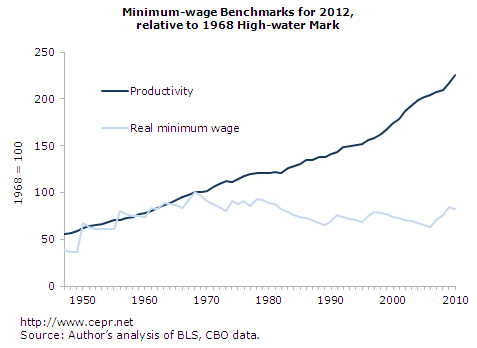
The point of using these measures as an alternative to inflation indexing is to show how a low wage earner’s share of the overall economy has plummeted over the past four and a half decades.
That economic growth had to have gone somewhere, though, and I’m sure you can guess where it went:
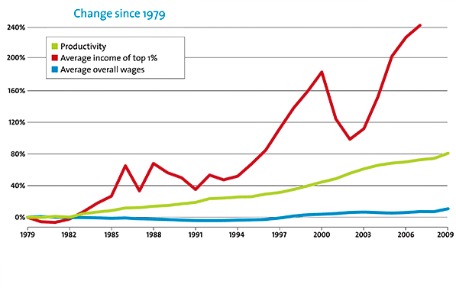
That Mother Jones chart just shows the top 1 percent. But the gains in that lucky group are concentrated amongst the richest of the richest. Most of the gains within the top 1 percent have gone to the top 0.1 percent, which has also captured more than a third of all income gains.
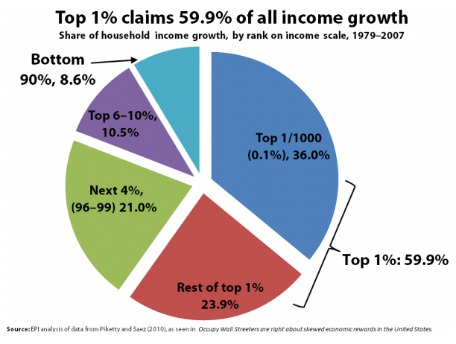
Yes, the top one in one thousand households reaped one in three new dollars earned over the last three decades or so.
This is no coincidence. Much of the money flooding into the coffers of the top one in one thousand has come from corporate profits, which go higher as workers’ wages go lower. And low wages at the bottom of the heap put downward pressure on wages for people at the 10th and 20th percentiles, say, and on up. Median wages haven’t gone up much either, over the last few decades:
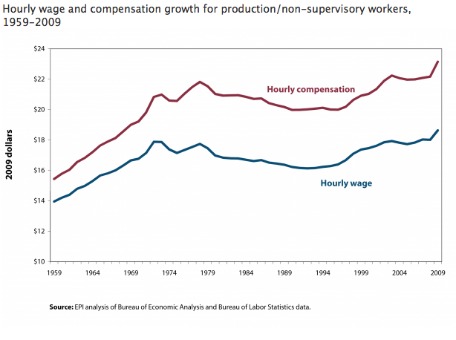
So keep this context in mind if you’re covering this issue. And find an actual worker or two to round out your story.


"The Times reports on one push, which seems not to have much political backing, to raise the federal minimum wage to $9.80 an hour. That will surely not happen, particularly since the economy is not going to boom anytime soon and there’s already an excess supply of labor. "
If the minimum wage was raised by even one dollar, that would help out the 76 million hourly workers in the U.S. There are only about 3.6 million actually earning min wage, but everyone would tend to get a lift. Let's say it averaged 50 cents an hour overall. That would take $76 billion out of the corporate coffers (they are holding back a trillion) and these folks would spend it. Direct, job creating stimulus. It starts to solve the demand problem. Also, a lot of these people would need less government support (food stamps, etc), so government spending would go down.
Oh, but that would reduce the dividends for millionaire political donors. Never mind.
#1 Posted by Minor Heretic, CJR on Fri 13 Apr 2012 at 09:16 AM
The other thing to keep in mind when reading about how much income the top 1% are capturing is how much that trend has accelerated in this recession/reeeeeccccooooveeerrryyyy (which is taking its time, no?).
Top 1% incomes grew by 11.6% while bottom 99% incomes grew only by 0.2%. Hence, the top 1% captured 93% of the income gains in the first year of recovery...It is likely that this uneven recovery has continued in 2011 as the stock market has continued to recover...This suggests that the Great Recession will only depress top income shares temporarily and will not undo any of the dramatic increase in top income shares that has taken place since the 1970s.
I blame the soshalists.
#2 Posted by Thimbles, CJR on Fri 13 Apr 2012 at 12:13 PM
Yet another thing to remember is how "flexible" the American labor market is, and by flexible we mean tilted towards low wages, low benefits, and low job security.
The US leads the OECD in low wage jobs.
http://www.cepr.net/index.php/publications/reports/low-wage-lessons
And the benefits accrued by this type of economy have gone to elites who are increasingly protected by their accumulation of power and therefore are increasingly corrupt and incompetent:
http://news.firedoglake.com/2012/04/11/inequality-accelerates-in-the-post-great-recession-recovery/
#3 Posted by Thimbles, CJR on Fri 13 Apr 2012 at 02:21 PM
All of which means idiots don't move on down (since they can threaten to take the nation down with them) and the lower tiers can't move on up.
When you have social immobility, it's your society that gets stuck.
#4 Posted by Thimbles, CJR on Fri 13 Apr 2012 at 02:24 PM
Ryan notes: "The minimum wage peaked at $10.47 in inflation-adjusted terms in 1968, which is still higher than any minimum wage in the country. It’s worth noting that the unemployment rate was much lower back then too.
padikiller responds: Geez, you think? You think maybe when American made things and sold things that labor was worth more?
Let's deal with this millennium. They aren't hiring people to make AMC Matadors and RCA hi-fi's anymore.
Bad jobs at bad wages are better than no jobs at all.
#5 Posted by padikiller, CJR on Fri 13 Apr 2012 at 11:16 PM
And since we're going down the CJR/OWS "Gimme Other People's Money" road again...
The simple, undeniable FACT of the matter, is that according to the U.S. Census, for every ONE hour worked by an adult in the bottom 20% of American households (by income) an adult in the top 20% of American household works nearly TWELVE hours!
That's right, people.. The "rich" are putting in a dozen times more work hours than the "poor"...
More work, more money! What a concept? Whodathunkit?
The solution to our national malaise is to require people to do more work. Not by force of government, but by simply demanding that they take care of themselves if they are capable of working. Work or go hungry. Their choice.
Banging drums and smoking dope doesn't create wealth. Running the cash till at Duane Reade does create wealth.
The trouble is that Americans aren't working hard enough. PERIOD. We are borrowing money (the labor of others) to dole out Snickers bars to obese food stamp recipients and to dole out money to pay people to remain unemployed.
Individual liberty and gubmint dependence for the necessities of life are mutually incompatible ideals.
#6 Posted by padikiller, CJR on Fri 13 Apr 2012 at 11:37 PM
Very good piece. I have one issue, though. You fall into the trap of using the term "elites" in your criticism of the NY Times. This is lazy language most used in political terms by the pundit class.
#7 Posted by Eclectic Obsvr, CJR on Mon 16 Apr 2012 at 12:47 PM
As I wrote earlier...
Bad jobs at bad wages are better than no jobs at all.
#8 Posted by padikiller, CJR on Mon 16 Apr 2012 at 01:29 PM
Sounds like Padi had his daily sean hannity without the crisco again.
#9 Posted by sergio, CJR on Thu 19 Apr 2012 at 03:04 AM