Sign up for the daily CJR newsletter.
Business news is booming these days. Business-news sections not so much. They are disappearing and have been doing so regularly for months. The trend seems set to continue.
Newspapers across the country are quietly eliminating stand-alone business sections to lower costs. The business cuts don’t come in isolation, but local business sections have been hit particularly hard. Many stand-alone sections were born within the past few decades, but their brief life is already coming to an end.
The death of the local business-news section won’t come as a great surprise to anyone reading, well, the business section these days. But a trickle is turning into a torrent, leaving a void in local communities and forcing local business editors to put the best face on it.
The death march has been noted by a few business-news watchers, most notably Chris Roush, who writes a blog called Talking Biz News. But the phenomenon has otherwise not gotten the coverage it merits.
That’s too bad, because who else but local business reporters and editors are going to report on the ups and downs of the local economies and the goings-on of the small-to-medium-sized businesses that have huge impacts on individual communities but never grace the pages of The Wall Street Journal? In some cases, local business weeklies have sprung up to fill a void, but those too often have the interests of business in mind, not those of the community at large. That’s a role general-interest publications have typically had to fill.
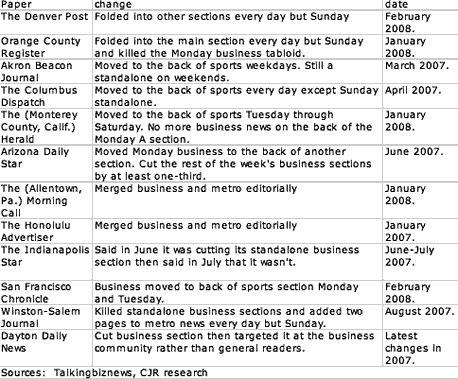
We compiled a list (above) of a dozen or so stand-alone business sections that have gotten the axe—along with a few that have absorbed lesser hits—and set about finding how local business editors were dealing with the situation.
The answer? Not very well.
The causes are the usual suspects: declining readership, declining ad revenue, and so on. Some business sections fell because editors figured readers could get stock information from the Internet. The stripping of these fig leaves revealed business coverage so thin that in many cases it couldn’t justify an entire section.
The Denver Post has folded its business section into its metro section Tuesday through Friday. Mondays, business is part of an expanded front section. Business editor Steve McMillan said the business-section downsize was part of a package of changes—all cuts, essentially. (The Sunday business section is still stand-alone. The Post, through a joint operating agreement with the Rocky Mountain News, doesn’t publish on Saturday.)
With the same size staff and the same amount of space in the paper, McMillan sees the changes having little effect on content, with a notable exception: business stories can no longer jump from the first business page. Editors try to scrape by with reefers, sidebars, and art packages to supplement coverage, and in some cases will devote the whole front business page to a single topic.
While McMillan is making the best of his new format, he has to admit: “It’s nice to have a section front.”
When editors decide to get rid of the stand-alone business section, what do they do with the business news? These days, you can find business behind sports at California’s Monterey County Herald.
The Herald has made a variety of cuts, which include reducing its stock pages. Herald executive editor Carolina Garcia called her paper’s cuts, which came along with a handful of layoffs, “a hard, hard thing to do.”
The sports-business nexus is a marketing thing. In the world-according-to-reader-research, the typical reader of the business and sports sections is male. With sports and business together, peace can reign at the breakfast table: women can read metro without their husbands lunging across the scrambled eggs for the section, or so the theory goes.
At The Columbus Dispatch, business could have gone behind metro, says business editor Ron Carter, but weather is on the back of metro along with valuable ad space.
The Dispatch cut its stand-alone section after the elimination of stock tables thinned it out. Carter says he initially got “hundreds and hundreds of calls and complaints.” As time passed, feedback dwindled, but he still hears from unhappy readers. “I tell them I don’t like it either,” he says.
The Orange County Register folded its business section into its main section Monday through Saturday, although its Sunday section is still stand-alone.
The idea of efficiency seems key to many of these cuts, prompting the Register’s president and publisher, Terry Horne, to explain the concept in a January Register article headlined “Where’s my Marketplace section?”
Shifting our business coverage into News is driven by a need to be more efficient in the type of news we publish in our newspaper versus online.
The economic questions are complex, as attentive news-watchers know—just because newspapers are facing tighter budgets (which they are) does not mean their owners are close to losing money. This combination of tight budgets and (in many cases) high profits is a quirk of media companies, which grew fat and happy on monopoly profit margins for the three decades or so before the Internet took hold. Margins have been shrinking rapidly in recent years because of revenue declines, but they are still high on average.
Ken Otterbourg, the managing editor of the Winston-Salem Journal, was candid with readers in describing the paper’s decision to merge business with metro last year:
Like many other things in journalism, there’s a financial component to it. We’re trying to control costs, and newsprint is a big one. I won’t BS anyone and say that this is an improvement, but I would like to think that a smaller newshole and less display space will force us to change some of our approach to business coverage and place more emphasis on bigger stories and less routine pieces.
The changes, made in August, included replacing the weekday stand-alone business section with two pages in the local section, and cutting five jobs.
Other papers are shuffling metro and business personnel.
The Morning Call in Allentown, Pennsylvania, now mixes the two: A metro editor oversees the business section.
How does it work? “We’re very new at this,” says editor Ardith Hilliard.
The Honolulu Advertiser last year promoted business editor David Butts to oversee a combined metro and business desk.
Assistant business editor Alan Yonan Jr. says the system has its advantages. For one thing, he says more business stories have made A1 because a joint editor is there to shepherd them through.
It’s worth noting that Allentown and Honolulu added stand-alone business sections relatively recently (Allentown in 2002 and Honolulu in 2001) and that Allentown saw subsequent increases in business-section readership, according to 2004 surveys.
Other papers have bucked the cutting trend.
The Miami Herald has added business staff in recent years, according to Kevin Sweeney of the Donald W. Reynolds National Center for Business Journalism.
He quotes Herald business editor Lisa Gibbs:
‘Simply, [something missing after Simply? awkward] that we are one of the most productive and well read sections at the paper,’ she says, ‘We contribute regularly to 1A, produce projects and special sections, and our Business Monday tabloid is one of the most successful and followed parts of the paper. Through additional staff and some reallocation of resources and prioritizing, we have focused harder on enterprise that makes us stand out.’
The Indianapolis Star said last year it would cut its business pages but later reversed course, according to the Indianapolis Business Journal, via Talking Biz News:
‘We’re always looking to improve the product, and don’t want to take anything away,’ said Star Executive Editor Dennis Ryerson. ‘The reality is, we just couldn’t figure out a way to make it work out any better than it was before.’
One more business section saved—for now.
A stand-alone business section in and of itself has not guaranteed top-quality business news. Let’s face it: most local business sections are not very good. That stock-listing cuts have decimated many business sections is just evidence that they didn’t have much original content that drew readers anyway.
Those who cut reporters and editors will make sure they never get those readers.
Has America ever needed a media defender more than now? Help us by joining CJR today.