Sign up for the daily CJR newsletter.
Print subscribers to the Los Angeles Times awoke this morning to find this where the front page—you know, the one with the news and stuff—usually is:
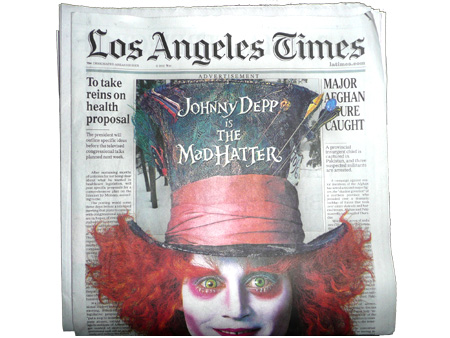
That’s an ad promoting today’s theatrical release of Disney’s “Alice in Wonderland,” splashed underneath the paper’s good name and masthead, and on top of dummied-up news copy.
Cue all the standard reasons to find this dispiriting.
But I’ve got another for the list. Take a look at what the paper’s spokesperson told Sharon Waxman, the proprietor of Hollywood news site The Wrap, when she called to discuss the placement:
“We worked very closely with Disney to come up with an exceptional and distinctive way to help them open ‘Alice in Wonderland,’” said John Conroy, a spokesman for the Times. “It was designed to create buzz, and to extend the film’s already brilliant marketing campaign.“
As a spokesperson for the Los Angeles Times, John Conroy’s job ought to be to explain, as best can be done, the Los Angeles Times‘s decision to run such a standards bending ad.
His job is not to blow kisses to the paper’s advertisers, praising their exceptional and distinctive marketing brilliance. These are the same advertisers who, mind you, the paper must cover fairly alongside their market competitors day after day.
Let’s just think this one through with a contemporary example:
“We worked very closely with Toyota to come up with an exceptional and distinctive way to help them patch up their public image and get people buying their cars again,” said John Conroy, a spokesman for the Times. “It was designed to create buzz, and to extend the company’s already brilliant damage control plan.“
Or fast forward a bit:
“We worked very closely with Mitt Romney to come up with an exceptional and distinctive way to help him win more votes and carry California and win the presidency,” said John Conroy, a spokesman for the Times. “It was designed to create buzz, and to extend the candidate’s brilliant political messaging.“
I at least hope the Times charges extra for this level of service.
(Image via The Wrap)
Has America ever needed a media defender more than now? Help us by joining CJR today.