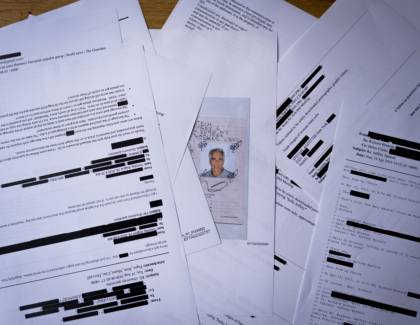
The former head of Pennsylvania’s Department of Environmental Protection is not happy with The New York Times’s Ian Urbina and his series about risks and regulations related to natural-gas drilling, a rapidly growing industry.
After the series launched with a long article on the front page of Sunday’s newspaper, John Hanger—who left Pennsylvania’s top environmental regulatory agency in January, following the ascent of a new governor—let loose with a string of seven posts on his personal blog explaining why he thought Urbina’s work was “deliberately” misleading.
Under the headline, “Regulation Lax as Gas Wells’ Tainted Water Hits Rivers,” the series opener homed in on radioactive materials in drilling waste. In a process called hydraulic fracturing, or hydro-fracking, large amounts of water, sand, and chemicals are injected into rock formations, usually shale, deep underground in order to break up the rock and release the gas they contain. Some of the mixture then returns to the surface as wastewater, some of which, the Times reported, is being discharged into Pennsylvania rivers:
While the existence of the toxic wastes has been reported, thousands of internal documents obtained by The New York Times from the Environmental Protection Agency, state regulators and drillers show that the dangers to the environment and health are greater than previously understood.
The documents reveal that the wastewater, which is sometimes hauled to sewage plants not designed to treat it and then discharged into rivers that supply drinking water, contains radioactivity at levels higher than previously known, and far higher than the level that federal regulators say is safe for these treatment plants to handle.
At his personal blog, Hanger criticized the story for what he felt was a predetermined “narrative of lax regulation and lax regulation and lax oversight of gas drilling in Pennsylvania.” He accused Urbina of “willful reporting errors and omissions,” but almost all of his complaints concern the latter.
The crux of Hanger’s disapproval is that Urbina did not mention a suite of strong regulatory and oversight that Pennsylvania’s Department of Environmental Protection enforced during the time period covered in the article. That includes, Hanger wrote, four new drilling policies and rules enacted under his tenure: finalizing water withdrawal policies designed to protect rivers and streams; putting an end to Pennsylvania’s “decades long practice” of allowing the unlimited discharge of wastewater untreated for total dissolved solids (salts, etc.) in rivers and streams; strengthening rules governing drilling well design, materials, construction, monitoring, testing, and disclosure of chemicals; and enacting a 150-foot buffer requirement between all development and “High Quality” streams. Other measures included increasing the department’s gas staff from eighty-eight to 202 positions and issuing 1,400 violations to the gas industry between January 2008 and June 2010.
Hanger also griped that Urbina did not mention a 2010 report from an independent auditing agency called STRONGER, for State Review of Oil and Natural Gas Environmental Regulations, whose board includes representatives from government, industry, and environmental organizations. The report issued a number of recommendations for improvement, but concluded that “the Pennsylvania program is, over all, well-managed, professional and meeting its program objectives.” Hanger felt that should have been the takeaway message from Urbina’s article, and he was irked that it wasn’t.
While Hanger has a point—Urbina’s article does use a specific example of poor oversight to make a much more sweeping statement about “lax regulation”—complaints focusing on errors of omission rather than errors of commission often seem like sour grapes. Indeed, Hanger found no fault with the main thrust of Urbina’s article, writing:
The most serious issue raised by the NYT is whether or not unhealthy levels of radium are in the drinking water as a result of gas drilling wastewater.
Good reasons exist to believe that the answer is no, including the new drilling wastewater disposal rule that went into effect in August 2010 and the now widespread use of recycling technology to manage at least 70% of drilling wastewater. But belief is not good enough.
We must not drift into a war of competing theories or studies. We need the facts. Pennsylvanians deserve nothing less.

Anyone who has ever lived in or near a field where fracking is used to any extent can attest to the quality of water that is sourced locally for domestic use. In my experience it is awful. If it tastes and looks that bad, something isn't right.
#1 Posted by Sidney Johnston, CJR on Thu 3 Mar 2011 at 02:51 PM
It's good reporting. The record to date doesn't support Hanger. People's wells are contaminated. The disposal of waste is another matter but we know one thing for sure: If the American Petroleum Institute did the study it's most assuredly skewed in their favor. As we often said in the Forest Service. No Effect. Log on!
I reported on this topic several times. This is one.
Published 11.19.2008
Rig looking for oil, gas south of Clyde Park
By Mark A. York, Enterprise Staff Writer
Oil and gas drilling began on a new private lease in Shields Valley, Tuesday.
Devon Energy of Oklahoma City, Okla., started moving into the area from Wyoming on Nov. 6.
The rig is drilling just west of U.S. Highway 89 and just north of Grannis.
“We just started drilling this morning,” said Sidney Blackwell, drilling consultant on scene at the Shields site Tuesday.
“I can’t talk about the well except to say the hole is round,” he said. “This is a Nabors M40 pace rig — a state-of-the-art computerized generation wildcat well exploration. This will be the seventh hole this rig has drilled. The others were all in Wyoming.”
“A wildcat rig is one that goes after anything it can find,” said Dave Johnson, also a drilling consultant for Devon, who just arrived in Montana from Riverton, Wyo., Tuesday.
A crewmember in a round hardhat reported for duty at the drilling office, a trailer parked across the site from the rig, which hummed in the background.
“Boy, it’s a long way from Wamsutter, (Wyoming),” he said of his drive to his new work site, shaking his head.
The drilling site is located a mile and a half west of Highway 89 south of Clyde Park, 15 miles from Livingston.
In September, state oil and gas leases caused a local uproar over drilling in and near the riverbeds of the Yellowstone, Shields and Boulder rivers.
While Montana Department of Natural Resources and Conservation Director Mary Sexton told concerned residents and landowners of Park and Sweet Grass counties at a September meeting in Livingston that just because a state parcel is leased doesn’t mean it will be drilled, this operation is evidence drilling can happen quickly.
The company uses a technique known in the industry as hydraulic fracturing, or “fracking,” a technique in which fluids are pumped into an oil or gas well at high pressure to fracture geologic formations and open up pathways for the oil or gas to flow to the well, according to industry documents.
This has caused drinking water well problems in Sublette County, Wyoming and Silt, Colorado, resulting in one rancher’s water well exploding, according to an investigation by ProPublica, an independent, nonprofit newsroom headquartered in New York that produces investigative journalism in the public interest.
“(Fracking is) part of the deal,” said Chip Minty, external communications supervisor for Devon Energy in Oklahoma City.
“We contain the runoff at the wellhead and dispose of it in an environmentally approved way in conjunction with state regulators.
“We’re very aware of the sensitivity of this issue in Montana and we’re working with the state.”
“We’ve got crew members from all over the country,” Blackwell, who is from Mississippi, said. “Some are from Louisiana, Oklahoma, Colorado, Montana, Wyoming, Oregon, Texas and Mississippi — 25 in all. We run 24 hours a day in 12-hour shifts, two weeks on and two weeks off.”
He said Devon had five rigs going in Wyoming, and that this was the only one they had in Montana.
According to the DNRC oil and gas lease sale list, there are 19 leased sites in Park County and 131 in Sweet Grass County.
Statewide there are 6.3 million acres of state lands open to lease for minerals and oil and gas exploration, Sexton said in July, when the
#2 Posted by Mark A. York, CJR on Thu 3 Mar 2011 at 05:11 PM
"Thanks to the Times, that wish might come true. The Scranton Times Tribune in northeastern Pennsylvania reported Wednesday that “U.S. Sen. Bob Casey [D-Penn.] joined a chorus of lawmakers on Tuesday seeking additional testing of public water supplies following” the Urbina’s article"
For anything like this to have a chance of succeeding, it will have to overcome an army of utter idiots.
http://www.philly.com/philly/blogs/attytood/Corbetts_clueless_new_DEP_commissioner.html
"In his opening remarks, Krancer emphasized a business-first philosophy of environmental regulation, saying “Responsible, strong, vibrant and growing business is necessary as an engine for the protection of the environment.”
If anyone had doubts about that, he said, “One need only look to the former Iron Curtain experience and the pollution that is there to prove that a moribund economy is the enemy of environmental protection.”
Democratic Senator Daylin Leach, who had introduced Krancer and said he “could not be happier” with Krancer’s appointment, responded “They also had very weak environmental enforcement, and that’s a reason there were the pollution problems there were.”"
The waste water that mixed with ground water in the past included proprietary secret POLYMERS (that's plastic you're drinking, people ). Water facilities are designed to filter out and sanitize bacteria and the like. They don't distill the water, therefore most of the chemicals dissolved in the water remain (that's why salts are a major problem) Furthermore, at the point of introduction into a river, the concentration of the chemicals will be much greater. These rivers are not sterile. There are food webs which spread all around us from which these chemicals can spread. If we aren't giving ourselves cancer through the introduction of poisons into our watersheds, we're likely giving the fish and biota some.
Monstrous stupidity.
#3 Posted by Thimbles, CJR on Thu 3 Mar 2011 at 05:52 PM
Couple of things, First, the EPA report has lots of statements indicating that distillation is not sufficient, for instance:
"Here, the agency discusses the use of diesel fuel in hydrofracking. This is important for two reasons, one related to the law and the other focused on health risks. First, although hydrofracking is generally not covered by provisions of the Safe Drinking Water Act that deal with underground injection, Congress decided that the exclusion would not apply to hydrofracking conducted using diesel. In this passage of the document, E.P.A. officials say that a report by the Environmental Working Group, a nonprofit advocacy group, found that the E.P.A. was not adequately enforcing laws on hydrofracking with diesel. Second, diesel carries high levels of the so-called BTEX chemicals -- benzene, toluene, ethylbenzene and xylenes -- which are carcinogens. But E.P.A. authorities say here that diesel is not the only component of fracturing fluid that contains high levels of BTEX and other toxic materials. Indeed, companies have disclosed to the authorities in New York and Pennsylvania that they use other types of petroleum distillates that contain high levels of benzene, a human carcinogen that is considered unsafe in drinking water at levels above five parts per billion, the equivalent of a few drops in a swimming pool. Some of these petroleum distillates that the industry uses include kerosene, mineral spirits, petroleum naphtha and Stoddard solvent. According to scientific literature, these additives can contain up to 93 times the amount of benzene contained in diesel."
Less of a "he said she said" and more of a "they said" when you look into both reports.
Second, it should be made clear that the API report was prepared by the "Biomedical and Environmental Assessment Group at Brookhaven National Labratory" for the API, not by the American Petroleum Institute itself.
Third, you should make more mention of the corruption angle which was buried in the second Urbina piece:
"The fate of more of the wastewater is unknown because of industry lobbying. In 2009, when regulators tried to strengthen oversight of the industry’s methods for disposing of its waste, the Marcellus Shale Coalition staunchly opposed the effort... Under the proposed system, a manifest would have been required so that each load of wastewater was tracked from the well to its disposal, to verify that it was not dumped at the side of the road.
After initially resisting, state officials agreed, adding that they would try to persuade the secretary of Pennsylvania’s Department of Environmental Protection to agree, according to the notes. In the end, the state’s proposed manifest system for tracking was not carried out.
Three of the top state officials in the meeting — K. Scott Roy, Barbara Sexton and J. Scott Roberts — have since left their posts for jobs in the natural-gas industry."
And yeah, John Hanger? Not exactly the most objective guy on the Natural Gas issue as a viewer of Gasland may tell you
http://www.pressaction.com/news/weblog/full_article/padep02012011/
"Hanger, who agreed to be interviewed by filmmaker Josh Fox for the documentary when he was still serving as DEP secretary, argued on his blog that Gasland “presents a selective, distorted view of gas drilling and the energy choices America faces today. If Gasland were about the airline industry, every flight would crash and all airlines would be irresponsible. In Gasland, the gas industry is unsafe from beginning to end and is one unending environmental nightmare with no benefits. Gasland seeks to inflame public opinion to shut down the natural gas industry and is effective. In pursuing this goal, Gasland treats cavalierly facts both by omitting important ones and getting wrong others.”"
And it also made you look like a
#4 Posted by Thimbles, CJR on Thu 3 Mar 2011 at 07:20 PM
Even industry friendly Business Week
http://www.businessweek.com/magazine/content/11_11/b4219025777026.htm
can't help but post some disturbing data:
http://www.businessweek.com/magazine/fracking/infractions.htm
"Over the past three years, the Pennsylvania Environmental Protection Dept. has cited 47 well operators more than 900 times for "environmental health and safety" violations. Chesapeake Appalachia, a unit of Chesapeake Energy, took the top spot with 109 violations."
Looking at the graph, one sees that the violations caught spiked around the time that Gasland was being shown on HBO and regulators were put under pressure to do some work. Now that Krancer is in charge, unless there is some public vigilance, you and expect safety violations to spike while citations for violations vanish. We don't wanna be like Russia after all.
#5 Posted by Thimbles, CJR on Thu 3 Mar 2011 at 07:33 PM
And tell me again, for the record, how many instances of groundwater contamination via hydraulic fracturing fluids have been documented? None you say! As in zero, nada, zip, zilch … why I never would have guessed! Even in instances where methane has leaked from a well head there were no corresponding measured leaks of wither fracturing fluid or produced water?
Almost sounds like a non-issue to me.
#6 Posted by Mike H, CJR on Fri 4 Mar 2011 at 09:06 AM
Didn't I mention the Business insider was being very industry friendly? From the link above:
"While there have been no documented cases of fracking fluids flowing underground into drinking water, there have been spills above ground. Fracking produces millions of gallons of wastewater; some of it containing benzene has spilled from holding tanks."
From the link in its sidebar:
http://www.businessweek.com/magazine/content/11_11/b4219027632126.htm
"Claim 1: Fracking is polluting underground sources of drinking water.
The film highlights the risk but overstates it at times. At least three contamination cases from faulty gas wells have been confirmed since 2007, says Scott Anderson, a senior policy adviser at the Environmental Defense Fund. In all three, the problem was flawed cement used in well construction, he says, not the fracking itself. Pennsylvania and other states have since toughened construction standards. The main risk is that drilling can allow naturally occurring methane to seep into a water source, says Jan Jarrett, president of PennFuture, a Pennsylvania policy group. Naturally occurring methane can contaminate water even without drilling, and Energy in Depth, a natural gas industry group, says that may explain the flammable tap water."
Which is it? None? Three? More than three but less than 50? No, I don't think I completely trust them on the subject.
Until the industry gets some serious scrutiny by having congress put it back under the Clean Water Act and making the EPA take serious looks at the water quality of the wells affected instead of taking the industry's word, I'm not buying it. The stuff that was coming out of people's sinks in Gasland after the injection wells were set wasn't perrier.
#7 Posted by Thimbles, CJR on Fri 4 Mar 2011 at 10:13 AM
I became committed to learning all I could about this industry after attending a town hall meeting in my area a year ago. Personally, they had me at 'halliburton loophole' and 'oil and gas act'. No Phd required to figure this grand scheme out.
John Hanger, who initially feigned interest in environmental damage, conveniently looked out for number 1 (himself) when he left his post.
Mr. Urbina has clearly done his homework and thanks to his supreme journalism, many eyes will be opened. This man deserves a journalism award, not crititicism. He has exposed what the average citizen could not and has validated claims that have been ringing from the scientific and health communities. The informed 'grass roots' organizations owe Mr. Urbina a debt of gratitude. Thank you, Thank you, Thank you!! Maybe integrity is alive and well.
Loretta Weir
#8 Posted by Loretta Weir, CJR on Fri 4 Mar 2011 at 11:46 AM
Flaming water faucets are as old as water well.
#9 Posted by Mike H, CJR on Fri 4 Mar 2011 at 02:21 PM
Yes, and lung disease is as old as fire, but if there is a high incident rate of lung cancer among people who use a likely cancer causing agent, such as tobacco, is it unreasonable to suspect tobacco as a culprit? Is it reasonable to absolve the likely agent before investigation because "lung disease happens"? Much of the fracking fluid used is a proprietary secret (which makes the water hard to test and establish frack fluid causality) and official EPA studies of well quality before and after drilling have not been done.
Regulation of this enterprise has been left to the states (due to federal exemptions) which were bought before the Tea Partypalooza moved in last November. These new guys are not only bought, but believe that it's proper that government should not regulate poison. They're cutting regulatory budgets and appointing hacks like Krancerman to oversee the industry.
It's your water your brewing this tea in. You and your children are going to have to drink it.
#10 Posted by Thimbles, CJR on Fri 4 Mar 2011 at 09:19 PM
I wanted to raise two issues with this blog post.
First of all, this blog post analyzes the merit of a massive investigative project by the Times that involved a level of research that few other venues or reporters are doing these days. And it measured this merit based on the gripes of one person. This line of critique seems to focus on form rather than substance. Isnt the major accomplishment of the story that it unearthed new facts, raw documents, and legitimate problems?
The second and related point concerns what you wrote in this sentence:
“While Hanger has a point—Urbina’s article does use a specific example of poor oversight to make a much more sweeping statement about “lax regulation”—complaints focusing on errors of omission rather than errors of commission often seem like sour grapes.”
There is a real factual inaccuracy in your sentence. Go back and look closely at the Times story. The story highlights a major lack of oversight in the monitoring of radioactivity at the drinking water intake plants and at the sewage treatment plants. The story points out that the river monitor that was supposed to protect Pittsburgh is in the wrong place. The story looked at spill plans from several major spill sites and revealed that after the spills these plans were still in violation of the law. The story crunched the fines data from the state and showed that the state was far more inclined to issue citations than fines. When issued, the fines themselves were systematically low. The story points out that for all the staff increases made by Hanger, the inspector to well ratio was still a complete joke making it laughable to think that the state can actually keep up with their duties. … Oh, and all these revelations, that are in the Times story have never appeared elsewhere (I know because I'm a reporter at another venue in the state where I have been clamoring to get my editors to do this kind of journalism). And the Times went so far as to back up with data and documents that the paper put up on their website. Based on those points - again, all of which are in the Times story, is it really accurate to say that the Times story used "a specific example of poor oversight to make a much more sweeping statement about “lax regulation”? That list above is far more than a single case of poor oversight.
All that is a long way of saying that focusing on Hanger’s gripes seems to miss what made that Times story so strong: facts not conjecture. And it also misses a larger point about journalism: There needs to be a bit less “he said, she said” reporting and a bit more rigorous, documented, reporting of facts.
#11 Posted by Jeremy Stall, CJR on Fri 4 Mar 2011 at 10:29 PM
As usual, democracy now has some great informative coverage on fracking and the EPA.
http://www.democracynow.org/2011/3/4/leaked_epa_documents_expose_decades_old
http://www.democracynow.org/2011/3/4/natural_gas_industry_attacks_oscar_nominated
#12 Posted by Thimbles, CJR on Sat 5 Mar 2011 at 05:27 AM
Yes, and lung disease is as old as fire, but if there is a high incident rate of lung cancer among people who use a likely cancer causing agent, such as tobacco, is it unreasonable to suspect tobacco as a culprit? Is it reasonable to absolve the likely agent before investigation because "lung disease happens"?
Tell me then, what is the average dissolved methane concentration in areas
1. without coalbed or shale gas reserves
2. with coalbed or shale gas reserves
3. with coalbed or shale gas development
After answering this question, you may have a point, but I dont think I should be holding my breath. Not only are you trying to show causation through correlation, you are trying to show correlation through limited ancedote.
Much of the fracking fluid used is a proprietary secret (which makes the water hard to test and establish frack fluid causality) and official EPA studies of well quality before and after drilling have not been done.
Wrong on both points actually. Most of the fracking fluid is water and sand.
One recent well publicized well casing propblem took place in Bainbridge Township PA. The situation was similar to Dimmock PA, except Bainbridge Township had extensive baseline water quality reports to test against. The results, not suprising in the least, were that NO fracturing fluids or produced water was found in the water table. The Ohio DEP's report can be read here
Come back when you get something more than talking points from Gasland.
#13 Posted by Mike H, CJR on Sat 5 Mar 2011 at 11:02 AM
"Wrong on both points actually. Most of the fracking fluid is water and sand."
You don't now that because, except in the cases where diesel fuel is a component, it's a proprietary secret used in a proprietary process. I, for one, don't care for proprietary secrets being applied around my drinking water.
Take for instance your report on the Ohio Valley Energy Systems Corporation pump.
They tested for three components to indicate the presence of frack fluid.
"The DMRM also had ground water samples analyzed for select components of the hydrofracture fluid used at the English No. 1 well. Information from material safety data sheets (MSDS) was reviewed for drilling and hydro-fracture operations. Selected components include ethanol, ethylene glycol, and isopropyl alcohol."
So even if you could say in this case that "frack fluid found here was water and sand", you could only say that about the frack fluid used by the OVESC.
Which you can't because it's a secret. Other than that, I don't know what your report was supposed to indicate since:
"Based upon a review of the water quality data and other observations, the DMRM has determined that 22 domestic and one public water supply were contaminated by the natural gas charging event caused by the English No. 1 well. The DMRM has also determined that the data indicates that ground water has not been contaminated or polluted by brine, crude oil, or hydrofracture fluids, which are commonly associated with the oil and gas drilling and well completion process. Furthermore, the data does not indicate that natural gas invasion of local aquifers alterated inorganic water quality, or caused pollution salts or metals."
"Ground water is considered “contaminated” when measured concentrations of induced chemical parameters of interest exceed “background” levels or ranges. Ground water is considered “polluted” when measured concentrations of induced chemical parameters of interest exceed background levels, or ranges, but there are no specific maximum concentrations or action levels specified by regulation or enforceable guideline."
In this case, to our knowledge, there was a gas leak. What the regulatory authorities should be doing is getting a full disclosure of the frack fluid's components, testing well water composition before each drilling operation in the area, and maintaining monthly checks to establish that the water quality is unchanged.
Especially when pumps start undergoing multiple fracks, further eroding the integrity of the layers between shale gas and water.
Is that so unreasonable?
#14 Posted by Thimbles, CJR on Sat 5 Mar 2011 at 06:54 PM
It's ashame that there is no regard for human life any more.Its all about meny.Its wrong and they know it ruins the water supply.But they always get around iy.A family buys a piece of land out of the city to raise theier kids in a safe enviroment away from crime.Instead they end up having illness.We don't own our property we just rent it.They do what they want.
#15 Posted by Vikki Tanner, CJR on Sun 6 Mar 2011 at 03:29 AM
You don't now that because, except in the cases where diesel fuel is a component, it's a proprietary secret used in a proprietary process.
Yes, actually I do know that. The additives are typically less than .25% of the fracturing fluid and included biocides, corrosion inhibitors, gelling agents and surfactants. Many companies have provided lists of additives and the concentrations at which they are injected although the exact proportions are proprietary.
The reason the Ohio DEP singled out ethanol, ethylene glycol and isopropyl alcohol (even though they tested for dozens of organic and inorganic compounds) was because, excluding water and sand, these three chemicals constitute the lions share of any fracturing fluid mix. So if these three were not found in concentrations higher than baseline what are the odds that any of the other fracturing chemicals would be present?
Especially when pumps start undergoing multiple fracks, further eroding the integrity of the layers between shale gas and water.
The layer separating the gas bearing shale formation from the water table is miles thick bedrock. The porosity and permeability of bedrock is so low that a crack from a frack job cannot propagate through it. In fact, if there was any porosity or permeability in the bedrock, there wouldn’t be any gas there in the first place. So yes, it would be unreasonable to require the kind of test you described because not only is there no evidence that there has ever been contamination of fracking fluids there is little reason to believe such contamination is even possible in a properly constructed well.
#16 Posted by Mike H, CJR on Mon 7 Mar 2011 at 10:42 AM
Got yourself some gas industry talking points, I see. Even if it is miles of bedrock between well water and shale, the integrity of the bedrock is not guaranteed to be 100%, by your own admission natural gas leaks out of some faucets naturally, and its chances of being 100% after fracking breaks up the underlying geologic formations is even further removed. Rock is not static, it is a hard but brittle substance in which faults appear and propagate. If these faults are large enough to allow gas to escape, which is bad enough, they could be large enough to allow frack fluids trapped in the shale layer to seep up and escape. Perhaps not even immediately, but over time the bedrock will be subject to stresses and contamination grows more likely.
It's your drinking water. If you want to trust a mining gas company to protect it, take your chances with your water. Other people should demand a rigorous test/inspection procedure.
#17 Posted by Thimbles, CJR on Mon 7 Mar 2011 at 07:56 PM
Got yourself some gas industry talking points, I see.
Well if good engineering = "gas industry talking points", then yes I suppose I do.
Even if it is miles of bedrock between well water and shale, the integrity of the bedrock is not guaranteed to be 100%
Geologists say otherwise, but OK.
by your own admission natural gas leaks out of some faucets naturally
Natural gas found in most water tables is from decomposition of biological matter present in the water table or from coalbed methan deposits, not from shale gas deposits miles down.
Rock is not static, it is a hard but brittle substance in which faults appear and propagate. If these faults are large enough to allow gas to escape, which is bad enough, they could be large enough to allow frack fluids trapped in the shale layer to seep up and escape. Perhaps not even immediately, but over time the bedrock will be subject to stresses and contamination grows more likely.
Shale gas lies in a sedimentary layer miles under bedrock and has rested undisturbed for tens of millions of years. The stability and inegrity of the bedrock is so uniform and complete, that it has kept the shale gas trapped for tens of millions years. Sounds pretty stable to me. There have been many many studes done confirming the lack of fissure propigation from shale beds through miles of bedrock to aquifers. Care to read some of them or are you content to regurgitate press releases from Gasland?
#18 Posted by Mike H, CJR on Mon 7 Mar 2011 at 11:31 PM
You folks really are sheep. First, the drilling industry, specifically hydraulic fracturing, DOES fall under the Clean Water Act. Do your homework. It does not fall under the Safe Water Drinking Act...and never has. Therefore, the much ballyhooed "Halliburton loophole" doesn't exist, I know it sounds all sexy and conspiratorial (that's how wackos garner support) but its just not real.
As for Times article, you haven't actually offered any evidence to support it. How about the fact that quotes attributed to Hanger were either out of context or flat out fictional? Or are you admitting you're as selective as the paper when it comes to fact? Oh, and you didn't mention the letter to the editor sent to the Times signed by Hanger and former Governor Ed Rendell, not exactly two guys in the pocket of drillers.
And oops, based on recent water testing, actual data shows no indication of elevated levels of ANYTHING in the water around Pittsburgh. Offer some evidence and you might really have a case. Oh, wait. I forgot you have the EPA. Yeah, the same agency that invented a case in Texas? Man, you guys really hitched your wagon to some winners.
#19 Posted by Keith McDonough, CJR on Sat 19 Mar 2011 at 09:06 PM