Sign up for the daily CJR newsletter.
Over the years, I’ve written often in this newsletter about the failures of horse-race journalism—but I never thought I’d have to do it so literally. Ahead of the Kentucky Derby, which took place on Saturday, the favorite status of a horse named “Journalism” offered journalists an irresistible metaphor that, sure enough, they did not resist. Joseph Gerth, of the local Louisville Courier Journal, wrote that it was essential for Journalism to triumph over another horse in the running, Citizen Bull, ridden hard here as a stand-in for President Trump and his attacks on the press. Kevin B. Blackistone, of the Washington Post, hoped that Journalism would beat (and you really couldn’t have made this up) a horse named Publisher, since “the new publishers in journalism haven’t necessarily been journalists’ best friends.” “It was never intended that we sort of become the media darling of the Kentucky Derby, but we will certainly take all the good energy and vibes coming Journalism’s way,” Aron Wellman, the managing partner of the ownership group of Journalism (the horse), told Blackistone. “In this day and age, when freedom of speech and journalistic integrity is, quite frankly, under attack, it’s pretty poignant that a horse named Journalism is receiving so much hype and attention.”
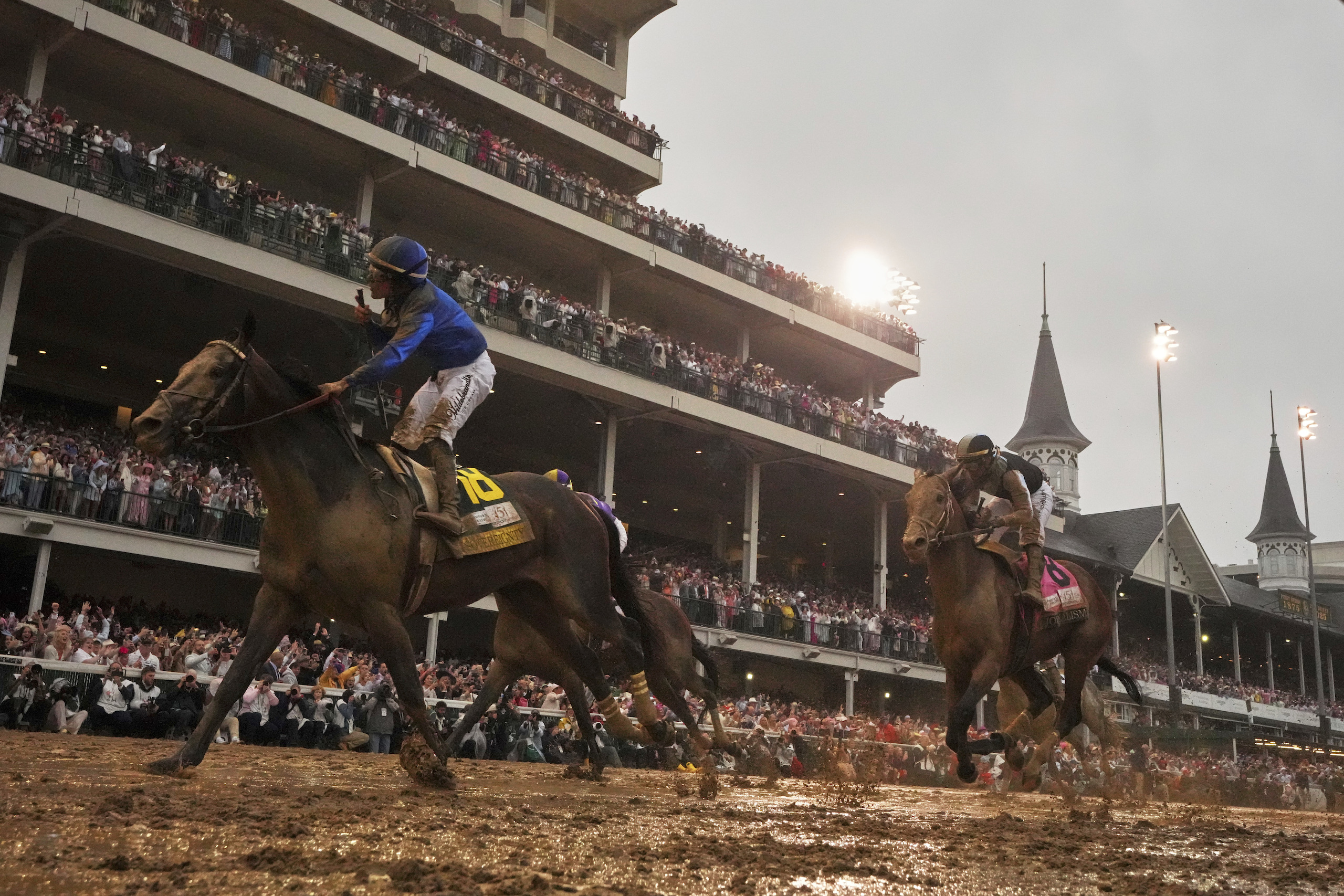
In the end, though, it was a horse named Sovereignty that won the race, in mucky conditions that further tortured an already absurd metaphor. Journalists agreed that this was a bad omen. Right-wing pundits—including, naturally, the defense secretary and deputy White House chief of staff—made hay. (The jockey being Venezuelan was, perhaps, lost on them.)
Trump himself, of course, did not need to wait for something as trivial as a horse race to try and make the metaphor literal—indeed, forty-eight or so hours before the derby was run, he did so in perhaps the most egregious way yet, issuing an executive order that called on the board of the Corporation for Public Broadcasting to defund NPR and PBS on the grounds that they are “biased and partisan” and taxpayers shouldn’t be expected to subsidize them. (The order also directed the Department of Health and Human Services to determine whether the broadcasters are complying with laws regarding discrimination in employment.) The following day, the White House put out a press release—headlined “President Trump Finally Ends the Madness of NPR, PBS”—that ticked off examples of coverage that ticked off the White House, including segments on furries, genderqueer dinosaur enthusiasts, and an interview with an author who ate a human placenta “osso bucco style.”
The order capped years of Trumpian threats to funding for public media: in his first term, he (unsuccessfully) urged Congress to cut it; since he returned to office, the Federal Communications Commission has begun investigating PBS’s and NPR’s commercial practices, and Trump allies have turned up the heat rhetorically, culminating in a congressional subcommittee hearing at which Republicans raked Katherine Maher, the CEO of NPR, and Paula Kerger, her counterpart at PBS, over the coals. As Liam Scott, who covered the hearing for CJR, noted at the time, NPR and PBS actually get relatively little money from the public purse—the figure for the former is only around 1 percent; the figure for the latter is significantly higher, at 16 percent—but the elimination of such funding would likely represent an existential threat for smaller stations around the country, especially in rural areas where the commercial media ecosystem has withered; NPR’s David Folkenflik noted last week that Trump’s order “appears to envision a continuation of federal subsidies for public radio and television stations” beyond NPR and PBS themselves, but that this seems hard to square with recent reporting that he plans to ask Congress to claw back funds that it already appropriated for all public broadcasting. The order wasn’t even Trump’s first concrete attack on the public media ecosystem last week: a few days earlier, he moved to fire three of the five members of the CPB’s board.
But not so fast, Sovereignty! The board members quickly sued over their removal, arguing that Trump did not have the legal authority to demand it. Folkenflik noted that even if the firings were to be approved, they would appear to deprive the CPB’s board of the quorum it needs to do things—like, for example, implement an executive order to defund NPR and PBS. And the order itself seems certain to get tied up in court. The text appears to preempt challenges based on viewpoint discrimination, which is unconstitutional (and was recently at issue in the Associated Press’s successful lawsuit over its exclusion from White House events)—“which viewpoints NPR and PBS promote does not matter,” the order states; “what does matter is that neither entity presents a fair, accurate, or unbiased portrayal of current events to taxpaying citizens”—and yet the accompanying press release suggests something very different. And crucially, the CPB is not an executive agency but a private entity that Congress established with explicit guarantees of independence. Kerger described the order as “blatantly unlawful,” Maher as an affront to the First Amendment. Yesterday, the two leaders appeared jointly on Face the Nation, the CBS Sunday show, and pressed their case. “We have never seen a circumstance like this,” Kerger said. “Obviously we’re going to be pushing back very hard, because what’s at risk are our stations, our public television, our public radio stations across the country.”
Of course, even if the order ultimately falls in court, it will surely cause confusion and chaos along the way, which seems to be at least part of the point of many of Trump’s actions since his return to office, including in the realm of media policy; his move to gut Voice of America and other overseas broadcasters, for example, has been hindered by adverse rulings asserting Congress’s ultimate authority over their funding, but that legal battle is ongoing and may have complicated plans for staffers at VOA to resume work this week, as CNN’s Brian Stelter reported over the weekend. At minimum, the fight is a distraction and a bad look; as Ira Glass, the host of the totemic public radio show This American Life, told The New Yorker’s E. Tammy Kim late last week, Trump’s order creates a “branding issue,” since “it’s not great to have the president saying your coverage is biased.” Still, the cases of VOA and NPR and PBS are not the same. (NPR’s and PBS’s may be more clear-cut, in some ways.) And the order can perhaps be seen not as a sign of Trumpian strength, but of weakness. The American Prospect’s David Dayen speculated last week that Trump might be going down the executive-order route because he’d failed to get sufficient numbers of congressional Republicans on board with the idea of clawing back funding that way. Reporting by Lisa Desjardins, of PBS, has suggested something similar, with lawmakers apparently expressing nerves to the White House about the prospect of cutting their local public stations.
As this nuanced picture began to unfold last week, the issues involved were put into global perspective: on Friday, Reporters Without Borders (RSF) published this year’s edition of its closely watched annual World Press Freedom Index, ahead of World Press Freedom Day, which fell on Saturday. The US fell to fifty-seventh on RSF’s index (out of a hundred and eighty countries and territories worldwide), a record-low ranking that the group attributed, in no small part, to the return of Trump and his moves against the AP, VOA, and so on. But this reflected not so much a precipitous decline as the acceleration of a more gradual one. (The US ranked fifty-fifth on the index last year, when Joe Biden was president.) Yet the country scored lowest not on RSF’s “political indicator” but on its economic one, a reflection of its “highly concentrated” media ownership and news owners’ general prioritization of profits over public interest journalism. (This flew in the face of yet another questionable claim in Trump’s CPB order: that “unlike in 1967, when the CPB was established, today the media landscape is filled with abundant, diverse, and innovative news options,” making public funding “outdated and unnecessary.”)
This finding tallied with RSF’s key broader takeaway from its research, which focused on “economic fragility” as an “insidious problem” responsible for dragging global press freedom levels down to historical lows. “Much of this is due to ownership concentration, pressure from advertisers and financial backers, and public aid that is restricted, absent or allocated in an opaque manner,” the group wrote. “The data measured by the RSF Index’s economic indicator clearly shows that today’s news media are caught between preserving their editorial independence and ensuring their economic survival.” What the group described is, essentially, a dual threat, emanating both from private owners and from governments. These tracks intersect with one another: news outlets that are financially weak are easier prey for autocrats, as RSF also pointed out.
To return to a tortured analogy, Sovereignty and Publisher appeared to be beating Journalism on World Press Freedom Day. (What? Surely you didn’t think that I would resist the metaphor?) But this state of affairs isn’t inevitable. (RSF also made this point, in an article calling for a global “New Deal” for journalism.) In the real-life horse race, Sovereignty may have beaten Journalism, but Journalism handily beat Publisher, which came fourteenth, one place ahead of Citizen Bull, in fifteenth. In his article ahead of the race, Gerth, of the Courier Journal, quoted something that Citizen Bull (Trump—keep up!) told The Atlantic last week: that in his second term in office, he runs “the country and the world.” But this isn’t inevitable either. To cite one manifestation of a contrary trend, in recent days voters in Canada and Australia handed stinging defeats to parties led by Trump-inflected populists—both of whom, as it happens, had themselves made threats to public media in their respective countries—to the benefit of liberal incumbents. Elections elsewhere rarely revolve around US politics to the extent that US journalists would like to believe. But this time, Trump does seem to have been a major factor.
The results were, at least, surprising: a few months back, the energy appeared to be with the populists; in the end, those two leaders lost not only the overall election but their own seats as lawmakers. Last summer, as the US election entered its final stretch, Poynter’s Annie Aguiar asked journalists who cover horse racing (in the literal sense) how they perceive horse-race journalism (in the political sense) and whether they think the metaphor is apt. “My colleagues who I admire in politics should remember that the rule of thumb in horse racing is ‘nobody knows nothing,’” Joe Drape, a racing reporter at the Times, said. “You got opinions, you got information in front of you, you got speculation, but until the race is run, nobody knows who’s gonna win.” The same principle applies even after elections have run their course. Journalism may have lost, but journalism isn’t done yet.
Other notable stories:
- The Atlantic’s Helen Lewis has a sharp review of a series of briefings that Karoline Leavitt, the White House press secretary, held for right-wing influencers last week. The briefings answered the question: “What if you took the least appealing aspects of traditional broadcast journalism—the self-absorption, the ponderous delivery, the grandstanding—and sucked out any sense of conflict?” Lewis wrote. “Almost everything about the Trump presidency can be understood as a quid pro quo. In the case of the influencers, they are offered access to all the awesome scenery of the White House—the perfect backdrop for any viral video—and the heady sense of being insiders. In return, all they have to do is ask questions that would make a Soviet propagandist blush.” (ICYMI, Aida Alami profiled Leavitt for CJR last week.)
- Earlier this year, it was reported that Hearst was in advanced talks to buy the Santa Rosa Press Democrat, a locally owned newspaper in California—but last week, a publisher owned by the cost-slashing financial firm Alden Global Capital acquired the paper and its sister titles instead; according to KQED, the development “stunned” the Press Democrat’s newsroom. In other local-news news out of California, the LA Times laid off fourteen staffers late last week, according to the paper’s union—the third round of job cuts in as many years. And a significant collection of digitized newspapers housed at the University of California, Riverside, could be forced to shut down due to a sudden shortfall in state funding. SFGate has more details.
- For his media newsletter, Status, Oliver Darcy spoke with Tina Brown, the former editor of Vanity Fair and The New Yorker. Among other topics, including the dangers of this political moment and her pivot to posting on Substack, Brown weighed in on Vanity Fair’s search for a new editor after Radhika Jones stepped back from the post, backing potential contenders including the tech journalist Kara Swisher, New York’s David Haskell, and The Ankler’s Janice Min. Speaking with Semafor, Min said that she doesn’t want the job and mentioned a different name—Brown’s. But Brown doesn’t seem keen either. (“Oh please!” she told Semafor in a text. “Never go back!”)
- CJR’s Feven Merid profiles Kismet, a literary magazine that aims to explore “spirituality, religion, and mysticism for seekers and skeptics alike.” Samuel Rutter, the editor in chief, and Alec Gewirtz, the publisher, envision Kismet as “an outlet for engaging with spirituality beyond the confines of how it has traditionally been defined by conservatives,” even if conservatives might agree with some of its foundational premises, Merid writes. “We think it would be a big mistake if the left reacts to how the right has appropriated spirituality by rejecting spirituality altogether,” Gewirtz said.
- And to mark World Press Freedom Day, the band REM reissued its 1981 hit “Radio Free Europe” as a gesture of support to its namesake broadcaster, Radio Free Europe/Radio Liberty, which Trump is trying to gut (alongside VOA). All proceeds will go to RFE/RL. “We love journalism. We love freedom of speech. And we love the world,” Michael Stipe, REM’s frontman, said, adding that “it’s important to democracy and important in the fight against authoritarianism” that RFE/RL survive.
Has America ever needed a media defender more than now? Help us by joining CJR today.