Sign up for the daily CJR newsletter.
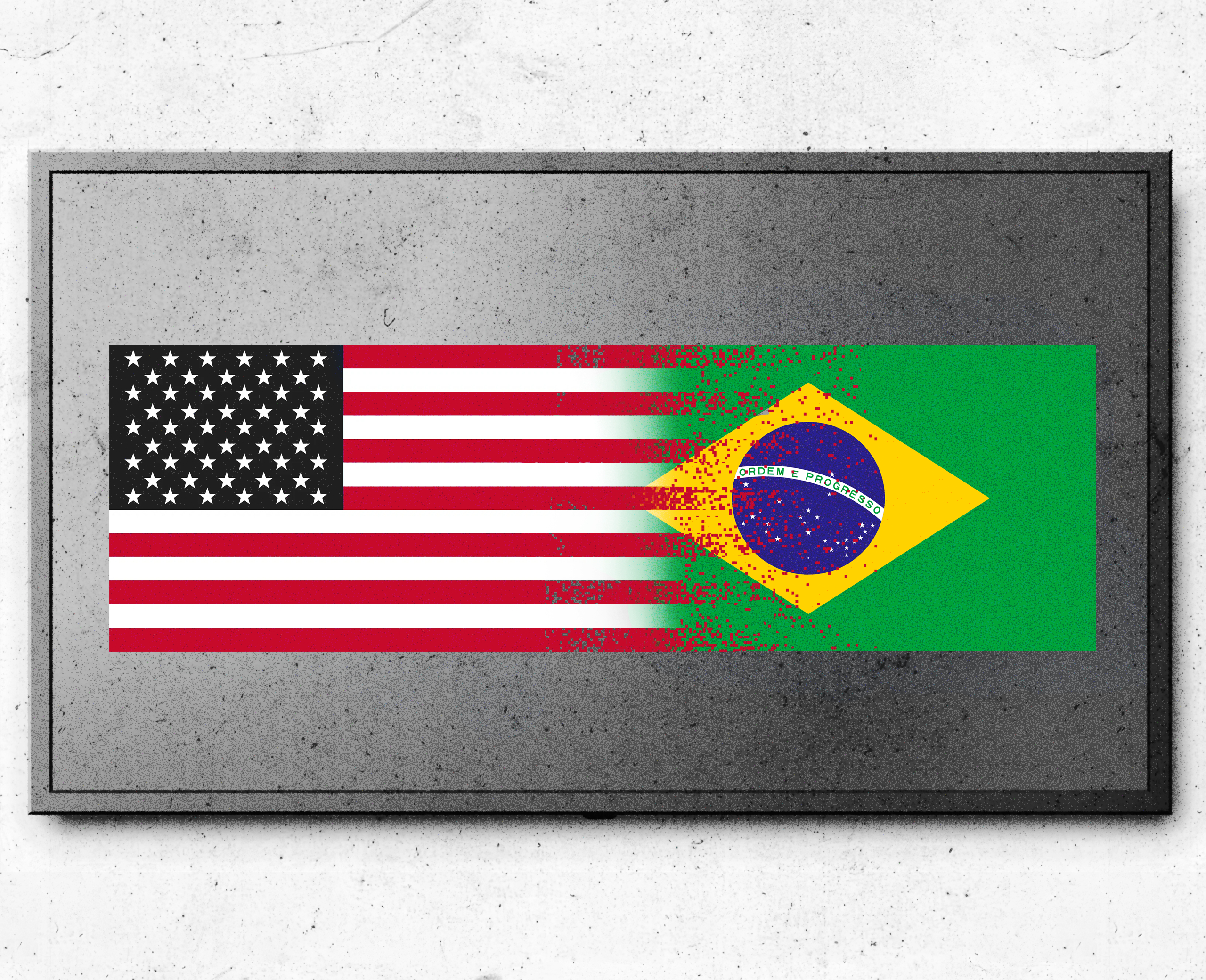
On a recent evening, Mike Benz, who was a State Department official during the first Trump administration, gathered with Catalina Stubbe, a former Miss World Colombia who is now the director of Hispanic outreach for Moms for Liberty; representatives from Turning Point USA; and other right-wing influencers in Miami for the screening of a documentary, God Complex: The Rise of America’s Censorship Machine. The film—which features talking heads including Benz; Jan Jekielek, a senior editor for the Epoch Times; and Chanel Rion, a host on One America News Network, the right-wing channel—revolves around a premise that “vast networks built over decades” are silencing dissent in the American political system. Though it is a movie about the United States, made largely for an American audience (promotional images depict the Statue of Liberty with a piece of red cloth tied around her mouth), the film can be traced thousands of miles away, to Brazil.
God Complex is the brainchild of Brasil Paralelo, Portuguese for “Parallel Brazil,” a production company and streaming service that Folha de S.Paulo, the Brazilian newspaper, once described as aiming to be the “Netflix of the right.” The premiere and a subsequent event in Washington, DC, marked the beginning of the firm’s expansion into the US market, where it has rebranded as Big Picture Originals. “We use the force of cinema to give life to the ideas that matter,” Lucas Ferrugem, one of Big Picture Originals’ cofounders, said in a speech at the beginning of the big night in Miami. “We produce with the techniques of cinema, but the soul of education.”
The company’s idea of education revolves around certain values: “The family, private property, anti-communism,” Fabio Zanini—the politics editor at Folha de S.Paulo, and one of the first journalists to cover Brasil Paralelo for a national publication—said. “Judeo-Christian culture, the defense of guns, anti-abortion—all of these cultural and behavioral questions. And in terms of economics, it’s the defense of economic liberalism, though that was more in the beginning. I think today their mission is more focused on cultural matters.” Films, which range from short clips to feature-length productions, cover a range of topics: there’s John Money, a documentary about a psychologist described as the “father of gender theory”; From the River to the Sea: The War in Israel; and Cortina de Fumaça (Smoke Screen), which traces “the political manipulation behind the fires in the Amazon.” The company is also known for its coverage of the coronavirus pandemic, for which it was later cited in a congressional inquiry into the Brazilian government’s handling of COVID-19. “They have an anti-media stance,” João Batista Jr., who has written about Brasil Paralelo for a magazine called Piauí, said of the company’s productions, which he sees as geared toward “people who don’t trust the press.”
Brasil Paralelo posts videos, short courses, and podcasts on YouTube, to more than 4.7 million subscribers, and on a proprietary streaming service for which more than 790,000 people are signed up. On the Brasil Paralelo site, you can find original films alongside major productions, like David Fincher’s The Girl with the Dragon Tattoo. The company states that it is mainly subscriber-supported and that it doesn’t receive money from political parties or politicians. Even so, its story has in many ways been entwined with the rise of conservatism in Brazil, according to Giovanni Franchischelli, a graduate teaching fellow at the University of Oregon who has been researching Brasil Paralelo. Around 2016, when Jair Bolsonaro, the far-right politician and future president, was gaining in prominence, “a lot of media companies emerged,” Franchischelli said, positioning themselves as alternatives to mainstream channels and surfing “a wave of Bolsonarismo.” Since then, according to a study by Quid, a progressive nonprofit, based on figures from Meta’s ad library, Brasil Paralelo has been among Brazil’s largest spenders on political and social Meta ads—between 2020 and 2024, the company shelled out 5.4 million dollars. (When Folha de S.Paulo covered the study, a representative for Brasil Paralelo said that the company is “rigorous in our pursuit of truth” and that the nonprofit behind the study was biased; Brasil Paralelo did not respond to my request for comment on this.)
“They often say that they don’t receive any state funds, the way a lot of film productions in Brazil do, but something in the math isn’t transparent and isn’t adding up,” Franchischelli said. “They take pride in not receiving government money, and they say their money comes from private supporters, but it’s not clear who their supporters are. They could be people, or think tanks, or relevant groups.” (Streaming-service subscribers pay ten Brazilian reais, or the equivalent of a couple of bucks a month. The option to subscribe to slightly more expensive “select” and “premium” plans is also available.) “They are not Bolsonaristas in the sense that they don’t make political propaganda for Bolsonaro and his allies,” Zanini said. “But it’s evident they have shared interests.”
The right is no longer in power in Brazil. In September, when the country’s Supreme Court found Bolsonaro guilty of plotting a military coup, he was sentenced to twenty-seven years and three months in prison. Brasil Paralelo responded to these developments by “becoming more like a formal media organization,” Franchischelli said. Unbylined articles and short videos on Brasil Paralelo’s website tackle current events: Bolsonaro’s arrest; the story of a student who, according to the website, “failed a test” because she “cited the Bible and criticized gender ideology”; the story of a family who escaped North Korea. “Who is Nayib Bukele? The president who made El Salvador one of the safest countries in the West,” a headline reads.
Unveiling Big Picture Originals in the US when Trump is in power allows Brasil Paralelo to court a similar audience to the one it has cultivated at home. “BP’s content has been reaching international audiences for a while now. People from other countries are consuming our films more and more with each passing year,” Henrique Viana—one of the company’s cofounders, who leads the Big Picture Originals project—told me. “Big Picture is a way for us to provide for and pay greater attention to a public that was already consuming our content.”
Viana, who directed God Complex, said the film was “well received.” How the company ultimately fares in the US will depend on whether new audiences continue to subscribe. The documentary ends with a montage that includes an image of an American flag flying atop a building, overlaid with a Charlie Kirk quote; praise for Trump; and an offer from one of the company’s cofounders, Filipe Valerim: “If you believe culture should not belong only to those who despise the values that built the West, become a founding member for three hundred ninety-nine dollars.”
Has America ever needed a media defender more than now? Help us by joining CJR today.