Sign up for the daily CJR newsletter.
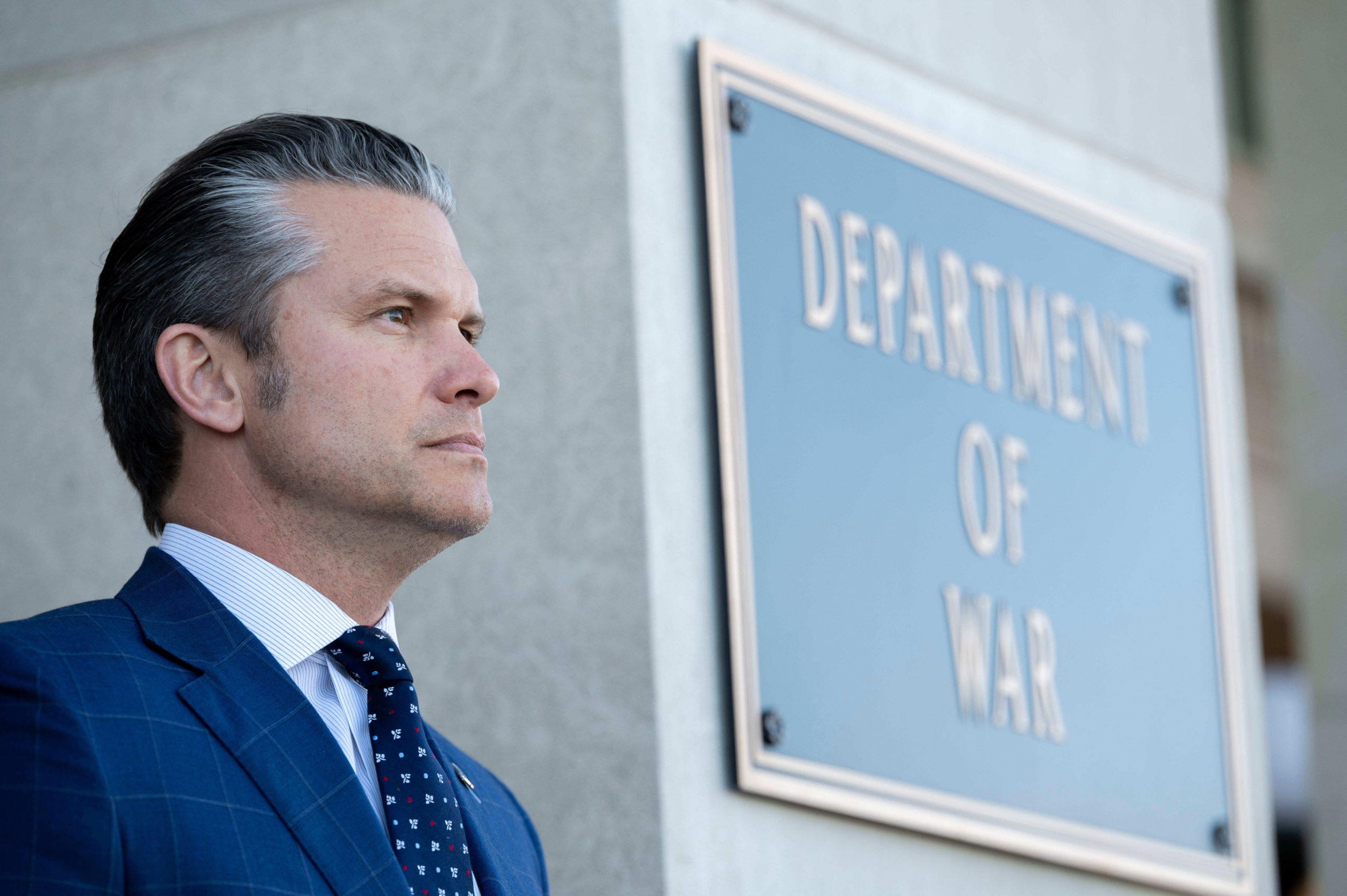
On Monday, two days after the United States attacked Iran, Pete Hegseth, the secretary of defense—or war, as he says—and Dan Caine, the chairman of the Joint Chiefs of Staff, held a press conference in the Pentagon. It was only the fifth briefing in the building under the current administration, and the second since October, when Hegseth handed down reporting guidelines that barred credentialed Pentagon journalists from issuing callouts for national security tips or otherwise “soliciting information” not authorized for release, essentially banning routine newsgathering practices in return for a pass to access the building. Nearly every member of the Pentagon press corps refused to sign on to the new rules, leading to their exodus. They have since been replaced by a handpicked group of loyalists.
Hegseth and Caine spoke for twenty-nine minutes, then opened the floor for questions. From the seat once reserved for the Associated Press, Alexandra Ingersoll of One America News, a pro-MAGA network, asked about Iran’s capabilities and the US exit strategy—questions that Hegseth deflected. Next came the Daily Caller, an outlet founded by Tucker Carlson. In the first few rows of the briefing room, MAGA-friendly reporters passed the microphone to one another for a total of thirteen minutes before Hegseth and Caine left the stage. (Kingsley Wilson, the Pentagon press secretary, denied that Hegseth had chosen the questioners in advance.)
Some of the national security correspondents who left in October even showed up, though none were allowed near a microphone. “The Pentagon sent out an invite to the briefing on Sunday to all the new media. We all got wind of it, so we emailed and asked to attend,” a reporter for a trade publication, who asked not to be named because they feared reprisals from the Pentagon, told me. Dozens of reporters got visitor passes, and Courtney Kube of NBC News shouted a question about Donald Trump’s claims that the military operation could take up to five weeks. Hegseth took the bait, calling it a “typical NBC gotcha-type question,” but didn’t give an answer.
“He doesn’t feel like he owes the American public any explanation for what they are doing,” the trade publication reporter said, adding that Hegseth seemed unprepared to engage even with the new pro-Trump press corps. “While in the first half Caine spoke about mourning those who died in the operation, Hegseth just went on with partisan bullshit. A good staffer would’ve told him that you always start with your troops.”
Monday was a snapshot of the new normal in the Pentagon, which will face a legal challenge this Friday, as oral hearings begin in the New York Times’ lawsuit alleging that Hegseth’s move to oust journalists from the building was unconstitutional.
In December, the Times sued the Defense Department, Hegseth, and Sean Parnell, the department’s chief spokesman, arguing that the reporting guidelines violate the First Amendment by giving the department “unbridled discretion” over credentialing, allowing officials to discriminate against journalists based on their perceived political views. Pentagon officials celebrated the departure of mainstream media outlets and called them “propagandists,” the suit notes, then welcomed Laura Loomer, who refers to herself as “President Trump’s chief loyalty enforcer,” and Lindell Media, whose CEO, MyPillow guy Mike Lindell, promised to make the administration “proud” with its coverage. The Pentagon said the new press corps was “better equipped to inform a broader swath of the American public about what goes on inside the department” than were the previously credentialed reporters, even as the Pentagon failed to impose its own guidelines on the new reporters, saying that a tip line opened by Loomer was “constitutionally permissible” but a similar callout from the Washington Post was not. And when James O’Keefe, the Project Veritas founder, who had recently received a Pentagon press pass, admitted to recording an official’s unguarded statements, Wilson praised his work even though it appeared to violate Defense Department reporting rules, according to the lawsuit.
The restrictions “set a bad precedent that could be embraced by other parts of the government,” A.G. Sulzberger, the chairman of the New York Times Company, told the Times, calling the move to replace independent journalism with propaganda “a disservice to the American people.”
In response, the Pentagon defended its credentialing, asserting that the policy is needed to protect national security. According to its motion for summary judgment, after reporting guidelines were revised in September, the Defense Department corresponded with press advocacy groups and addressed multiple concerns, and those talks were reflected in the rules that took effect in October. When I reached out for further comment, a Pentagon official responded via email: “As a matter of longstanding policy, the Department does not comment on ongoing litigation.”
Jane Kirtley, a professor of media law at the University of Minnesota, told me that the Times’ allegations of “viewpoint discrimination” constituted the strongest part of its case. “It is evidenced by who has been granted” a Pentagon press badge since the new rules took effect, Kirtley said. “The vast majority are MAGA-friendly groups, and that tells me that this is not a viewpoint-neutral rule.” Kirtley also pointed to the importance of the Pentagon’s eighty-year tradition of press access: “When the court looks at questions about rights of access to government, they look at what historically has been the practice—and the Pentagon has not made a clear case about national security that would justify these kinds of restraints.”
Other experts noted that the Pentagon’s actions after the journalists’ walkout last fall may have weakened its position. “I think the policy itself is plainly unconstitutional, but—like in many other cases involving the Trump administration—what they say after the fact makes their arguments even worse,” Trevor Timm, the executive director of the Freedom of the Press Foundation, said. “They basically admitted that they don’t care if people break this as long as they agree with them.”
The Times’ suit also alleges violations of journalists’ Fifth Amendment rights, claiming that the reporting rules are overly vague and don’t provide due process if access is revoked. “The Times’ approach is smart, because a judge doesn’t have to even rule on the content-discrimination issues,” Carey Shenkman, a First Amendment lawyer, told me. “The Times is giving the judge an opportunity to only rule on the procedural point, which is just as strong, maybe even stronger: that the Pentagon implemented this policy without giving any rights or notice to the press corps, and there is no opportunity for the press to challenge a determination of revocation.”
Letitia James, New York’s attorney general; the Reporters Committee for Freedom of the Press; the American Civil Liberties Union; and the Pentagon Press Association (PPA) filed amicus briefs in support of the Times. If the newspaper wins, the PPA will seek to ensure that the relief extends to all previously credentialed members of the press corps, David Schulz, the PPA’s legal counsel and the director of the Media Freedom and Information Access Clinic at Yale Law School, told me.
But the damage may be irreversible. Several former Pentagon reporters told me that their outlets have gotten used to this new reality; that, for the first time in eight decades, covering the Defense Department is “a remote job.” While those without a Pentagon badge can technically still enter the building with a day pass, they must be accompanied by an escort at all times, and they may be asked to list the people they plan to interview, a condition many reporters understandably reject.
In the nearly five months since the press corps left the building, the United States has invaded Venezuela to capture President Nicolas Maduro and killed Ayatollah Ali Khamenei, Iran’s supreme leader, just hours into the US-Israeli bombing campaign. Journalists who used to roam the hallways felt the chill, explaining that in high-pressure moments like these, access to the Pentagon is crucial. “Is the senior military aide’s car still there? Are people in the Joint Staff hallway? Being present in the building gives you so much more information besides just people talking to you,” a former Pentagon reporter, who asked not to be named because their employer didn’t give them permission to speak to CJR, told me.
The new Pentagon press corps isn’t getting much clarity either. After a highly publicized “boot camp” in December, which celebrated Hegseth’s Pentagon as the “Most Transparent War Department in History,” the department held no press briefings until this week. Many of those who recently received Pentagon passes never intended to work from there in the first place, and the press corps’s bullpen is largely empty these days, the reporter for the trade publication told me. “It’s more about the absence of us than the presence of them,” they said.
While the Times’ lawsuit seeks to reinstate independent journalism inside the Pentagon, “even if it goes completely in favor of the Times, something’s been broken, and I doubt that it could be put back together,” the former Pentagon reporter who didn’t have their employer’s permission to speak to the press told me. “I don’t believe that the folks who orchestrated these policies to remove the press would eagerly welcome us back under a court order.”
Has America ever needed a media defender more than now? Help us by joining CJR today.