Sign up for the daily CJR newsletter.
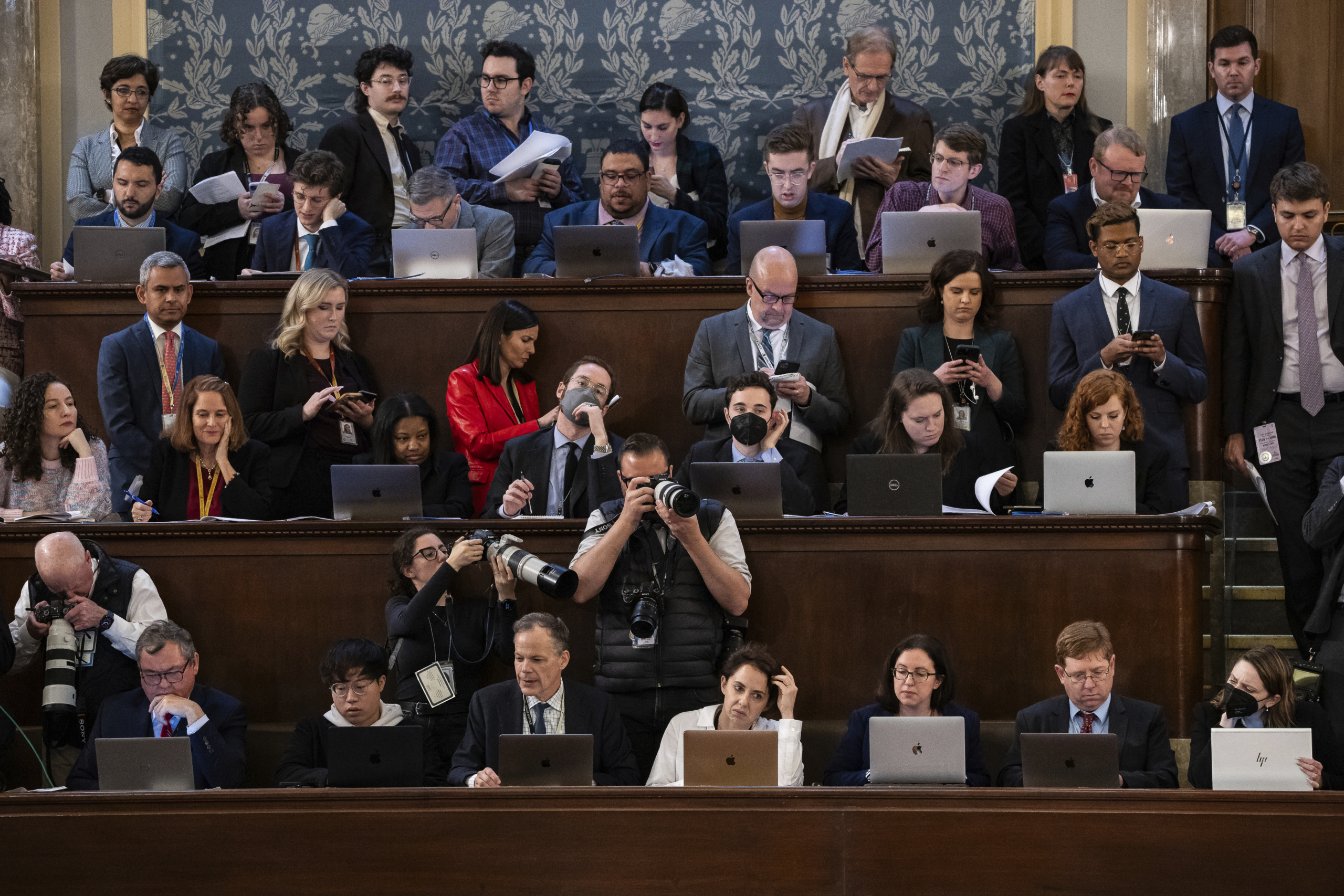
Last Tuesday evening, Tyler Kirwan put on his blue suit and knotted his red tie. He was heading to the US Capitol Building to cover Donald Trump’s State of the Union address, for which he had been studying photos of the Missouri delegation “to make sure I had their faces locked.” Kirwan, a twenty-one-year-old senior studying journalism at the University of Missouri, was reporting for the Columbia Missourian, which serves the state’s fourth-most-populous city. Kirwan’s assignment: documenting events inside the House chamber to capture the details his peers watching the address on TV outside couldn’t see.
From his perch in the press gallery, Kirwan was an anomaly—both as a college student and as a reporter covering national politics for a regional publication. About two decades ago, hundreds of regional reporters worked the Hill beat, chasing down lawmakers and competing for scoops. Now the Regional Reporters Association has only about sixty members.
The dwindling number means there are far fewer reporters scrutinizing elected officials in Washington and putting national politics into a local context for audiences hundreds or thousands of miles away, according to Nick Grube, a member of the board of the Regional Reporters Association and the Washington correspondent for the Honolulu Civil Beat. “As politics are becoming more nationalized and tribal, regional reporters are able to break through that noise and cover Washington from a local perspective,” he told me.
The fall of the regional reporter is a lesser-known consequence of the hardships facing the local news industry. Decades ago, the St. Louis Post-Dispatch had a sizable bureau in Washington, with about a dozen staffers. Now it has none. In January, Missouri lost its last Washington reporter, who worked for the Kansas City Star.
Enter Kirwan and three of his peers from Missouri. This semester, the school started a program allowing students to live in Washington and report on the Missouri delegation for publications affiliated with the university. The Columbia Missourian is an independent nonprofit publication, though it’s staffed by more than two hundred journalism students and edited by professors. “We’re learning Washington political reporting by just jumping in the pool,” Fletcher Mantooth, a twenty-two-year-old senior and program participant, told me.
Kathy Kiely, a Missouri School of Journalism professor, teaches a seminar for the Washington students and serves as their editor. “There’s an opportunity for our students in Washington to fill the gap—and it’s gaping,” she said. “I’m trying to make lemonade here,” she added. “Do I wish it weren’t necessary? Yes. But any journalism is better than no journalism.”
The students spend much of their time attending committee hearings, tracking down Missouri lawmakers in the hallways of the Capitol Building, and hounding press secretaries for comment. “I realized you have to bug them. You have to call. You have to email them at least two to three times before they answer you,” Kalli Fowler, a twenty-year-old junior, said. The day after US Immigration and Customs Enforcement agents killed Alex Pretti in Minnesota, Molly Gibbs, a twenty-one-year-old senior, found herself in a press gaggle with Josh Hawley, the senior Republican senator from Missouri. She asked him how he would feel about an ICE presence in Missouri similar to that in Minnesota. “As scary as it is to ask somebody like that a question, it’s also scary to go back to your editor and be like, ‘I didn’t ask the question,’” Gibbs said. “Maybe I embarrass myself a little bit and shake or ask the wrong question, but I would rather do that than not try at all.”
Back in the House chamber, Trump’s speech finished just before 11pm. Kirwan and his colleagues convened just outside the chamber, where Mantooth managed to ask Eric Schmitt, the junior senator from Missouri, for his thoughts on the address. “I’ve seen a lot of President Trump’s speeches. I thought it was one of his best,” Schmitt said. The trio then got to work finishing their story. “We’re in America 250 now,” they quoted Schmitt saying.
After filing their article, they wandered around the building, looking for an exit that wasn’t closed off. They finally managed to leave shortly after one in the morning. Gibbs ordered burritos. “I was very tired,” Mantooth said. “I got home, ate my Taco Bell, and fell asleep.”
Correction: This story has been updated to amend a spelling error.
Has America ever needed a media defender more than now? Help us by joining CJR today.