Sign up for the daily CJR newsletter.
I’ve been a freelance photojournalist for two decades, which means I’ve watched multiple crises rock the industry. First it was the rise of smartphone cameras in 2007 (everyone will take their own photographs, we’ll lose our jobs!), then Instagram in 2010 (everyone will publish their own photographs, we’ll lose our jobs!), and so on. But I’ve remained an optimist. When the Wall Street Journal launched a metro section, in 2010, I joined its cohort of contract photographers and felt like I had made it, running to cover the Occupy Wall Street protests and New York Fashion Week and to take (many) portraits of Fortune 500 CEOs.
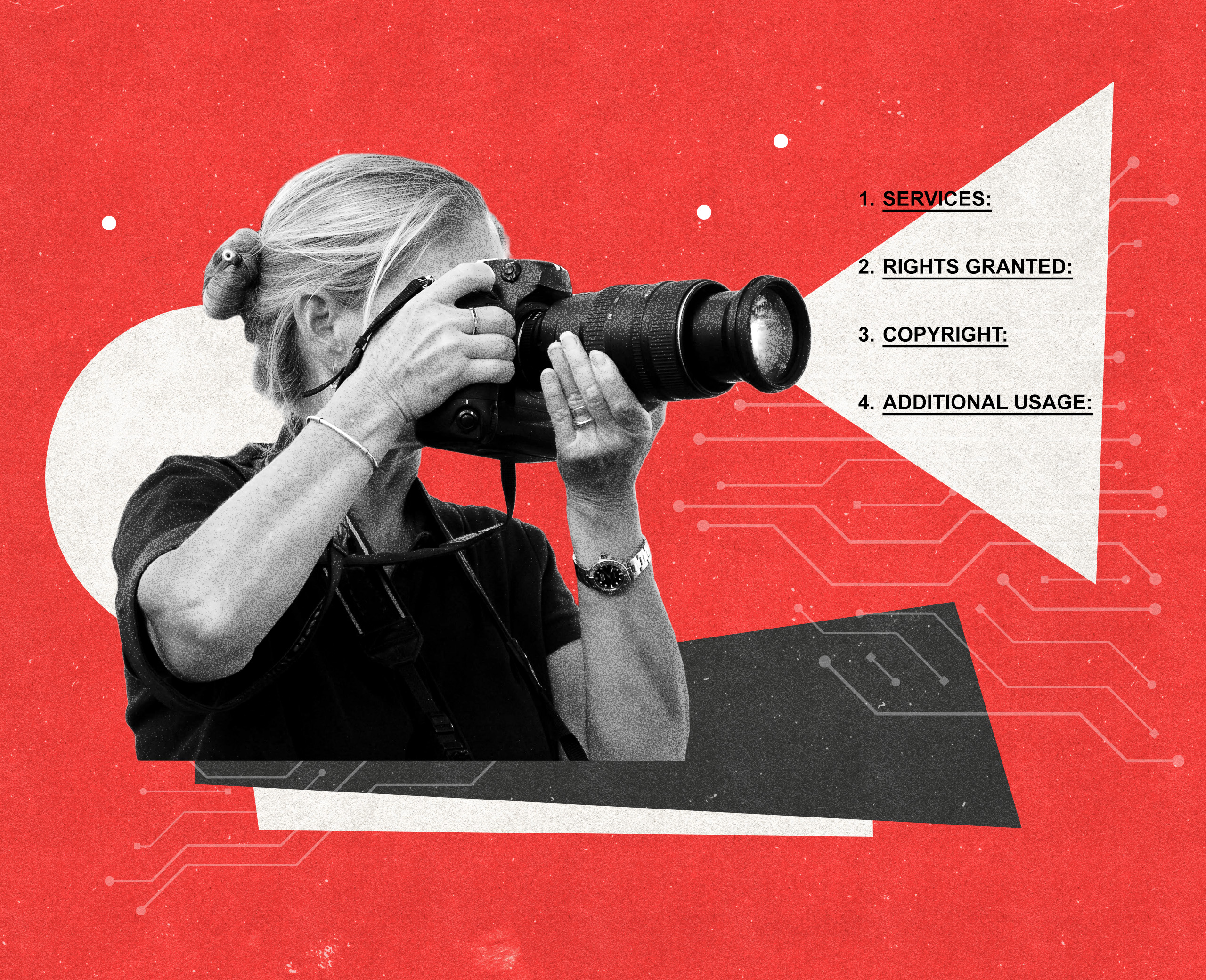
But last November, the Journal told its freelance photojournalists about a new version of the standard contractor agreement. Two elements caused widespread alarm among current and former contributors, including me: a change in the ownership terms for images produced on assignment, and language that allowed the Journal to sublicense images with no restrictions—and no exclusion for companies developing AI technologies. For the first time in twenty years, I thought: Oh, shit. We’re going to lose our jobs.
Soon after, a group called Your Visual Colleagues sprang up, run by four regular Journal freelancers who anonymously detailed their fears about the contract and asked the Journal to reconsider. In the six months since they started their campaign, six hundred and fifty freelance photographers who work with the Journal have signed on—myself included. It is perhaps the most unified and the most angry I have ever seen the photojournalism community—and may be a bellwether for the visual-media industry.
A Journal spokesperson told me that the adjustments to the contract were “essential for protecting the integrity of the Wall Street Journal’s online archive and ensuring the historical permanence of these important photos that we commissioned.” But photographers have bristled at this argument, saying that the changes present a blow to their business model. At almost every major newspaper and magazine in the United States, photographs produced by freelancers remain the sole intellectual property of their creator. The new contract would assign the Journal primary authorship of all photographs produced on assignment through what’s known as a Work for Hire clause, giving the Journal unprecedented control.
The Journal, which has negotiated with its contributors for more than six months, has made some concessions, including raising the day rate. A Journal spokesperson disputed the impact of the changes and said that, although work under the new contract would be owned by the paper, the Journal will immediately assign a joint copyright back to photographers, and so “this model still fully enables photographers to participate in the financial market for their work. They retain the ability to license photos to others after a shortened ten-day exclusivity period, and we are committed—as we have long been—to directing third parties seeking stand-alone licenses directly to them.”
For the Journal photographers I spoke with, this is not enough assurance. “The whole trade-off when I got into this business is: if you’re going to be freelance, you’re going to own your work outright,” Brian Frank, a California-based photographer, told me. Frank has worked for the Journal regularly since 2008, more or less since the introduction of photography to the paper, and has routinely licensed images from his Journal work for three to five thousand dollars. “Now they want to own the work and we don’t get job security,” he said. “It’s complete insanity.”
Mickey Osterreicher, the general counsel for the National Press Photographers Association (NPPA), which is also pushing back against the contract, said that “photographers should be asking whether those protections are contractual and enforceable or simply a matter of current practice that could change over time.” The half dozen Journal photographers I spoke with noted that photo editors at the Journal have made similar promises, and yet they all were wary of how easily this handshake agreement could be forgotten.
It’s worth noting that the new contract’s ownership language opens the door for the Journal to provide tech companies with a vast catalogue of photographs to use in AI training. This fear is grounded in the fact that, in May of 2024, the Journal’s owner, News Corp, inked a deal with OpenAI that could be worth as much as two hundred and fifty million dollars, in which “OpenAI would use content from News Corp’s consumer-facing news publications, including archives, to answer users’ queries and train its technology.”
News photographers are often responsible for photographing people who are at risk or who need to remain anonymous for their safety. Frank, whose work regularly involves documenting the lives of immigrant communities and other vulnerable populations, was particularly concerned about storage of his outtakes—images that are submitted to an editor but never published. Typically, a photo editor reviews those carefully to make sure vulnerable sources can’t be identified by visual elements like street addresses and name tags. Would outtakes become part of an LLM’s training set? Frank said he went directly to Journal management to ask some of these questions, and was told “we don’t know.” The Journal spokesperson did not respond to a question about whether photos would be shared with OpenAI or whether any measures would be taken to safeguard vulnerable sources.
Annie Flanagan, a New Orleans–based photographer who has worked for the Journal sporadically for the past decade, said that the Journal reached out four times since the introduction of the new contract—including a multiday assignment covering a Bitcoin convention in May. “Any multiday assignment right now is really exciting, because they’re few and far between,” Flanagan told me. “I said no because what I was being told by editors did not match what was in the contract, and the reassurances I was getting were only verbal. It’s hard for me to wrap my mind around the potential of AI—but it wasn’t clear in the contract where the end was or where the use of our images ends.”
But the furious organizing coming from Your Visual Colleagues and the NPPA isn’t just about the Journal—it’s about awareness that, like other journalists who have organized around similar concerns surrounding intellectual property and AI, the moment demands that freelance photographers either take a stand or be complicit in the demise of our livelihood.
“At the end of the day,” Osterreicher said, “I think the debate is less about any single provision and more about a fundamental question: Who controls the future use of journalistic work, and who benefits from that use? That is a conversation that extends well beyond the Wall Street Journal and one that is likely to become increasingly important as technology continues to evolve.”
Has America ever needed a media defender more than now? Help us by joining CJR today.