

Sign up for the daily CJR newsletter.
This week, we’re delighted to welcome Bill Grueskin back into the regular column rotation.

Friends, readers, countrymen: I come today not to bury Newsmax, but to praise it.
Yes, I suspect that many of you don’t share Newsmax’s right-wing slant on the news. Yes, I know the company had to pay more than a hundred million dollars to settle two lawsuits over its conspiracy-fueled coverage of the 2020 election. Yes, I realize that Chris Ruddy, the network’s founder and CEO, once said this about Trump: “We have an editorial policy of being supportive of the president and his policies.”
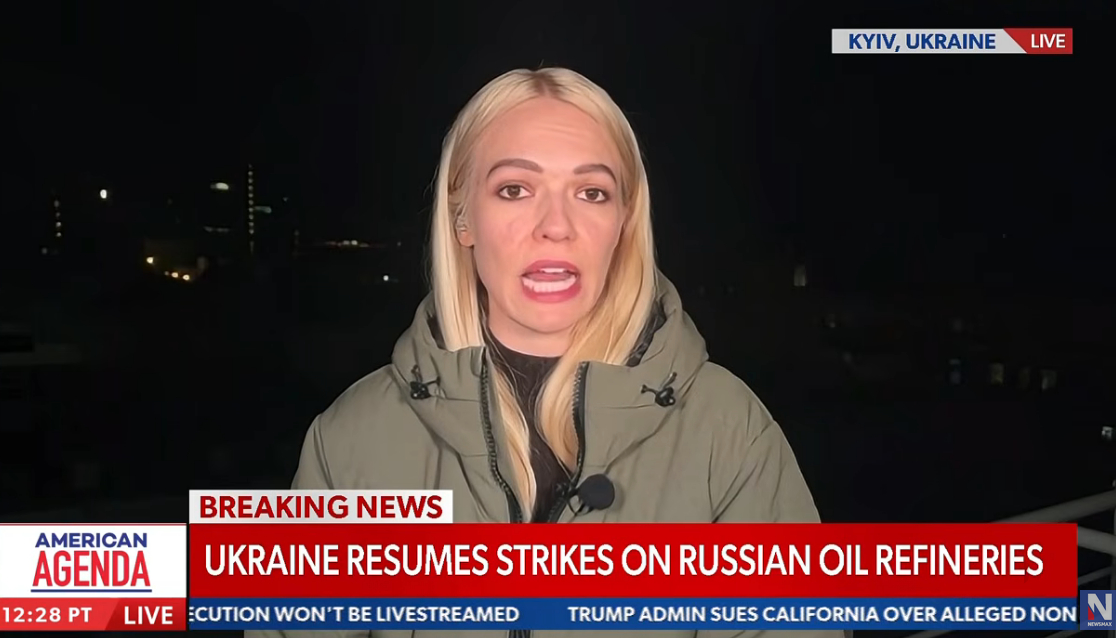
But put all of that aside for a moment, and look at how the network covers the Ukraine-Russia war. In particular, you should watch how Shelby Wilder, a Newsmax foreign correspondent, has delivered vivid coverage of the conflict to an audience in and around the MAGAverse.
She met with a Ukrainian teenager who told the story of how Russian captors abducted him after a bombing. She posed a tough, detailed question to Jared Kushner when Trump’s envoy was in Kyiv last month. She covered Russian prisoners of war explaining how they wound up in such dire circumstances. She has interviewed Volodymyr Zelensky, the president of Ukraine, multiple times.
She has been broadcasting these stories on Newsmax against the backdrop of Donald Trump shredding support for Zelensky—particularly in recent days, by allowing Russia to export diesel and evade sanctions approved by Congress, while standing by as Elon Musk throttles the network that speeds Ukraine’s drones. Whether out of temerity or mendacity, Trump said this on Monday: “Russia, frankly, has been fine on Ukraine. They haven’t been doing much.”
Into the maelstrom several days ago stepped Wilder, during a Newsmax panel. A heated exchange began when Christian Whiton, a conservative commentator, blasted Ukrainians, saying “they’re corrupt, they’re incompetent, they’re ingrateful [sic].” He added, “Frankly, I’m surprised President Trump has kept at it as long as he has in supporting Zelensky.”
Wilder would have none of this. When an anchor threw to her, she didn’t hold back: “I think at this point the question is: What side are you on? Are you on Ukraine’s side? Or are you on Russia’s side?”
Then the anchor asked Wilder what the war is like these days on the ground. Her response is worth quoting in full:
This is the most deadly time for civilians since the war began. I want you to know that under the Trump administration, we have only seen the death toll rise. I am in Kyiv. This is now a frontline city. We are under attack constantly, twenty-four-seven. The question is now, with regards to sharing intelligence, do you want to save Ukrainian civilian lives, or would you rather hinder and kneecap what’s supposed to be your ally in its fight for survival against Russia? That’s simply what it comes down to now.
It is a dire time here. Russia is hitting hospitals, schools. They are hitting universities. They are hitting the bridges, the highways. This is not “military targets.” These are civilian targets, and Putin is throwing everything he has now at this country to make them pay.
“We appreciate your courage,” the anchor told Wilder. Given that she is speaking to an audience so closely tethered to Trump, an audience that might not be receptive to learning the truth about Ukraine, we appreciate it as well.
Typically, I’d move on to my next laurel or dart, but I’ll make an exception here. On Tuesday, I reached out to Wilder, who is thirty-four, with a few questions. A few hours later, while she could hear explosions in the distance, she wrote back to me. This slightly condensed and edited version of our Q&A is worth your time:
BG: How long have you been covering the Ukraine war?
SW: Since the start of the full-scale invasion. I knew no one here, but after watching the invasion unfold in horror from my home in New York City, I was determined to document the war firsthand.
I came to Ukraine as a freelance journalist in the opening months, without medical insurance, press accreditation, or a media outlet sending me on assignment. None of the outlets I approached, including those I’d previously worked with, were willing to take the risk of backing me. I crossed into Ukraine on foot from Poland, carrying my own body armor, and headed straight to Kyiv.
To those who might call this reckless, I would point out that everywhere I report, even near the front lines, children are never far away. It’s civilians, especially children, who so often pay the highest price in war. And that has always been one of the reasons I do what I do.
This summer I moved my full-time base to Kyiv. Before that, I typically spent six to eight months a year in Ukraine.
How long have you been with Newsmax?
I joined Newsmax full-time in July of 2023 as a foreign correspondent. I work exclusively for the network, leading its coverage of the Russia-Ukraine war. Before that, I covered the war for a number of international media outlets as a freelancer, across the political spectrum, working in radio, television, and print.
How do you weigh the costs and benefits of being in-country, for you and your colleagues?
Writing this from my desk, I can hear loud explosions repeatedly rocking Kyiv as Russian jet-powered drones attack the city.
I made the choice to be here, when I first came to Ukraine and now. And I genuinely believe my work matters and that documenting this war is important. I don’t say this to portray myself as a martyr. It’s what journalists do. But that belief keeps me going, along with the privilege of meeting people who entrust me with their stories.
As for my team, day-to-day operations are largely just me. I produce, shoot, edit, and report live. I’m also my own security adviser, travel agent, and everything else in between.
When I’m filming a news package in the field or conducting interviews, I work with a small Ukrainian team, usually my camera operator and, when needed, a driver or fixer. We discuss the stories I want to pursue, assess the risks, and make calculated decisions. My Ukrainian colleagues are less hesitant than I am. But I worry about their safety more than anything else. My driver, Denys, has children. My camera operator, Katya, has a husband. I’m acutely aware that they have families waiting for them, and I feel an enormous responsibility to make sure they get home safely.
Given Trump’s position on Ukraine, especially of late, and given that Newsmax’s audience leans toward favoring him, how do you see your role at Newsmax?
My role is to report on what’s unfolding here and explain what decisions made in Washington actually mean for the people living through this war: how those decisions affect their lives, what Ukrainians are experiencing, and what they want the world to understand.
Unfortunately, so much gets lost in the coverage of war. As the conflict grinds on, news fatigue sets in, mis- and disinformation run rampant, politics takes precedence over civilian lives, and crucial historical context is often overlooked. (To be clear, I’m speaking about the media more broadly.)
I’m here to help bridge the gap between the realities on the ground and viewers back home, whether they agree with what I report or not.

The saying goes, “It’s not the crime, it’s the cover-up.” Or as we might revise it for the social media era: It’s not the tweet, it’s the follow-up.
You may already be aware of the town hall last weekend in Caro, Michigan, where a young man named Tommy asked Abdul El-Sayed, the Democratic candidate for the US Senate, “I have one simple question: Will you disavow the Muslim Brotherhood?” El-Sayed responded, “Sure, yeah, absolutely,” and then went on to invoke the Constitution and Americans’ right to worship as they please. After a few minutes of this, the young lad slunk out of the room like a Dunkin’ customer mad that the manager wouldn’t give him a refund for his stale strawberry-sprinkle donut. (It also turns out that Tommy was not exactly an undecided voter, as Marisa Kabas ably explained here.)
For reasons known only to her, Jan Crawford, the chief legal correspondent for CBS, thought she should weigh in on X with a hearty endorsement of the questioner: “Tommy, thank you. I had to watch this twice to catch Dr. Abdul El-Sayed’s nanosecond, ‘yeah, absolutely,’ response. His subsequent uninterrupted three-minute diatribe proving your exact point is the kind of spectacular self own most ppl only dream about triggering. Congrats.”
This was the last thing that her beleaguered editors at CBS needed, and Crawford soon deleted the post, replacing it with this: “Earlier, I tweeted a video from an Abdul El-Sayed town hall. I deleted that tweet because it was a violation of CBS News standards. I apologize.”
The problem goes beyond “standards.” The real trouble is that Crawford was completely wrong! She characterized El-Sayed’s disavowal as lasting a “nanosecond,” as if you needed a sophisticated listening device to detect it. But anyone watching the video can see his statement was full-throated and clear. What Crawford calls a “diatribe” was simply a recitation of First Amendment rights, something you’d hope that she, as a reporter-lawyer who covers the Supreme Court, would already be aware of. Crawford watched a video that millions of others did, and in her zeal to boost Tommy, she completely misrepresented what occurred.
Journalists’ posts are often deleted because they constitute a “violation of standards”—especially if they appear to exhibit political bias. Sometimes the consequences are dire, such as when Terry Moran, ABC News’s senior national correspondent, wrote that Stephen Miller, the White House adviser, was a “world-class hater,” and was promptly out at the network. It looks like Crawford’s job is safe for now, and CBS did not immediately issue any public statement on the matter—which says as much about the network as it does about the reporter.
It’s easy to get inured to the haphazard absurdity and tragedy of so many ICE arrests, but every now and then, you read about one that sets a new low. A few weeks ago, an asylum-seeker named Nayeli showed up at a Maryland courthouse to resolve a $12.08 McDonald’s debt to her former employer. She had left the company, but had apparently forgotten to delete the firm’s credit card from the McDonald’s app; in any case, Nayeli’s mother had already paid the debt back. No matter. Her old boss took her to court, and once she was there, four plainclothes law enforcement officers took her away; she was then shuttled off to a detention center in Virginia, where she awaits a hearing. This brief laurel describes only the gist; for the full details, read Madeleine O’Neill’s excellent piece in the Baltimore Brew.
Some of my favorite stories don’t reach a firm conclusion, but they lay out enough evidence that you can glean a semblance of the truth. That’s the situation with this piece by Brian Reinhart, dining critic at D Magazine in Dallas. He lays out a persuasive—if not absolutely airtight—case that the Michelin Guide could be relying on AI to write local restaurant reviews. Among the compelling pieces of evidence: Reinhart ran some recent reviews through the Pangram detection tool, and “it identified AI’s work in 25 out of 31 sentences.” Reinhart then ran reviews from two previous years through the same tool, and didn’t get a single AI hit.
Hat tip to Investigative Reporters and Editors’ invaluable Local Matters newsletter. If you have a suggestion for this column, please send it to laurelsanddarts@cjr.org. We can’t acknowledge all submissions, but we will mention you if we use your idea. For more on Laurels and Darts, please click here. To receive this and other CJR newsletters in your inbox, please click here.
Has America ever needed a media defender more than now? Help us by joining CJR today.