

Sign up for the daily CJR newsletter.
Tapajós de Fato, a small newsroom in the western Brazilian state of Pará, spent much of 2026 planning how to cover the country’s national and state elections, for a region where agribusiness, mining, and the struggles of Indigenous peoples and other rural communities are inseparable from politics. Then, before publishing its first story on the campaigns, the newsroom decided to abandon election coverage altogether.
The reason was fear. In June of 2026, Marcos Wesley Pedrosa, the founder and editor of Tapajós de Fato, awoke to find that his car, parked outside his home, had been severely damaged. Security footage later revealed cyclists circling the block and pointing at the house in the early morning hours, followed by a car that appeared to deliberately crash into Pedrosa’s. Pedrosa suspected that the collision was intended to lure him outside—and that it may have been connected to Tapajós de Fato’s recent investigative reporting on agribusiness, which revealed that local schoolchildren had been exposed to pesticides. It was the latest in a series of threats, acts of surveillance, and violent incidents that have affected the newsroom for years and that journalists speculate are related to their coverage. “The fear is no longer confined to the work,” Pedrosa told me. “It enters your everyday life. It affects how you leave home, how you return, the places you go and how closely you have to watch the people around you.”
Tapajós de Fato produced a report about what happened to Pedrosa’s car, and spread the word to journalists across the Amazon about the stakes. “When it is better not to speak, as a matter of survival, the one who loses is society,” João Paulo Serra, the outlet’s project coordinator, wrote.
Brazil’s presidential runoff, on October 25, may be one of the most consequential elections for the Amazon in a generation, and presents a choice between two visions of the forest: a living territory defended by communities, or a frontier for extraction, infrastructure, and commerce. Flávio Bolsonaro, who has pledged to loosen restrictions on mining and deforestation, has cast himself as a defender of press freedom—despite his father, Jair, having been convicted by a São Paulo court in 2023 for systematic attacks on the press. His opponent, the incumbent president, Luiz Inácio Lula da Silva, known as Lula, has a mixed environmental record, though he has pledged to end illegal deforestation in the Amazon by 2030 and strengthened protections for Indigenous territories. Deforestation has fallen by 51 percent under his leadership since 2023, with an estimated six hundred and ninety thousand fewer trees lost each day than during Bolsonaro’s presidency.
That local journalists are being pushed into silence feels especially troubling in the Planalto Santareno, in western Pará, where there is no other coverage. “We don’t even call it a news desert,” Serra told me. “It is an absence of information about the region.”
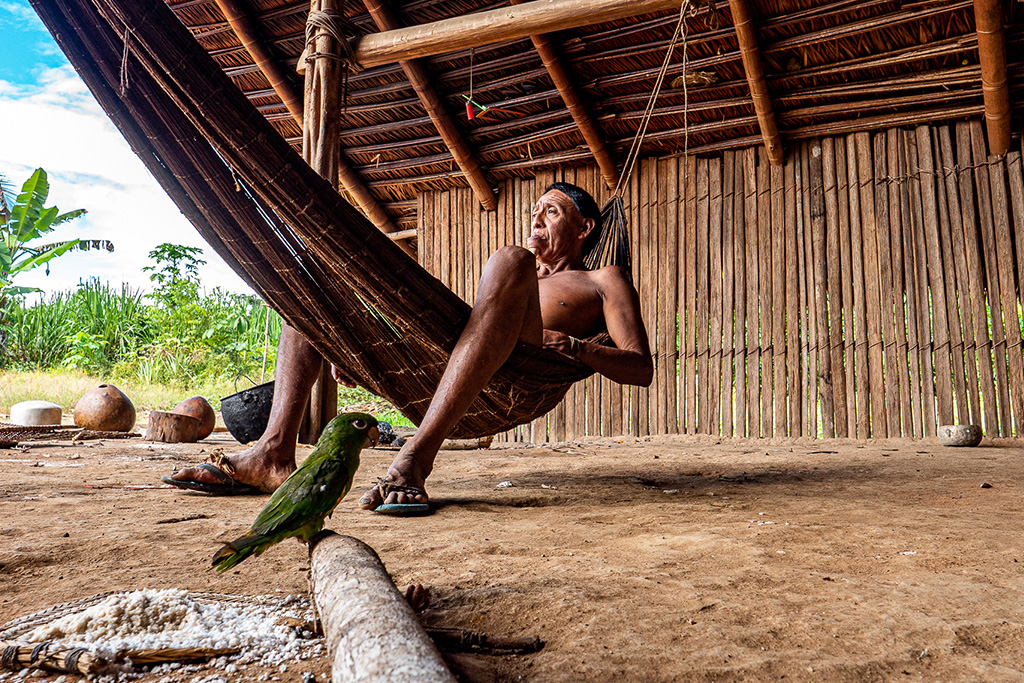
Founded in 2020 in Santarém, at the confluence of the Amazon and Tapajós Rivers, for which the outlet is named, Tapajós de Fato soon became an essential information hub. Santarém has about three hundred and sixty-four thousand residents, and Tapajós de Fato’s social media channels have grown to reach more than a hundred thousand people. Tapajós de Fato also disseminates reporting in offline ways—a booklet distributed by hand; an audio file played through a loudspeaker to communities living along the rivers’ banks—since both internet and electricity can be unreliable.
Because of its proximity to soy and corn fields, the Tapajós region has served as an important corridor for the national grain economy, as supplies move north along highways and rivers toward Brazil’s ports, a role that would only intensify if a proposed railway project, at stake in the election, were to be built. The territory is known for mining, land grabs, deforestation, and long struggles for agrarian rights, Indigenous land rights, and recognition for the quilombolas, an Afro-Brazilian community. “There is a political, economic, and logistical force on one side,” Serra told me, “and on the other, a history of struggle and enormous strength from these people and these territories. We were born inside these places.”
Serra told me Tapajós de Fato aims “not only to interview people or hear from sources, but to be a partner” and bring together trained reporters and comunicadores populares, or community communicators. Journalism goes hand in hand, he said, with policy change. Their approach is one that I have called slow-seeing journalism—which prioritizes in-depth coverage and building relationships with community members, and which recognizes change before catastrophe turns a territory into a headline.
For instance, in 2023, when students and teachers reported headaches, nausea, eye irritation, and other symptoms at a school in rural Belterra, an area surrounded by soybean fields, residents suspected pesticide exposure was at fault. Tapajós de Fato covered the story devotedly, and the reporting then became part of a “Popular Tribunal Against Pesticides,” a symbolic, community-led initiative that brought together journalists, activists, academics, and union members, who used the format of a trial to demand accountability. Although the tribunal had no formal legal authority, its discussions helped mobilize support for stronger pesticide regulations. In 2026, a coalition of nineteen civil society organizations presented a proposal to a Pará state lawmaker seeking tighter restrictions on pesticide spraying. In 2025, as poisoning cases continued to rise, from the dozens into the hundreds, reporters collaborated with Repórter Brasil, a national platform, to produce data and a podcast on how communities could respond to pesticide drift.
Since Tapajós de Fato’s founding, its journalists have been followed, stalked, and threatened outside their offices—often in the wake of investigations, such as the pesticide coverage, or a piece in 2021 about illegal mining. In 2022, a reporter was attacked by a knife-wielding assailant outside the newsroom, narrowly escaping injury. After the 2022 election, while Tapajós de Fato was reporting on Jair Bolsonaro supporters, Serra received a threatening phone call demanding the removal of a social media post, which he refused to do. Soon, the tires of Tapajós de Fato’s company car were slashed. Nearby, the journalists found the decapitated head of a cat and a message threatening Pedrosa.
The incidents were reported to police and prosecutors, but no suspects were identified, and investigators have not established whether all of the incidents were connected. “Tapajós de Fato’s journalism is always on alert,” Serra told me. “We don’t make every piece of content in the way we would like, because we know we cannot expose ourselves in just any way.” Reporters sometimes leave their bylines off stories and have reduced their visibility on social media.
“I’ve even had to move six times in less than four years,” Pedrosa told me. Serra said he stopped visiting his mother for about a year because he feared revealing where she lived. Other Brazilian journalists have experienced more of the same—though at the national level, the post–Jair Bolsonaro era has led to greater press freedom. Now journalists fear a reversal.
Although Tapajós de Fato will forgo election coverage, it is still empowering the community by keeping a steady watch on stories. “It is work that resists and continues because it has to continue,” Serra told me. “Because if we don’t do it, locally it will be very difficult for another initiative to take our place.”
Has America ever needed a media defender more than now? Help us by joining CJR today.