Sign up for the daily CJR newsletter.
The Smokehouse Creek Fire burned through the Texas Panhandle in 2024, eventually making its way to the small, charming town of Canadian. At one point, the entire town was penned in by flames. Laurie Ezzell Brown, the seventy-three-year-old editor and publisher of the Canadian Record, the local newspaper, spent most of her days reporting on the fire, which ultimately burned about 70 percent of the county. As it consumed the rolling hills around Canadian, Brown, whose family has owned the paper since the 1940s, was overcome by a different fear: that the fire would destroy the Record’s archive. “I would have been devastated,” she said. “It’s not just the history of this community. It’s the history of my family. It’s who we are. It’s what we’ve done.”
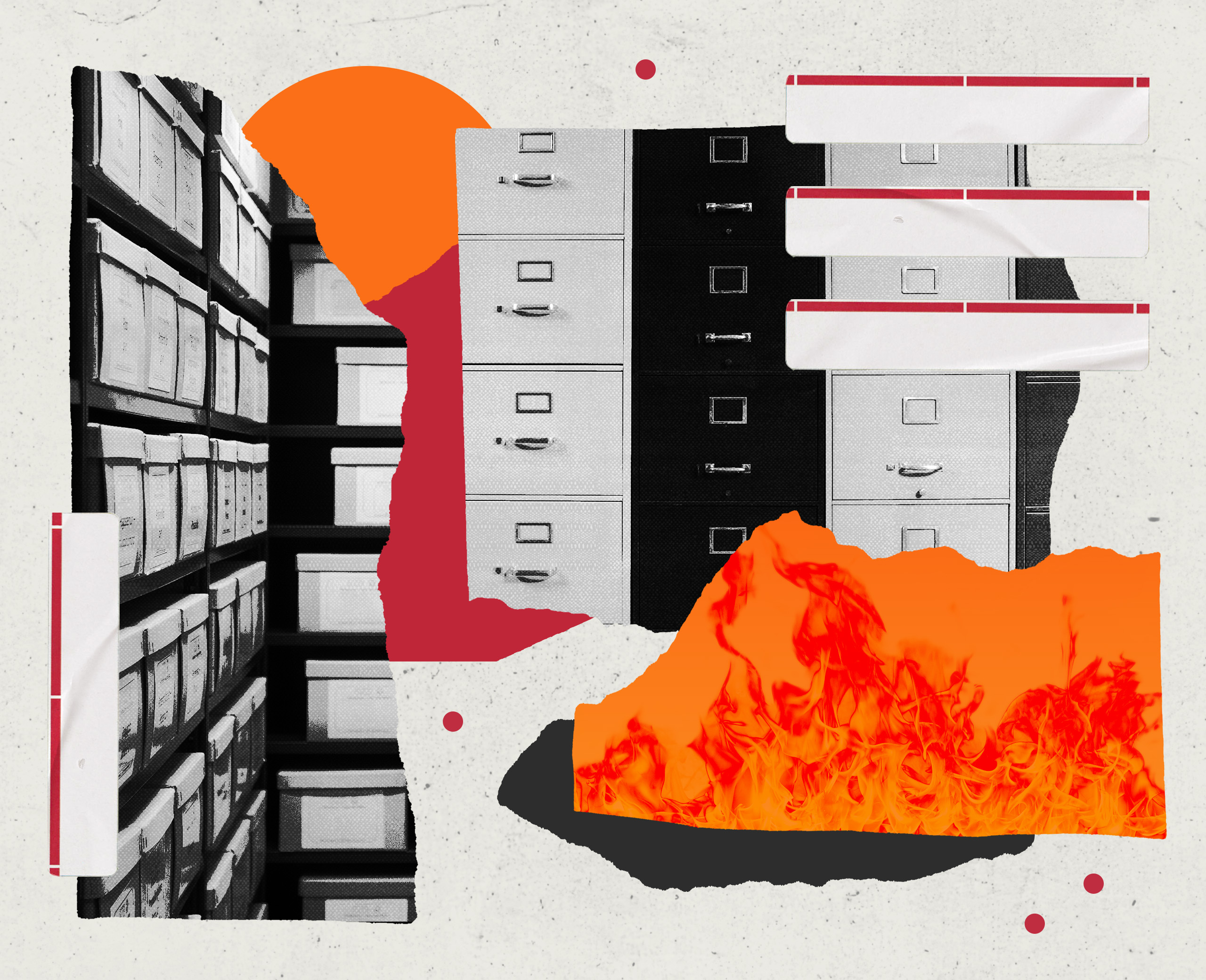
Newspaper archives are at risk around the United States. Sometimes the threat is a natural disaster, as it was in Canadian, but archives are more commonly lost when newspapers shutter, move to smaller offices, or are purchased. Photographs, more time-consuming to digitize than text, are particularly vulnerable, and copyright issues can make repurposing them complex, archivists say. Some newspapers partner with universities to preserve their archives; others turn to libraries and historical societies. Many have no plan at all. When an archive is destroyed, “we’re losing that individual community identity, that voice from this group of people at this point in time,” says Ana Krahmer, an archivist at the University of North Texas.
Frank LoMonte, a University of Georgia law professor who has studied the loss of photo archives from local newspapers, estimates that only a small minority of papers have the financial resources and foresight to proactively safeguard their archives. LoMonte especially worries about unpublished photographs, because they provide an unfiltered perspective on what life was like—and offer a window into how editors at the time chose to portray major news events, and what they chose not to include. “The loss to history from the purging of photo morgues is unquantifiable,” he said.
In the 2000s, Marianne Mather worked as a photojournalist at the Aurora, Illinois, Beacon-News and the Elgin Courier-News, both of which were owned by the Chicago Sun-Times. Years later, she was working at the Chicago Tribune when its parent company purchased some of the Sun-Times’ papers, and she was curious about what remained of their photo archives. “There was barely anything,” she said. Mather had worked at those papers for over a decade, but she found that just two of her photos remained in the archive. She and two other former staffers said that many of the photographs had been lost during layoffs and consolidations among the brands; some were even thrown in a dumpster, according to Jim Svehla, who was the Naperville Sun’s photo editor when they were trashed.
Mather knows the value of preserving published and unpublished photos. In 2016, she spent two days searching through the Tribune’s archive before finding what she had been hunting for: a previously unpublished photo of then–presidential hopeful Senator Bernie Sanders being arrested at a 1963 civil rights protest in Chicago. The photo eliminated doubts about Sanders’s participation in the movement. “I held it up to the light, the acetate negative, and I said, ‘I think we have him,’” Mather recalled. “It was amazing.”
The University of Louisville spent years trying to acquire the photo archive of the Louisville Courier Journal, but the paper’s owner, Gannett, held out in the hope of finding someone willing to pay, said Cassidy Meurer, an archivist at the university. In 2022, when the Courier Journal began the process of relocating to a smaller office, Gannett finally agreed to donate the archive to the school. The collection includes an estimated ten million photos, Meurer said, which are in the process of being digitized. “It’s not just a window into big historical moments,” she said. “It’s also a window into everyday life and how things felt in a very different time.”
Back in the Texas Panhandle, the fire spared the Canadian Record, but the near miss prompted Brown to start donating her paper’s archives to the Digital Newspaper Program at the University of North Texas, which preserves papers from around the state. The Record stopped publishing a print edition in 2023, but Brown has kept a digital edition going with her personal savings. Come what may, she knows the archives won’t be lost: She delivered the last batch of back issues to the university in June, and she plans to donate the photo archive as well. “They’re out of here,” she said. “And they’re in a safe place.”
Has America ever needed a media defender more than now? Help us by joining CJR today.