Sign up for the daily CJR newsletter.
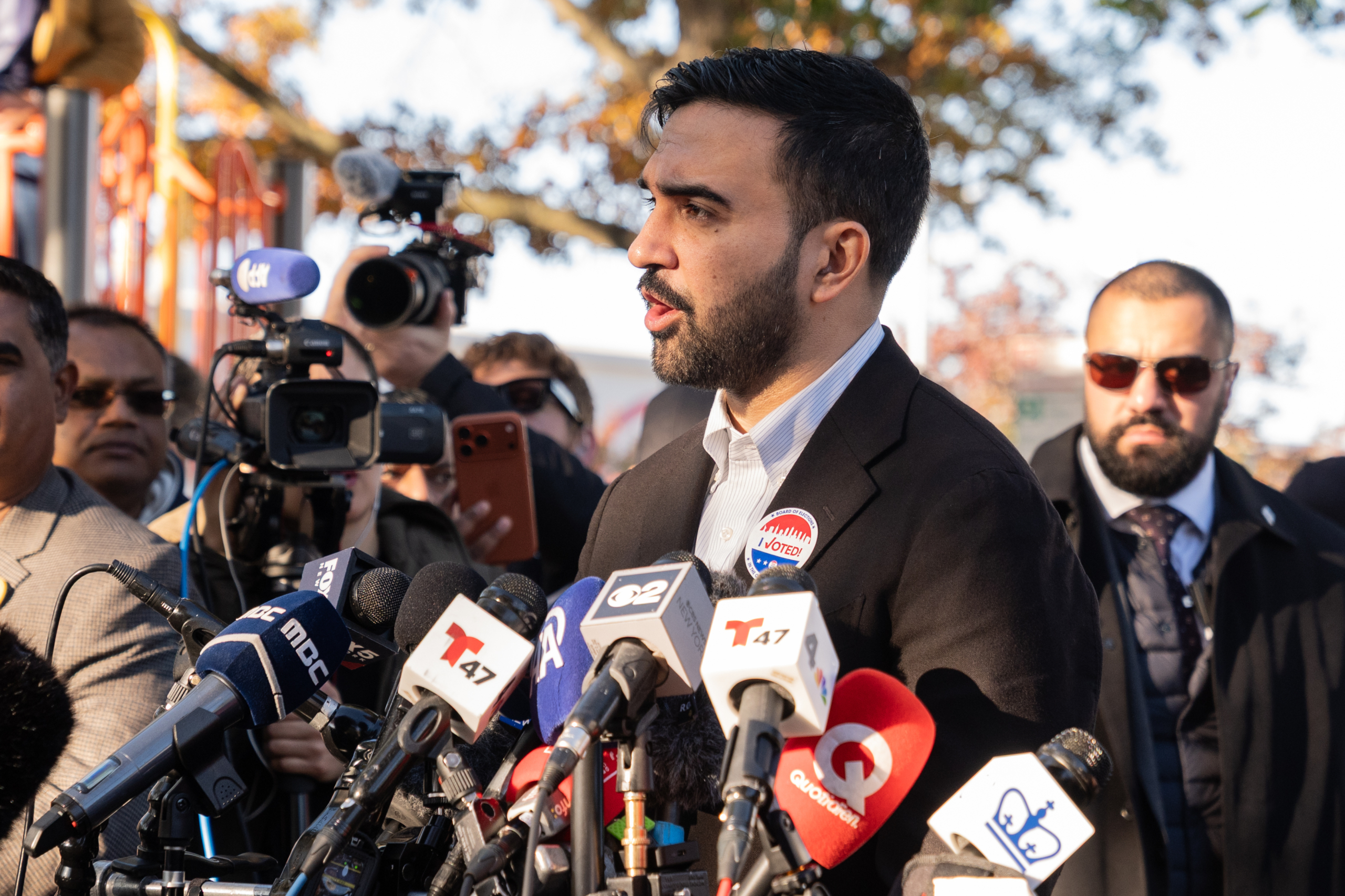
Zohran Mamdani, the thirty-four-year-old Democratic Socialist poised to become the next mayor of New York City, has drawn much attention for his social media skills. His jaunty videos and online savvy have so effectively helped him build an army of supporters that his opponents began trying to copy the style of his videos. Less remarked upon, though, is the fact that he has no other choice than to be good at new media. The old media hates him.
Newspapers and their editorial sections emerge out of obscurity when it is time for the establishment to bare its fangs against a perceived threat. To most New York City voters, Mamdani is known for his smile, his charisma, and his wish to make the city a more affordable place to live. National newspapers have taken a different view.
If you live and work in the part of New York City that is not Wall Street, the Wall Street Journal opinion section’s coverage of Mamdani has been a great amusement these past months, like watching a clumsy barbecue chef frantically rolling in the mud after his apron has caught fire. Since June, when the mayoral primaries were held, the paper has run more than fifty editorials and op-eds attacking Mamdani. For a paper that ostensibly covers the entire nation, that is a lot.
On one hand, the Journal’s writers have noted that Mamdani is a “good-looking” person who “you might not mind matching with on a dating site.” On the other hand, they have also said he is radical and unpatriotic and anti-Semitic and “sympathetic to Islamists” and a “demagogue” and a “caudillo” and a “real economic threat” and “like a bad therapist” and “has made statements of unheard-of violence about Israelis and Jews” and will end public safety and wipe out landlords and destroy charter schools and steer the city “in a disastrous direction” that may very well include both suicide bombs and Soviet bread lines. Thus the paper’s entire opinion section has taken on the discomforting character of a drunken middle-aged man trying to hit on a self-possessed college student by lecturing her on why she shouldn’t believe all the communist crap they teach in school. Such romantic blunders—just like the paper’s attempts to dissuade normal people from electing Mamdani—tend to be embarrassing and unsuccessful.
The ravings of the Journal’s right-wing editorial board are predictable. But even their good liberal counterparts at the New York Times have been, in their own way, equally weird and hostile toward Mamdani’s candidacy. This manifested most clearly in the Times editorial board’s non-endorsement in the June Democratic primary. In a piece that dwelled on imaginary threats of disorder and the “chaotic or even menacing” quality of subway rides, the Times said that Mamdani “shows little concern about the disorder of the past decade,” and concluded: “We do not believe that Mr. Mamdani deserves a spot on New Yorkers’ ballots.” The piece pointedly added that either Mamdani or Andrew Cuomo would probably win, and that what mattered was where voters ranked each, thereby effectively endorsing Cuomo without coming out and saying it. This, from the paper that has spent years reporting on every last detail of Cuomo’s corruption and sexual harassment scandals.
Nor has the allergy to Mamdani’s rise been confined to New York City. The editorial board of the Washington Post—a paper that has been the victim of an explicit ideological purge this year, in which owner Jeff Bezos made clear that the paper’s editorial stance will now reflect his own business interests—weighed in yesterday with an ominous piece headlined “Zohran Mamdani’s success is a warning.”
“It seems that there are enough voters to put him in power—but if New Yorkers begin to flee in droves, it could force him to moderate,” the piece said, echoing a hilariously implausible scare poll from the Daily Mail warning that “at least 765,000” New Yorkers will “definitely” leave the city if Mamdani is given a chance to implement his terrifying agenda of, uh, making the buses free. The writers at the Post, small-town residents that they are, seem to have fallen prey to smooth-talking big-city con men. How typical.
Before Zohran Mamdani, the only two political figures who received the same level of vitriol from newspaper pundits were Bernie Sanders and Donald Trump.
It is easy to imagine the Journal, the Times, and the Post as three nervous suburbanites on a day trip to New York City: purses clutched tight to their sides, their hands grasping pepper spray as they descend into the threatening depths of the Times Square subway station, vigilant to the possibility of an attack from a homeless person. These types of visitors, their view of the city shaped by too many urban crime dramas, are common. We welcome them. We do our best to soothe their fears. We even try to gently persuade them to go to Jackson Heights and try some Indian food. But we do not let them tell us how to run our city. That would be ridiculous.
More seriously, the stunning unity of the papers in their opposition to the possibility that Mamdani may represent something positive is indicative of what all these publications have in common. More than any other media outlet, great old papers like these represent the establishment. Being a part of the political, social, and economic power structure defined the nature of successful big-city papers and their owners for generations. Their commitment to keep change modest, to keep reform within reason, to keep the basic arrangement of things steady is far more fundamental to these publications’ worldview than their relative spot on the right-to-modestly-liberal spectrum. Before Zohran Mamdani, the only two political figures in recent decades who received the same level of common vitriol from this slice of the pundit world were Bernie Sanders and Donald Trump. The only thing that unites those three is that all of them sought, to varying degrees, to upend the establishment. That inclination—disrespectful as it is to the social ladder that members of these media institutions have climbed—will always rub such newspapers the wrong way.
“At the very least, New York, don’t give the Democratic Socialist a mandate or anything he can claim as such. Make it a close one,” wrote Peggy Noonan, the soul of the Wall Street Journal, a few days ago. Her plea embodies the establishment’s increasing disgruntlement with the fact that nobody seems to be listening to them. A hint to why that might be is contained in Noonan’s cheerleading of the city’s resurgence: “We are up and operating again, getting our strut back. Midtown Manhattan is clogged again with impossible traffic, downtown’s booming, people are back in the office and out on the town, Broadway is back.”
Within a thirty-block radius in Manhattan, the city’s best-paid pundits wonder what has gone wrong. Throughout the other 95 percent of New York City (there are four whole other boroughs!) voters seem to grasp the situation with more clarity than the writers who are supposed to be analyzing it for them.
Has America ever needed a media defender more than now? Help us by joining CJR today.