Sign up for the daily CJR newsletter.

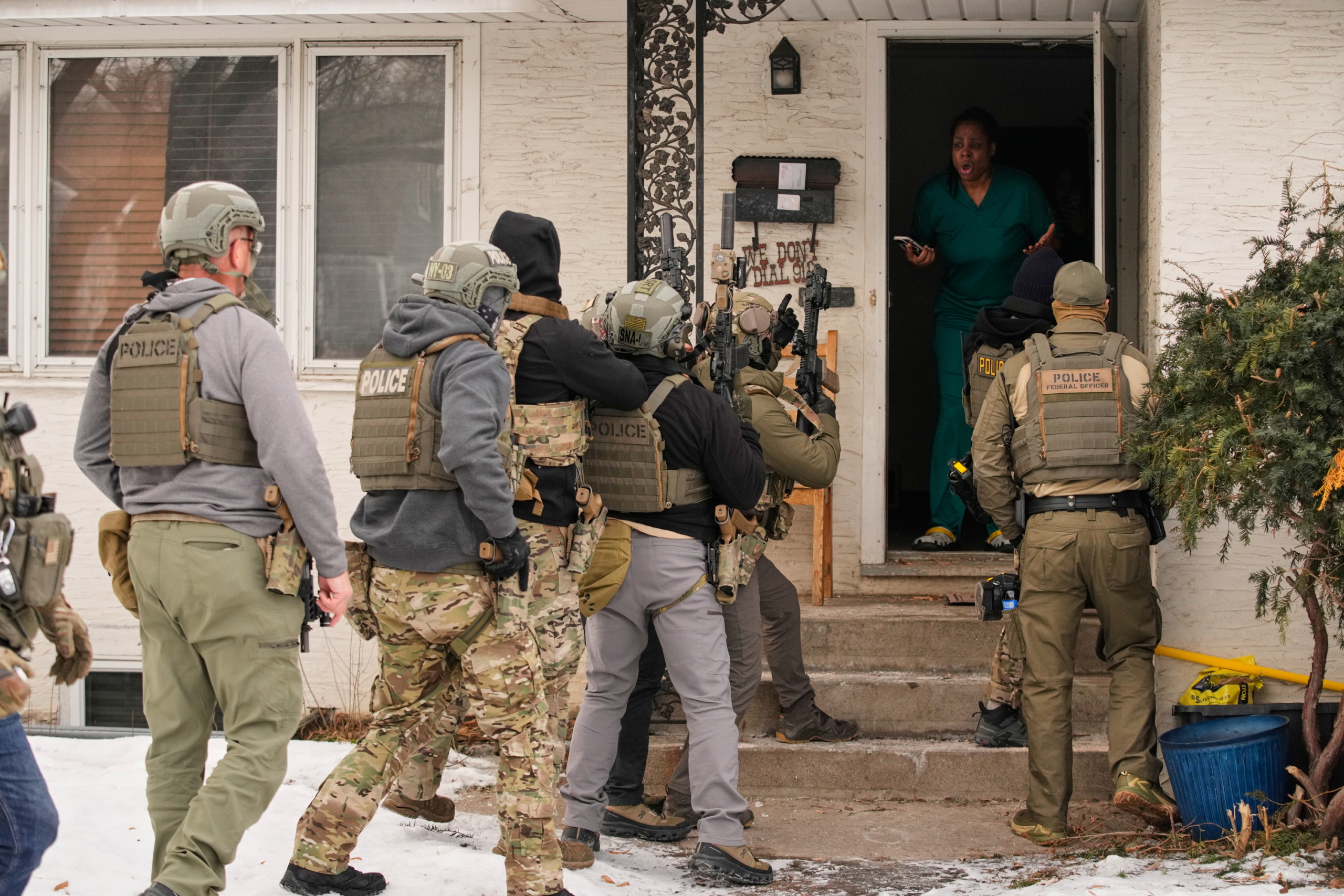
On January 11, just days after Renee Good was killed by an Immigration and Customs Enforcement agent in Minnesota, the Associated Press witnessed ICE officers in heavy tactical gear use a battering ram to force their way into the home of Garrison Gibson, a Liberian man with a 2023 deportation order. After further investigation, the AP discovered that agents had used only a limited administrative warrant to justify their action, violating long-standing guidance that a judge has to authorize any raid on a residence.
Now, the AP is out with a bombshell report that offers a possible explanation. It obtained a secret internal memo that authorizes ICE officers to use force to enter a home based only on an administrative warrant, a move that asserts a sweeping power seemingly at odds with Fourth Amendment protections and reverses years of guidance shared with immigrant communities. The memo was signed last May by acting ICE director Todd Lyons.
According to the AP report, from Rebecca Santana, the directive was not widely distributed, but new ICE officers have been told to follow its guidance instead of other written DHS materials that directly contradict it. Santana writes that the shift is expected to trigger court challenges and backlash from advocates and local officials: “For years, immigrant advocates, legal aid groups and local governments have urged people not to open their doors to immigration agents unless they are shown a warrant signed by a judge. That guidance is rooted in Supreme Court rulings that generally prohibit law enforcement from entering a home without judicial approval.”
As the chaotic immigration crackdown continues in Minnesota and expands to Maine, it’s important reporting that will likely have a significant impact on how the administration conducts future operations—and tell us whether “rule of law” is still a functional concept in this country.

It has been nine days since FBI agents executed a shocking raid on the home of Hannah Natanson, a Washington Post reporter, seizing her phone, two laptops, a recorder, a portable hard drive, and a Garmin watch.
The raid was immediately condemned by Matt Murray, the executive editor of the Post, who wrote in an email to the newsroom that the search was an “extraordinary, aggressive action” that raised “profound questions and concern around the constitutional protections for our work.” Later that day the Post’s editorial board also condemned it, writing: “The Justice Department’s decision to send FBI agents to raid a Washington Post reporter’s home Wednesday was an aggressive attack on the press freedom of all journalists.” Eventually, Will Lewis, the publisher, released a statement of his own, one strangely focused on Natanson’s “spirit” rather than possible government overreach, which he referred to only as an “outrageous action that was taken against her.”
But perhaps the most significant response has come from Jeff Bezos, the billionaire owner of the paper, who has maintained a shameful silence. Bezos’s lack of engagement is not entirely surprising, given his many recent attempts to curry favor with the Trump administration, but it’s still disappointing. One staffer characterized it to Status as “nauseating and irresponsible to have our owner remain silent given this unprecedented event.” Another person at the Post told me that the topic of whether Bezos would comment was raised in a recent meeting and an editor was dismissive, saying they did not believe it was under consideration.
Nevertheless, the Post has vigorously defended Natanson in court. On Wednesday, the Post asked a judge to block federal agents from opening up Natanson’s electronic devices and demanded their return, saying in a filing with the US District Court for the Eastern District of Virginia that the seizure “chills speech, cripples reporting, and inflicts irreparable harm every day the government keeps its hands on these materials.” US Magistrate William B. Porter granted the motion the same day, blocking federal prosecutors from reviewing material seized by the FBI until a hearing scheduled for February.
A year after one of California’s most destructive wildfires tore through Los Angeles, taking at least thirty-one lives and incinerating almost every home in its path, thousands of survivors are still rebuilding their lives and adapting to an era of increasingly unpredictable fires.
In The Palisades Fire: A Sandcastles Special, a new podcast from PRX and WaveMaker Media, Adriana Cargill revisits the devastation by taking listeners behind the fire lines with a group of local volunteers trained by LA County’s Fire Department to help emergency responders during wildfires.
That group is the Community Brigade, a first-of-its-kind collaboration between citizens and professional firefighters. It began as a spontaneous grassroots effort led by Keegan Gibbs and Tyler Hopman, childhood friends and surfing buddies, in the wake of the Woolsey fires in 2018, in which they both lost family homes. There are now about fifty Brigade members, and they have received more than six hundred new applications in the past year.
In the two-part documentary special, Cargill explores whether the program can help shape a more secure future for people in high-risk fire zones: “During these massive wildfires, there will never be enough first responders. So could they train everyday citizens to fill the resource gap? I’ve been following this program’s development for six years now, with a single question in mind. Could this new vision of civic engagement be the thing that finally moves the needle?”
It’s an emotional and intimate look at resilience in the face of profound loss and the power of a community that refuses to be rendered powerless. As Cargill puts it:
“They have chosen to find a better way to live with wildfire, even if the path there isn’t always clear. Defiantly, creatively, using whatever is available to them. They are alchemists, experts at turning their own suffering into purpose and service.”
In the aftermath of the deadly “Unite the Right” rally in Charlottesville, Virginia, in 2017, Thomas Rousseau, a far-right activist, formed the Patriot Front, a white nationalist organization that has grown into one of the most prominent extremist groups in America.
When catastrophic and deadly floods hit Central Texas last July, the hate group shared a video with its members highlighting their participation in relief efforts. In the video, Rousseau explained their participation: “We are prioritizing the interests of our people in this mission. While every other race and religion across the country and the world, for that matter, can establish charities, communities, and institutions that explicitly exist by and for their own, it is regrettably a revolutionary act to do so for Americans.”
In an investigation for the Texas Observer, Steven Monacelli and Tristan Lee explore just how far Patriot Front is willing to go to create institutions that are entirely “by and for their own.” The group tries to hide the identity of its members but, through extensive reporting and analysis, Monacelli and Lee identify a network of businesses affiliated with the Patriot Front in Texas and map out how they are connected. Their work reveals that the group is developing an independent economic system to protect members from potential consequences if their ties to the group are exposed.
“When people find out you’re a racist or a white nationalist, you tend to lose your job pretty easily,” Scott Ernest, of the Center for Extremism Prevention and Intervention, told the Observer. “The idea behind their self-sustaining economy, it’s just common sense. If you build your own business, you don’t have to worry about people getting you fired.”
If you have a suggestion for this column, please send it to laurelsanddarts@cjr.org. We can’t acknowledge all submissions, but we will mention you if we use your idea. For more on Laurels and Darts, please click here. To receive this and other CJR newsletters in your inbox, please click here.
Has America ever needed a media defender more than now? Help us by joining CJR today.