Sign up for the daily CJR newsletter.
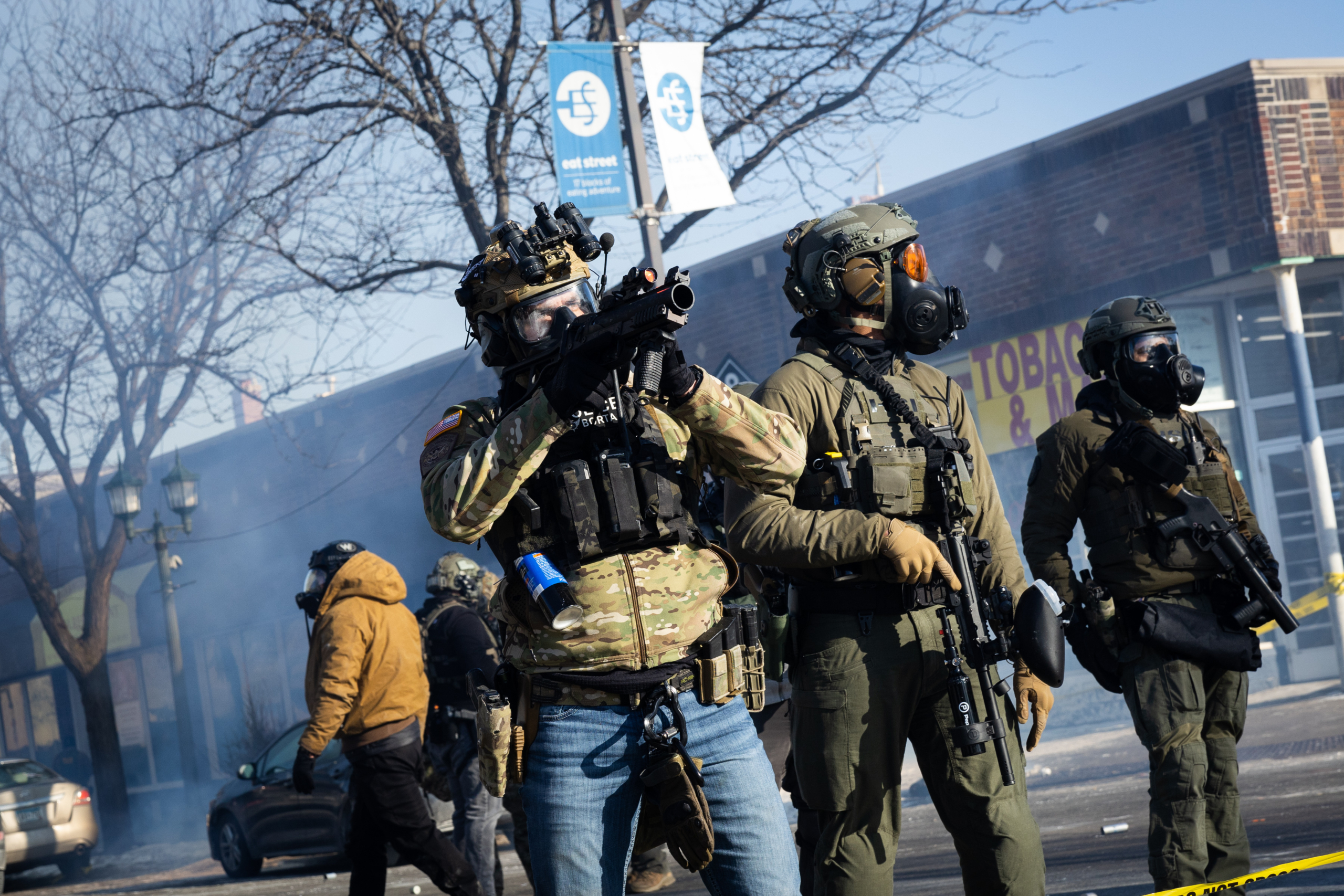
At about 9am on Saturday in Minneapolis, Alex Pretti, a thirty-seven-year-old ICU nurse, approached an immigration agent and two civilians standing in the road. Pretti, wearing a cap and holding his phone aloft, appeared to be filming the encounter—a common sight in Minneapolis in recent weeks, as thousands of federal agents have descended on the city to conduct aggressive immigration raids. Residents have sought to document and bear witness to the actions of what Jacob Frey, the mayor, has described as an “occupying force.” Approaching the officers, Pretti attempted to get between them and their targets. Soon, he was being grabbed at and pepper-sprayed by multiple people and thrown to the ground, a swarm of seven agents standing over him as he struggled. During the skirmish, an agent removed a gun that seems to have come from Pretti’s pocket—at no point in footage taken by onlookers does he appear to be holding it—and, seconds later, an officer shoots Pretti at point-blank range. In those videos, taken from multiple angles, at least ten shots can be heard in five seconds as his body collapses on the pavement. “What the fuck did you just do?” one woman shouts.
In the hours that followed, Trump administration officials sought to paint Pretti as a “domestic terrorist,” despite that description being plainly contradicted by the emerging video evidence. Stephen Miller, the White House deputy chief of staff, said Pretti, who worked at a Veterans Affairs hospital, was “an assassin” trying to “murder federal agents.” Greg Bovino, the Border Patrol official in charge of agents in Minnesota, said it appeared Pretti wanted to “do maximum damage and massacre law enforcement.” The Department of Homeland Security posted an image on social media of the gun Pretti was allegedly carrying (Minnesota is an open-carry state for those with gun permits; local police said Pretti had a valid firearms permit). At a press conference, Kristi Noem, the DHS secretary, claimed that “an agent fired defensive shots,” and said Pretti had come “with weapons and ammunition to stop a law enforcement operation” and “committed an act of domestic terrorism. That’s the facts.”
In the administration’s version of “the facts,” it was impossible to ignore the loud echoes of the justifications for the January 7 killing, just a few blocks away, of Renee Nicole Good. Good, also thirty-seven, was a mother of three who was shot and killed by an Immigration and Customs Enforcement agent while attempting to drive her car away from a heated interaction. Noem claimed afterward that Good was trying to “weaponize her vehicle” and run over an officer in an “act of domestic terrorism,” a statement that was belied by video footage, which the New York Times and other news organizations analyzed. Talking to CNN’s Jake Tapper on Saturday, Alexandria Ocasio-Cortez, the Democratic representative from New York, said the Trump administration was “asking the American people to not believe their eyes”—to ignore, in Ocasio-Cortez’s words about Pretti’s death, “an execution at the hands of the state.”
The administration’s gross misrepresentation of “the facts” poses a particular test for newsrooms. If journalists uncritically repeat baseless claims about domestic terrorism in their coverage, they risk laundering, and spreading, the often ludicrous statements of MAGA officeholders. But the press is still squeamish about directly calling out the administration’s lies. As journalists, we must remember that our responsibility is not to present both sides evenly; it is to make a determination about the facts that helps audiences understand a chaotic world.
After Saturday’s shooting, a number of right-wing outlets were happy to follow the administration through the looking glass. Fox News framed the shooting through Noem’s claims of “domestic terrorism” and her accusations that Frey and Tim Walz, the governor of Minnesota, were inciting violence; Newsmax and the Washington Times led with Donald Trump’s Truth Social post labeling Pretti a “gunman” and accusing Frey and Walz of “inciting insurrection.” More-serious news organizations, though, did a good job of covering the aftermath of Saturday’s shooting, particularly those—like the Times, NBC News, CNN, and The Guardian—that drew attention to videos contradicting the administration’s rhetoric, often deploying visual-investigation teams to verify and unpick bystander footage. M. Gessen’s Times op-ed on state terror helped make sense of Minneapolis, citing the “spectacle of random violence” and the “postmortem vilification of the victims” as core parts of “our new national reality.”
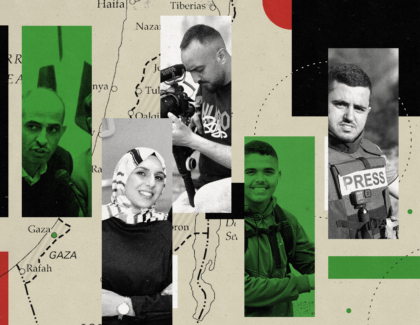
Elsewhere this week, I found it hard to overlook the through line between the Trump administration’s accusations of “domestic terrorism” and the Israeli military’s justification for a precision air strike that killed three journalists on Wednesday south of Gaza City. Mohamed Qishta, Anas Ghneim, and Abdel Raouf Shaath were recording footage of a tent encampment for displaced people, the Washington Post reported, when they were killed in their vehicle. (Qishta, Ghneim, and Shaath were reportedly on assignment for the media arm of a relief committee run by the Egyptian government.) Shaath was a freelance cameraman and contributor to CBS News and Agence France-Presse (AFP); he had gotten married less than two weeks earlier. A statement from the Israel Defense Forces (IDF) said that troops identified and bombed “several suspects who operated a drone affiliated with Hamas in the central Gaza Strip, in a manner that posed a threat to their safety.”
In a manner that posed a threat to their safety. A familiar justification, followed by familiar sights: First, images of the charred, warped metal skeleton of a bombed-out vehicle. Then, photos of mourners at a Gaza hospital lifting a stretcher bearing a white shroud in the shape of a body, covered by a blue flak jacket marked “PRESS.”
Israel has killed about two hundred and fifty media workers in Gaza since October 7, 2023, according to the Committee to Protect Journalists, including sixty-four cases that the CPJ “classifies as murders” because the victims were killed “in direct retaliation for their published reporting or to head off a sensitive story on which they were working.” The IDF has repeatedly justified its killings of journalists in Gaza by labeling them terrorists or accusing them of being affiliated with Hamas. The CPJ has accused Israel of “coordinated smear campaigns and efforts to delegitimize [journalists’] work,” and said such attacks seek to “undermine the documentation of war crimes and genocide by discrediting those bearing witness.” That phrase is as good as any for illuminating the dark work of autocracy: the discrediting—or extrajudicial killing—of those bearing witness, be they professional journalists or bystanders with a smartphone documenting abuse by federal agents.
Our moment, as I’ve written before in this newsletter, offers a litmus test for news organizations, separating those willing to document the uneven authoritarianism of the present from those content to lie low. After Shaath’s death, AFP paid tribute to him as a “deeply committed journalist” and strongly condemned Israel’s attack. Meanwhile, on CBS Evening News, Tony Dokoupil, the new host, said colleagues described Shaath as “a brave person doing dangerous work,” but repeated, without comment, Israel’s accusation that the group of slain journalists was “operating a drone affiliated with Hamas.” That framing seemed to add to the discontent inside CBS. “I mean, this was a person who risked his life for our company and lost it,” one CBS source told Substack publication Zeteo. “It was really a disgrace.”
Other Notable Stories…
- After federal agents executed a search warrant at the home of Hannah Natanson, a Washington Post reporter, on January 14—seizing a phone, two laptops, a recorder, a portable hard drive, and a Garmin watch—a federal judge in Virginia ruled on Wednesday that officials may not examine the devices until litigation stemming from the search of her home is settled. The case has alarmed press freedom and First Amendment groups as a dramatic escalation in the administration’s hostility toward journalistic institutions. As Maddy Crowell wrote for CJR recently, despite other reporters having been “tracked, subpoenaed, or compelled to turn materials over to the government,” the raid on Natanson’s home “is virtually without comparison.” Meanwhile, in other news, Puck’s Dylan Byers said over the weekend that “massive layoffs,” potentially affecting hundreds of people, are expected at the Post, with the foreign and sports desks expecting to be hit hard—despite the newspaper being owned by Jeff Bezos, one of the world’s richest men.
- After years of uncertainty, a deal announced Thursday will allow TikTok to continue operating in the US. The video app, owned by Chinese company ByteDance, has more than two hundred million American users and has long been the subject of scrutiny from US lawmakers over potential national security concerns. A new US entity, controlled by what the Wall Street Journal described as “investors seen as friendly to the US,” will operate the app. Among the most significant of those is Oracle—the software giant owned by Larry Ellison, whose family, as I wrote for CJR last year, has become the Trump era’s leading media moguls. Ellison’s company will oversee TikTok’s US data management and algorithm training. Politico reported that the deal “could tighten Trump’s cultural grip.”
- In a UK court last week, lawyers for Prince Harry, Elton John, and five other prominent names accused the publisher of the Daily Mail, formerly known as Associated Newspapers Ltd, of “clear, systematic, and sustained use of unlawful information gathering” between 1993 and 2011. In the latest high-profile legal battle between Harry and the tabloids, at the UK’s High Court in London, the newspaper publisher was accused of illegal practices—which it denies—including tapping phone lines, bugging the windowsills of homes, stealing medical records, and other forms of intrusive surveillance. Prince Harry claimed the behavior was “terrifying” and made him “paranoid beyond belief, isolating me.” Meanwhile, the Daily Mail and General Trust (DMGT)—which owns the Daily Mail and other media assets such as Metro, The i Paper, and Ireland on Sunday—must get regulator approval to complete its proposed five-hundred-million-pound (six-hundred-and-eighty-two-million-dollar) takeover of The Telegraph, the Labour government announced on Tuesday.
- On Tuesday, the National Labor Relations Board (NLRB) filed contempt charges against the Pittsburgh Post-Gazette for defying a court order to restore editorial workers’ contractual, collectively bargained health plan. That follows the announcement, earlier this month, from Block Communications Inc., the owner of the Post-Gazette, that the paper would cease publication on May 3. For more on the long-running dispute between the paper and its employees, which late last year was the longest active strike in the country, check out Riddhi Setty’s report for CJR from November.
- And for The New Yorker, Vinson Cunningham wrote a sharp piece about how the Trump administration has made the press conference its “signature rhetorical form.” “Throughout January, the members of the Trump regime welcomed the New Year by blitzing the podium: they took the chaos they’d created—the sudden power vacuum in Venezuela, the fatal incursions of ICE in Minnesota, a spun-up territorial crisis over Greenland—and tried to wrestle it into the shape of a story in which they would prevail,” Cunningham writes. The White House press briefing room, he adds, has become a “small theatre for an increasingly sick show.”
Has America ever needed a media defender more than now? Help us by joining CJR today.