

Sign up for the daily CJR newsletter.
For more than three decades, Novaya Gazeta, Russia’s leading independent newspaper, chronicled Russia’s reality: the promise of democracy, the economic collapse, the boom years, the spreading corruption, the repression, the wars, and the rise of Vladimir Putin’s dictatorship. Throughout, Novaya Gazeta battled attempts at censorship, ranging from debilitating cyberattacks to the murder of six of its journalists, which Dmitry Muratov, the cofounder and former editor in chief, has described as “warlike casualties.” In April of 2022, not long after Russia’s full-scale invasion of Ukraine, Muratov was attacked, splashed with red paint and acetone while riding on a train. He underwent a series of surgeries and suffered vision loss.
As the war, and Russia’s crackdown on the press, intensified, Novaya Gazeta was muzzled, its website blocked, its newsroom raided, its top editor arrested. Yet it continued to function, serving its readers as best it could by skirting restrictions, using Kremlin-approved language, distributing a small-circulation magazine by hand, and posting stories to Telegram and YouTube. Muratov called this form of journalism “our samizdat.” In September, the designation of Novaya Gazeta as a “foreign agent” imposed new and crippling restrictions. Last week, Novaya Gazeta was ousted from its offices and announced it would permanently shut down on November 9. “We haven’t died, they killed us,” Muratov declared.
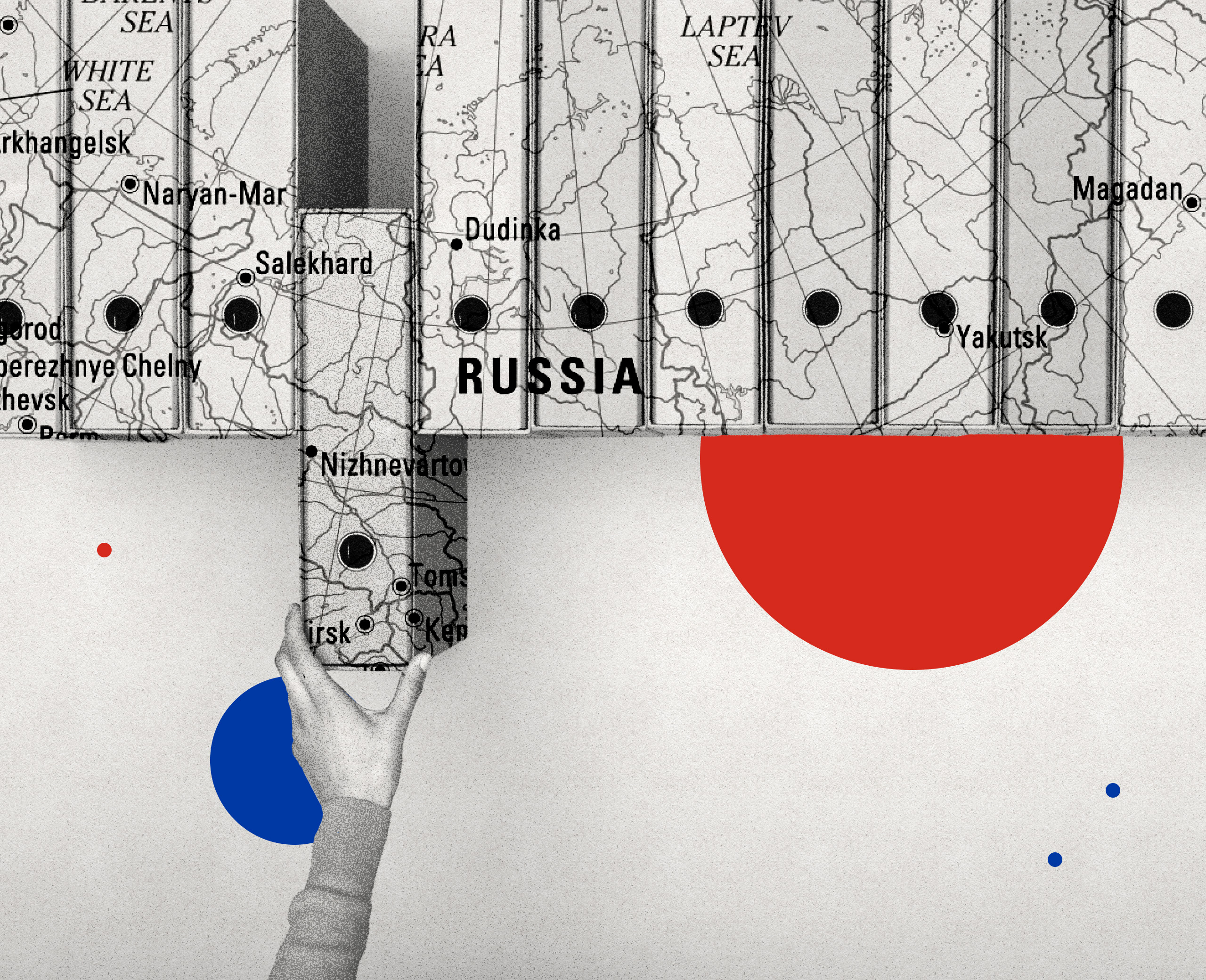
An organization called Kronika is fighting back. Founded in 2022 as a project of PEN America and Bard College, Kronika has set out to digitally preserve the work of independent media and journalists at risk of being erased by censorship, persecution, or war. For months, it has been working to bring Novaya Gazeta’s entire archive online, from the earliest print newspapers to special sections and regional editions, and to make them searchable in Russian and in English. The archive even includes the full run of That Same Novaya Gazeta, a weekly PDF edition the newsroom started in 2023 after its print license was revoked. As Muratov told me, without this archive, Russia would have lost not only independent journalism but also core historical memory: “We would not know how dictatorships take shape.”
M. Gessen—the author, New York Times opinion writer, and my fellow professor at CUNY’s Craig Newmark Graduate School of Journalism—is one of Kronika’s cofounders. They described Novaya Gazeta as “the longest continuously functioning independent newspaper in all of Russian history.” In that context, the creation of the archive is “an extraordinary event.” They recalled returning to the Soviet Union in 1991 as a reporter, after having immigrated to the United States with their family as a teenager. “I can’t really describe what it’s like to work as a journalist in a country that has no history,” they said. “I had no idea whether people knew about the gulags; whether they believed there was a Great Terror; whether they knew that the Soviet Union and Hitler had a nonaggression pact and divided up Europe between them. It’s actually very dislocating for a journalist to realize how much you depend on a shared historical narrative to do your basic work. That was my own motivation behind trying to get Kronika off the ground four and a half years ago.”
Kronika is focused on Russia but has global ambitions. In addition to operating the Russian Independent Media Archive, it houses the Central American Media Archive, and has plans to expand further. One goal is to make it harder for authoritarian leaders such as Putin to rewrite history. “We gradually tried to build a pipeline to get all the important journalism inside the archive,” Ilia Venyavkin, the head of communications at Kronika, told me, of the Russian archive. “We realized that there is a very significant gap.” With Novaya Gazeta’s complete archive now available, that gap has been closed.
Most of Novaya Gazeta’s former journalists have fled into exile. Kronika reached several of them and collected their accounts. Elena Kostyuchenko, who was part of the team that reported from Ukraine following the invasion, said, “The significance of Novaya Gazeta is that it was founded by a group of journalists and was owned by journalists.” Nadia Yurova, a reporter and video host, observed: “Novaya Gazeta, from the very beginning to the very end of its existence, made those in power uncomfortable. It’s a memory, an imprint, and a chronicle of the Russian government’s failures.” Ekaterina Glikman, who spent nearly two decades as a reporter and special correspondent in Russia, said the archive affirms the value of a type of journalism that is fast disappearing. “Even if you step outside the context of Russia, wars, censorship, Putin, and look at what’s happening to journalism worldwide: it’s increasingly desk journalism, not field journalism,” she noted. “I still hope field journalism survives. It’s the core of real journalism—nothing can replace it.”
Some of this group have come together to create Novaya Gazeta Europe, which is based in Latvia and independent of the Russian publication. Muratov remains in Moscow, living a circumscribed and increasingly precarious existence, protected by his prominence, his connections, and his Nobel Peace Prize, which he shared with Maria Ressa of the Philippines in 2021. I reached Muratov through a trusted intermediary just two days before the paper announced it would be shutting down. I asked him what would happen if Novaya Gazeta’s journalism suddenly disappeared.
“Without this archive, we would not know how Gorbachev and Reagan came up with Reykjavík, which gave us thirty years without war,” he replied, referring to the period after a summit that took place in Iceland in 1986. Muratov went on to cite Novaya Gazeta’s reporting on the 2000 Kursk submarine disaster; the 2014 crash of flight MH17, bound from Amsterdam to Kuala Lumpur, shot down by Russian forces in Eastern Ukraine; and the brutal war waged by Chechen leader Ramzan Kadyrov, with the backing of Putin, as the kind of coverage that could be lost.
But the Novaya Gazeta archive is not only about preserving the past. It’s about fighting for a different future, one grounded in the lessons of history. “We live in a world where 14 percent of people trust facts, while the rest trust their own convictions,” Muratov told me. “When we abandon facts, there will be nothing left to feed AI, and it will start devouring itself. For AI to give future generations reliable information, it has to read the brilliant journalists who sometimes gave their lives to tell the truth and set out the facts. That’s why it’s important.”
Has America ever needed a media defender more than now? Help us by joining CJR today.