Sign up for the daily CJR newsletter.
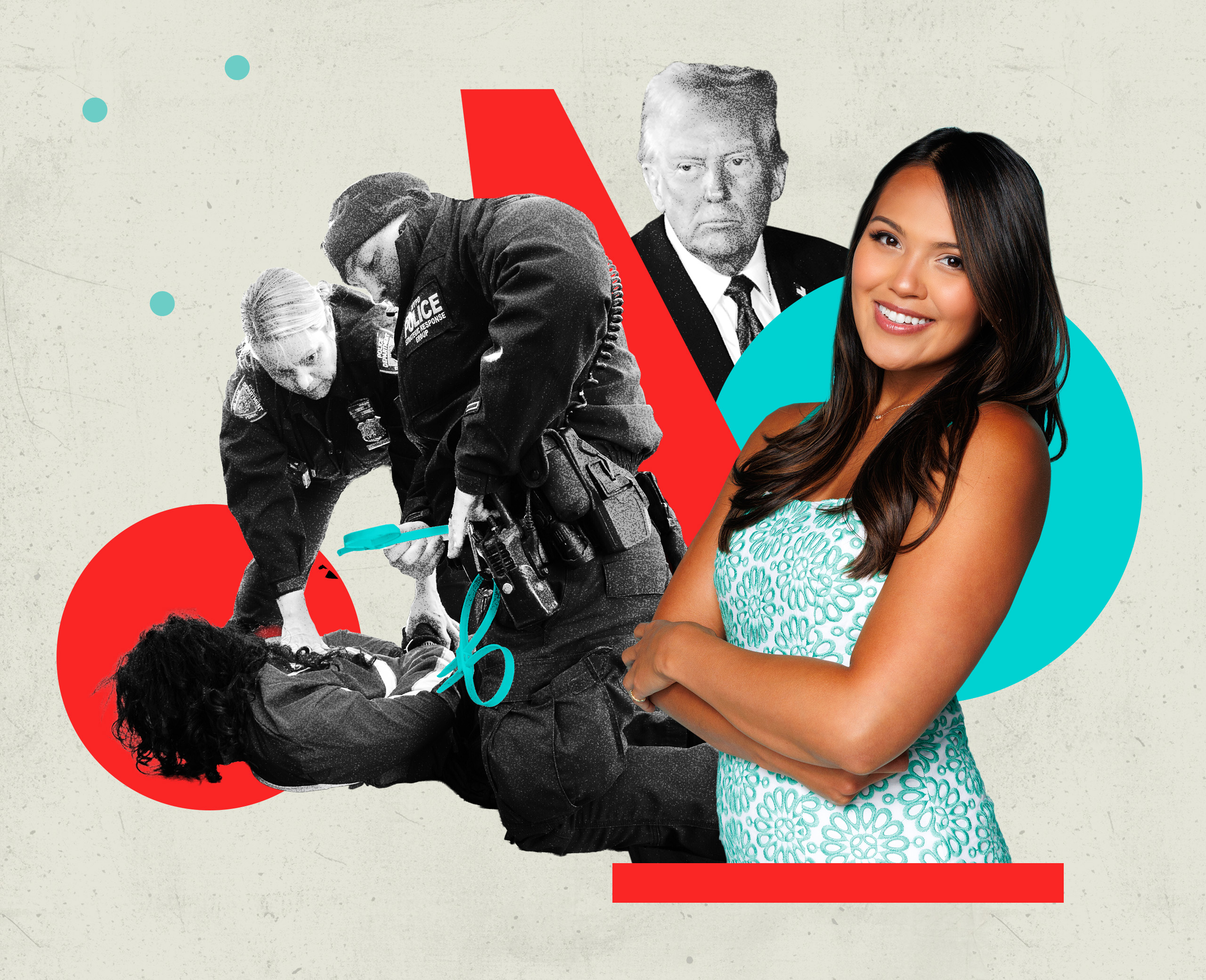
This past October, while visiting New York City, Savanah Hernandez, a correspondent for Turning Point USA, spotted street vendors selling handbags on Canal Street—a common sight. Hernandez—who is twenty-nine, wears black-framed glasses, and identifies herself on X as a “Proud American”—is a rising star at Turning Point, an advocacy organization originally founded by Charlie Kirk to promote right-wing activism on college campuses that has since grown into a prominent media platform. In a hundred-and-one-second video that Hernandez posted on her personal X account, where she has more than seven hundred thousand followers, she pans and zooms at a rapid clip while declaring the scene the “craziest thing I’ve ever seen.” In her caption, she tagged the X page for Immigration and Customs Enforcement (ICE) and wrote “Perhaps @ICEgov should go check this corner out.”
Two days later, ICE agents raided Canal Street. In a press release, the Department of Homeland Security, which oversees ICE, declared that it was “MAKING NEW YORK’S CANAL STREET SAFE AGAIN” and announced the arrests of nine “criminal illegal aliens” and four “violent rioters” who had protested at the scene.
The raid sent panic across the city’s migrant vendor community and gave rise to political blowback. Zohran Mamdani, who was about to become the mayor-elect, called the raid “authoritarian theatrics.” A food vendor told The City that she spent the next few days indoors: “Yes, there’s a lot of fear.” Justin Brannan, a member of the New York City Council, told me afterward, “Savanah Hernandez’s entire business model is stoking resentment. She strips away context and targets vulnerable people to rile up her audience and juice her algorithm. That’s not truth-telling. It’s exploitation.”
Later, when I reached Hernandez, she told me that no one from ICE had contacted her about the videos. “Initially I was a little bit shocked—like, ‘No way,’” she said. “There was a part of me that was like, ‘Is this because of my report?’” (ICE and DHS did not respond to my requests for comment.) By the time the raid took place, she was back home, in Austin. She found out about what happened via a text message from her friend Nick Shirley, a fellow social media star who runs a right-wing YouTube account with more than 1.4 million followers. “That’s great,” Hernandez remembered thinking. “The goal of my journalism is to enact positive change. I want to help people.”
On a video call, Hernandez, gauzily lit, spoke to me through a hefty professional microphone. At Turning Point, she works for the “Frontlines” division—which, she said, is dedicated to “neutral,” fact-based reporting, providing the ostensible newsroom of an enterprise otherwise focused vociferously on opinions. She had intended to present the Canal Street story via Turning Point—which pushes its content out through an X page, where it has 1.5 million followers, and on YouTube, where it has five million subscribers. But, she said, her editors told her, “We don’t see the newsworthiness—you can post it on your own.” (When reached for comment about why the editors turned down the video, Turning Point did not respond.) Hernandez made the decision to tag ICE almost as an afterthought, she recalled: “I was being kind of cheeky.”
Growing up in California and New Mexico, Hernandez was homeschooled by her parents, who “didn’t push anything political on me,” she said. (Her father worked in oil fields; her mother was a stay-at-home parent.) At sixteen she got her GED, then enrolled in New Mexico State University, where, she said, she was “not involved in politics at all.” She graduated in 2017 and majored in journalism but planned to pursue marketing or public relations. “It would be super fun to make advertisements or fun, artistic videos,” she remembered thinking.
After college and “throwing my résumé out wherever I could,” she said, Hernandez was hired as a production assistant at Infowars, the notorious platform run by Alex Jones, the Sandy Hook conspiracy theorist. She has claimed to have had no prior knowledge of Jones or his radical views, but she went on to become an on-screen Infowars personality. Then came the summer of 2020. As the Black Lives Matter protests sweeping the nation “popped off” in Austin, Hernandez said, “I simply went out with my camera,” posting on Twitter and Instagram. She also went out with a sign reading “Police Lives Matter,” for which she gained nationwide media attention. She framed her posts from the time, which depicted unrest and destruction, as a corrective to the mainstream media narrative. “I wanted to highlight what was actually going on,” she said.
That fall, Hernandez got a serious career boost: Donald Trump posted on social media about her footage of the Million MAGA March, a rally backing his claims of election fraud. She continued to gain traction by glomming on to other major culture-war subjects—COVID mask mandates, pride parades, trans athletes. One Hernandez video, in which a college swimmer criticized a fellow competitor—a prominent transgender swimmer named Lia Thomas—traveled widely thanks to pickup by Tucker Carlson. Hernandez started appearing regularly on Fox News; in 2022, she was hired by Turning Point.
During Trump’s second term, Hernandez has been among a set of content creators whom the White House has recruited to form an alternative, MAGA-friendly press pool. Many of those content creators were at the White House in early October for a roundtable on the alleged dangers of antifa, where their policy recommendations were fielded and eventually carried through. Hernandez said she still has not had any direct contact with ICE or DHS but told me that she did meet Kristi Noem, the head of DHS, at the roundtable. (When reached for comment on Noem’s familiarity with Hernandez’s content, DHS did not respond.)
Hernandez told me she was also at the White House in February when Pam Bondi, the attorney general, shared binders of material on the Jeffrey Epstein case with a group of influencers. Later, photos of beaming influencers clutching the binders were shared widely. Hernandez kept her distance from the shots. “I stayed far away from getting my picture taken because I’m not interested in photo ops,” Hernandez said. “I’m not interested in being a propaganda piece for any administration. I really am interested in legitimate journalism.”
Even so, Hernandez identifies as a “Trump supporter, absolutely.” She positions herself as a bulwark ensuring Trump sticks to his most radical policy promises. “That’s why I did the Canal Street story,” she said. “This is the Trump administration, which has touted itself as the law-and-order administration that’s going to be mass-deporting people. Yet you have an open black market in the middle of a Saturday?”
That day in October, Hernandez hadn’t planned on covering the vendors on Canal Street—she had never heard of the place. She was in town to cover the anti-Trump “No Kings” rally. But when Ubering back to her hotel after the protest, she recalled, “I just see this street filled with African migrants.” She stopped the car and jumped out. “I stayed in the area for a good hour and a half,” she said. “I wasn’t there just to shoot a video and leave. I like being on the ground; I like experiencing things. I was talking to the vendors. I was talking to the New Yorkers.”
Hernandez had mined New York’s immigration policies for content before. Like many of her peers in right-wing media, she has fixated on the city’s Row Hotel, which in the past few years has been used as a shelter for migrants. Hernandez told me that migrant families at the Row were getting “amenities” and perks—like seeing the Times Square ball drop from their rooms on New Year’s. Even so, she claimed that she has a sincere appreciation for the city: “It’s where tourists come from other countries. It’s where culture is at. We have Wall Street up there.” She sees New York as the “crown jewel of America,” she said.
In November, Hernandez returned to New York to film a follow-up from Canal Street. In the video, she boasts of the October raid and the arrest of “nine illegal immigrants” tied to “many, many bad crimes,” and laments that “this entire corner was filled with, once again, those illegal migrant street vendors.” She notes, too, that Canal Street is “just an example of how disregarded law and order is here in New York City.” (According to recently released New York Police Department data, the city is historically safe these days, with murders, shootings, and subway crime at all-time lows.)
Jonathan Choe, a fellow contributor to Turning Point, expressed pride in Hernandez: “Every law enforcement authority is watching her work” on X, he said. “You can imagine the power and clout she has now.” Before Elon Musk bought the company, in 2022, Hernandez was repeatedly banned; since Musk took over, she’s seen her following skyrocket. For right-wing news influencers such as himself and Hernandez, “X has been the game changer,” Choe said. “I thank Elon Musk every single day for buying that platform.”
When we spoke, Hernandez told me that she hates being called an influencer. “It pisses me off,” she said. “I’m not out here posting selfie videos.” Then she cut herself off. “I am posting selfie videos—but not for likes. I’m really trying to make a positive impact.” She paused. “I’m just a regular person that, for some reason, people listen to.” Then she threw her hands up, shrugged, and smiled. “I don’t know why.”
Has America ever needed a media defender more than now? Help us by joining CJR today.