Sign up for the daily CJR newsletter.
Earlier this month, days after the deadly crackdown on Iran’s protesters began, a specialized team at the BBC received a massive leak: 392 photos of dead bodies. “There was blood all over them. Their faces were mangled and disfigured,” Shayan Sardarizadeh, a senior journalist at BBC Verify, a unit at the British broadcaster that specializes in fact-checking, video verification, countering disinformation, and visual investigations, told me. “There were severe injuries to their faces and parts of their bodies,” he said. “It was crystal-clear that these were not people who died normally.” Of the 392 dead, Sardarizadeh’s team was able to identify 326 people. “There’s not much that I can say about how we got hold of those photos, to protect our source, but we went through every possible process to make sure that they were legit,” he said.
These days, photos and video from breaking-news events often reach audiences first via social media, making teams like Verify and comparable units at the New York Times, Washington Post, and others crucial to driving coverage of fast-moving stories. Following its launch, in May of 2023, Verify has investigated Israel’s strike on Gaza’s European Hospital, identified a paramilitary commander linked to a massacre in Sudan, and debunked Russian troll videos.
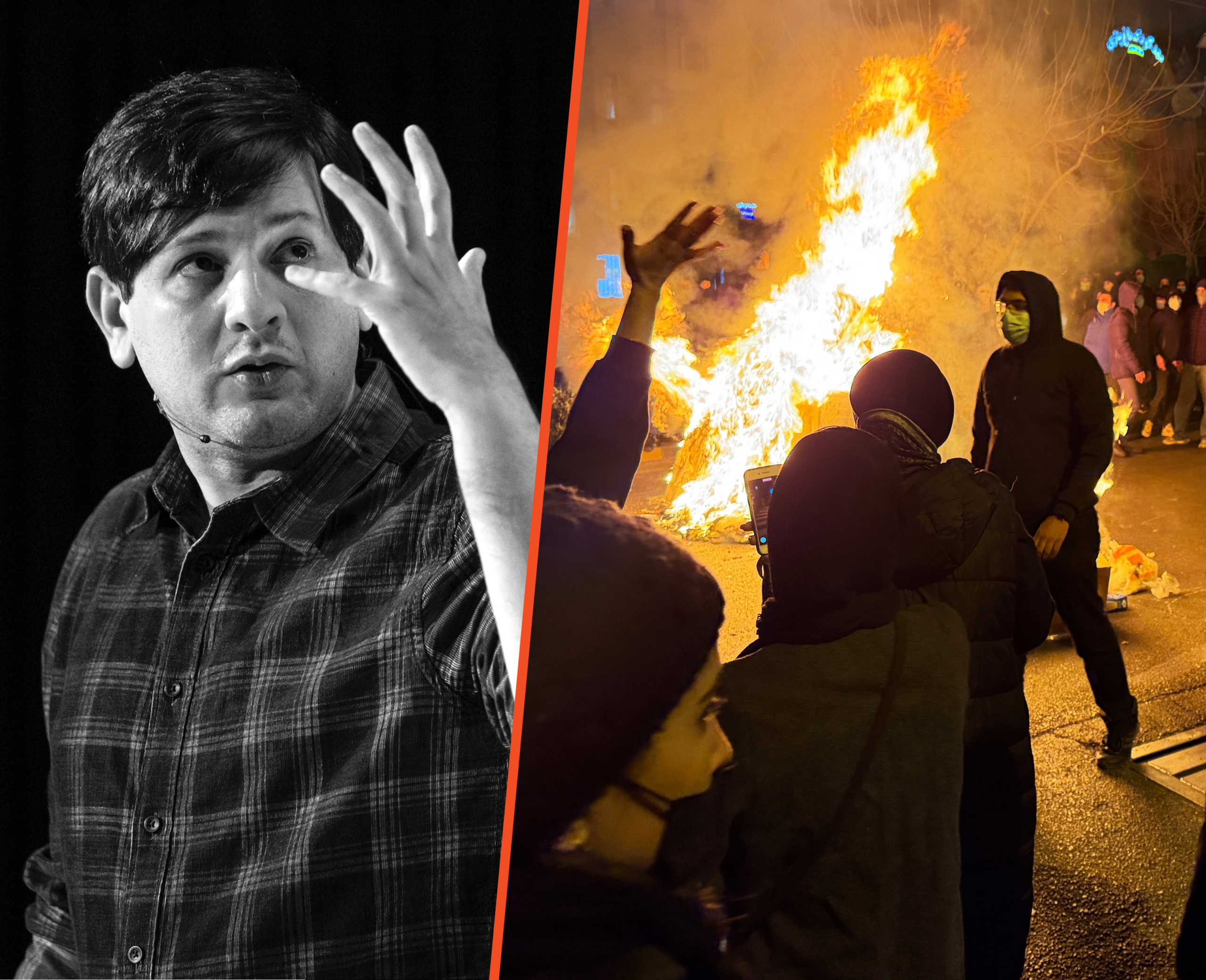
Since the authorities in Iran cut almost all access to telephone lines and the internet across the country on January 8, open-source investigations like Sardarizadeh’s—which are based on the little information that has managed to trickle out—are especially relevant to reporters covering the protests there. “We have to rely even more on social media, on citizen journalists, on sources who risk their lives and their safety and their well-being to get in touch with us and give us information,” Sardarizadeh said. His account has been edited for length and clarity.
I’m Iranian British. I was born and raised in Iran and emigrated in my early twenties. My leaving the country coincided with a wave of protests. Since then, I’ve been trying as much as possible to document what’s been going on there over time. I want to try to use the privilege that I have here in the UK as a BBC journalist to try to reflect the voices of people inside Iran who do not have the freedoms that I have.
More than 100 of the 392 photos [we got] had handwriting in Persian that included dates on them. These corresponded exactly to the ninth of January, the day that we think the deadly crackdown happened, and bodies started piling up in the forensic medical center in South Tehran. Some of them had tags on them that said “unidentified man” or “unidentified woman” in Persian. On about 28 of them, we could read a first name or a surname, which we used to start looking for the names that have been circulating online of protesters who have been killed in Tehran in particular. In doing so, we could find a match for a few of them.
The country is on a complete internet blackout, so the information that is trickling through is very small. But the fact that we could find matches for some of them, as well as evidence of the funerals and burials, gave us more confirmation that what we had was legitimate. Six or seven videos have since emerged from that particular center, and we also tried to see whether there were similarities—in the layout, in the way the bodies looked, the tags, and the handwriting. And there were.
In the 392 photos, we were able to identify 326 individuals. We were able to do that because after these bodies were taken to this center, people from all around Tehran and the suburbs visited to see if they had somebody in their family or loved ones that were missing for a couple of days there. They tried to see if they could identify their loved one among these bodies. Sometimes, because injuries were so severe, they had to take photos from multiple angles; otherwise it would not be possible to easily identify them.
While we only identified 326 individuals in those photos, we believe, based on other eyewitness accounts and reports and videos that we’ve seen from different parts of Tehran and the entire country, that this is just a snapshot: of the ninth of January, in that particular forensic center in Tehran. The real number—both in that forensic center and also nationwide—is likely much higher.
Because Iran is a country where the flow of information is tightly controlled by the state, even during normal times, it’s not that easy to get information from people. Blackouts are not a new thing for the Iranian authorities. They did the same thing in 2022, during the Woman, Life, Freedom protest. [They did it] in 2019. They did it even in June, during the twelve-day war with Israel. But this one in particular was so severe that it basically almost completely cut off the entire population of Iran from the outside world.
However, Iranians over the years have become really adept at sending information out, even though most of the social media platforms—like Facebook, X, YouTube—are banned. They can get around those state controls using a variety of methods like VPNs [virtual private networks that make a device’s internet connection private]. Normally, we get quite a lot of information from inside Iran via citizen journalists, people who are just basically documenting what’s happening.
There’s a small minority of Iranians who have access to Starlink [the satellite-based internet service run by Elon Musk’s SpaceX], which has been a lifesaver, because the small number of eyewitness accounts and reports and videos that have trickled through since the eighth of January have all pretty much been sent through this. Still, the Iranian authorities are trying their absolute best to stop that. There have been reports of the authorities going to specific houses in areas of cities where they think that there are Starlink connections, looking for terminals. [Earlier this month, armed plainclothes officers detained fourteen people outside Tehran over their alleged use of Starlink, according to Iran International, a network based out of London. —Ed.] So people have to constantly hide them. Whether they’re positioned near windows or on the roofs of their homes, they have to keep moving them so they won’t be detected by the authorities and agents. For us, if Starlink goes, it will be extremely difficult to know what’s going on.
The obvious con to this kind of work is the fact that you’re not necessarily on the ground. The other one is that, in some parts of the world, the evidence that you can get via satellite imagery, for instance, is limited. Lastly, the content that we work with can also be really, really grim. Open-source journalism usually comes into play where there’s a grim story happening, and people have to watch horrendous stuff in some cases: conflict, protests, government crackdowns, earthquakes. But it’s part of work, and we do it so that people in the general public who don’t want to look at those grim videos or images don’t have to. We can give them a sense of what’s happening without them having to go and watch them for themselves.
Has America ever needed a media defender more than now? Help us by joining CJR today.