Sign up for the daily CJR newsletter.
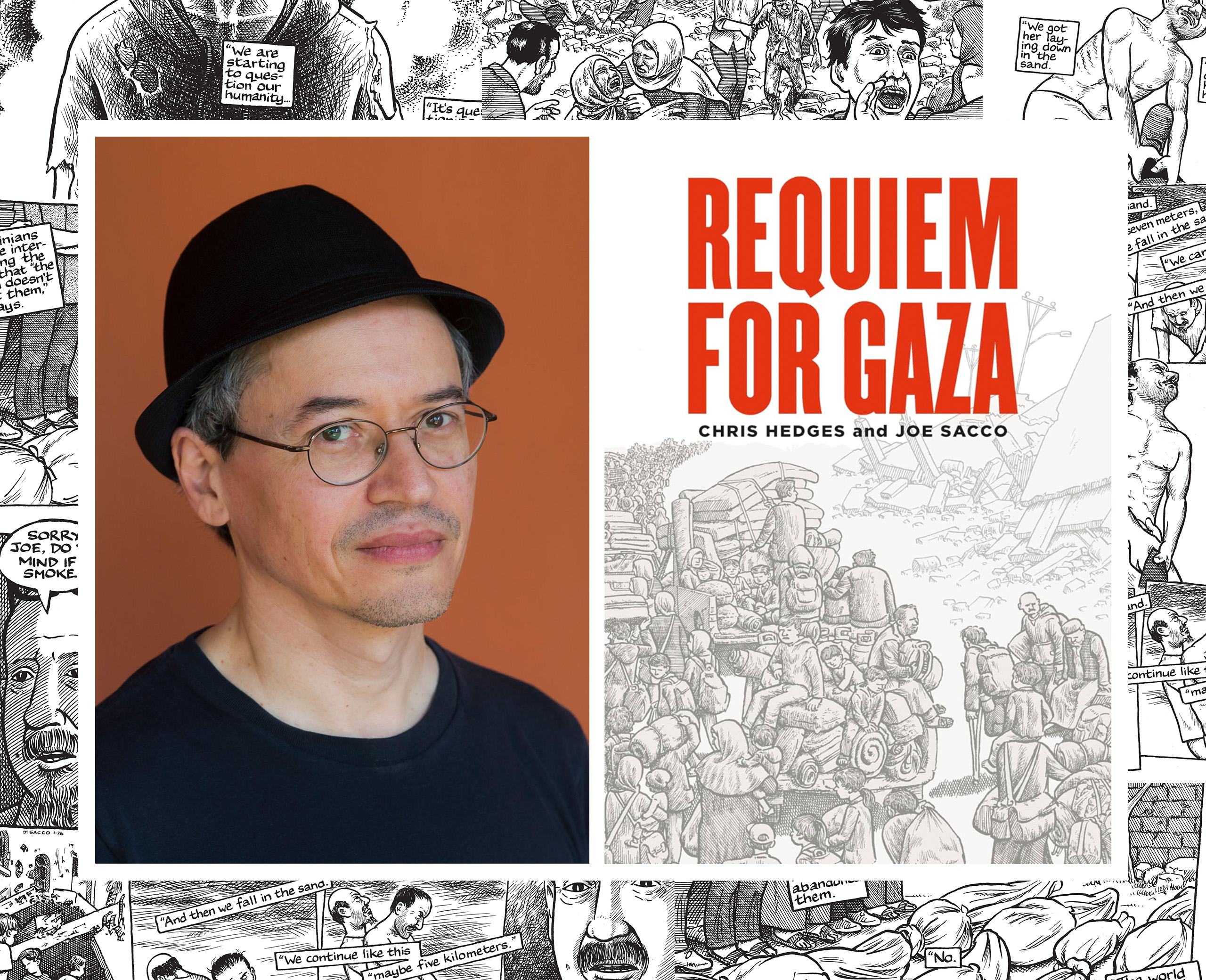
For a long time now, Joe Sacco, one of the world’s foremost cartoon journalists, has wanted to stop chronicling killings. In late 2023, as Israel began a post–October 7 assault on Gaza, he’d been planning on—finally, finally—turning to a long-gestating passion project: a book about the Rolling Stones in which he uses the band as a way to empty his brain of philosophical riffs developed through his years of international reporting. An excuse to really let it rip. But as Israel’s killings mounted—more than seventy-four thousand Palestinians are now dead—a friend from Khan Younis, a now-devastated city in Gaza, sent Sacco a message: “Please raise up your voice.”
“I have an attachment to Gaza,” Sacco, who is sixty-six, told me over eggs and coffee one morning. We were sitting in a well-worn diner near Penn Station; placed on the table between us, rakishly, was his fedora. “I know the people there. I know the streets.” In the early nineties, he spent months reporting from Gaza and the West Bank for Palestine, a classic 2001 collection. “I expect something from myself. I think other people expect something from me too. And that’s all legitimate. I couldn’t live with it myself if I just went on my merry way.” So the Stones book went into the desk drawer. “I have wanted to move away from conflicts for a while,” he said. He flashed a weary smile. “It just doesn’t seem to happen.”
Sacco’s books—illustrated, deeply reported conflict-zone travelogues—are wonderfully strange: Sacco stumbles and chats and, somehow, by the end, reveals the daily lived realities and historical root causes of traumas and massacres. (They also often manage to be funny.) When turning back to Gaza in 2023, Sacco’s instinct was to do on-the-ground reporting, but the Israel Defense Forces (IDF) instituted an embargo on foreign press that has not been lifted since. So in War on Gaza, a short book Sacco published at the end of 2024, he leaned instead on “dark satire.” (At one point, he imagines mailing his tax check to the IRS, only for the money to be funneled immediately into paying for the last bit of a missile headed to Gaza.) Now comes Requiem for Gaza, out tomorrow, a follow-up coauthored with Chris Hedges, the former Middle East bureau chief for the New York Times, for which the two went to Cairo to interview nearly thirty families who escaped the enclave.
I have loved Sacco’s work for a long time, and for many reasons, but above all for his ability to capture a scene in full, from its central heartbreak to its minutiae. In the finale of Paying the Land, his 2020 book on Indigenous Canadians, he takes you inside a stuffy gym where members of the Dene tribe are playing a raucous round of handgame. You can feel the sweat on the napes of the necks; you can taste the gym’s stale air. In Palestine, there is sloppy mud and heavy rain and bad roads. And, always, everywhere he’s roamed, from Uttar Pradesh to Sarajevo, there is the upward curl of cigarette smoke. Sacco told me, of his reportage: “It’s all color.”
In the early 2000s, Sacco often sat around with journalists from major newspapers in Jerusalem as everyone unloaded after a long day of reporting. Over dinner or drinks, he’d hear incredible tales. Reading those reporters’ articles the next day, the tales would be absent. “Because a lot of the stories involve them,” he said. “People confronted them, something happened to them. In the objective style, you never really feel the dust. But the world is very visceral. I don’t want to hammer down the flesh and blood in the name of objectivity—for journalism’s godly rule. I want to feel something. The atmosphere. The nastiness of it. The strangeness.”
In his books, he’s often transparent about grappling with the journalistic process. In a first-person commentary, he might share his skepticism as he receives information from sources he doubts. At one point in Palestine, he draws himself scrambling as Israeli authorities throw percussion grenades in the West Bank, then adds a speech bubble expressing gratitude for the friction and nakedly pining for something riskier: “A comic needs some bangbang and I’m praying Ramallah delivers.” It’s a wonderful bit of journalistic sacrilege. Sacco is admitting a forbidden impulse every reporter has had: of course you want something fucked-up to happen.
Along with the IDF’s targeting of Palestinian journalists—nearly two hundred have been killed in Gaza since October 7, according to the Committee to Protect Journalists—the army’s press ban is an attempt to render present-day Gaza as an unknowable zone. In Requiem, Sacco fights against that. He focuses on the story of Osama Abdou, a clinical psychologist who was forced by heavy bombing to evacuate his home in Gaza City, then forced by IDF soldiers to flee to Rafah. When his elderly mother was too exhausted to move, Abdou had to drag her through the sand of the beach. Sacco renders the ordeal with his bedrock empathy. “I think: Imagine if I was in this situation with my parents. Imagine if I couldn’t help them.” In another scene, Sacco is back home, in Portland, having a follow-up video call with Abdou. In drawing the scene, Sacco makes sure to pause to add a bit of humdrum humanity: through the screen, he shows us Abdou enjoying a delicious, smooth cigarette.
Sacco was born in Kirkop, a small village in Malta, but, shortly after, his family left the country (in part because, locally, the Catholic Church “held more sway over people’s lives than my parents were comfortable with,” he explained). After about a decade in Australia, the family moved to Los Angeles and eventually settled outside of Portland, in Beavertown, Oregon. While working at the Sunset Scroll, his high school newspaper, “the light bulb went off,” Sacco said, and he decided to study journalism at the University of Oregon. But there, he became disillusioned by professors who dared to respond to one of his zany ideas by asking what outlet he was considering pitching. At nineteen, Sacco didn’t want a shred of pragmatism; he wanted to be told “fucking go out there and just launch yourself.” He graduated college, he said, without “really knowing how journalism works.” He also left holding on to a belief in “the objective style of American journalism.” Not for long.
Sacco was in his early twenties in 1982 when, following skirmishes with the Palestine Liberation Organization, then based in Lebanon, Israel invaded the country and oversaw a series of mass killings of Palestinian refugees that became known as the Sabra and Shatila massacre. Seeing photos of some of the thousands of victims, Sacco felt his head turning: from newspapers and TV news, he’d understood Palestinians as the sole violent aggressors. “I felt like the wool had been pulled over my eyes,” he recalled. “I got furious. I was pissed off at the idea of journalism.” That was the seed for everything that would come later: “The books I’ve done about the Palestinians are a form of penance for my misconceptions beforehand.”
But his Palestine work was still a decade away. After college, he worked in a factory threading wires through load coils, as a library page, and as a proofreader at a law firm. He briefly bounced back to Malta, where he helped start a short-lived line of romance comics. During a stint in Berlin, he drew tour posters and album covers for rock bands, evolving his style. “Little by little you develop something of your own,” Sacco said. “But it’s not like you come up with the whole plan.”
These days, he has a refined system. He always transcribes his own interviews: “Now people let AI do it, or they hire someone. No. I want to hear the inflection in people’s voices. I want to remember when the person gasped.” (For his 2009 book, Footnotes in Gaza, about two mass killings by Israeli forces in 1956, Sacco had about seventy recorded interviews as well as almost four hundred pages of journal entries.) Once done reporting, he creates an index for all his material, often a weeks-long process. He doesn’t storyboard and he doesn’t use a computer. Everything is hand-drawn. For anything he hasn’t personally witnessed or photographed, he gets “as much reference as I can.” He’s spent a lot of time taking the bus to the library to check out, say, Israeli troop carriers in massive reference books such as Jane’s World Armoured Fighting Vehicles.
When he’s sitting at his desk at home, ready to draw, “I let it all out,” he said. “I need to feel something.” He might look at himself in a mirror to pretend he’s, say, protecting himself from the blow of a club. “It’s a version of Method acting,” he said. “How would someone wince if this was happening?”
Apart from high school drafting classes, Sacco is self-taught. His major influences were comix, the now-revered underground cartoons of the sixties and seventies. Comix artists like R. Crumb, S. Clay Wilson, and Spain Rodriguez “could be offensive, even to me,” Sacco said. “But they were pushing boundaries in a way that you could not do now without people just banging you over the head.” Inspired by the style of comix, he started out drawing characters “grotesquely,” he said. He has moved toward realism over the years, though he’s largely kept drawing himself as a strange caricature. “I can never really draw myself realistically,” he said, and shrugged. In Requiem, he depicts that caricature subtly, sweetly, as having aged.
Since 2012, Sacco has been carving out time on the weekend for that other thing. “Saturday, that’s Stones day,” he said. “That’s what helped me along the way of doing these harder books.” He swears it’s coming along. When we spoke, he had something like a hundred and sixty pages.
So now that Requiem is being published, it’s Stones day every day?
“Now I’m back to it. Well, actually…”
Actually, Sacco said, he was working on a comic adaptation of an interview he did with Francesca Albanese, the UN special rapporteur on the occupied Palestinian territories. “She wanted me to get involved in this thing, and I said I didn’t really want to, but we Zoomed and she convinced me. It’s four pages. And I’ll get them done and I’ll move on. I do want to move on.”
He smiled. “What can you do?”
Has America ever needed a media defender more than now? Help us by joining CJR today.