

Sign up for the daily CJR newsletter.
Last week in the lobby of a trendy Brooklyn hotel, dozens of partygoers chanted: “Squash king, squash king, squash king!” A raffle had just taken place. Al Mullen, the winner, took center stage to receive his prize: a big orange gourd roughly the size and shape of a dachshund.
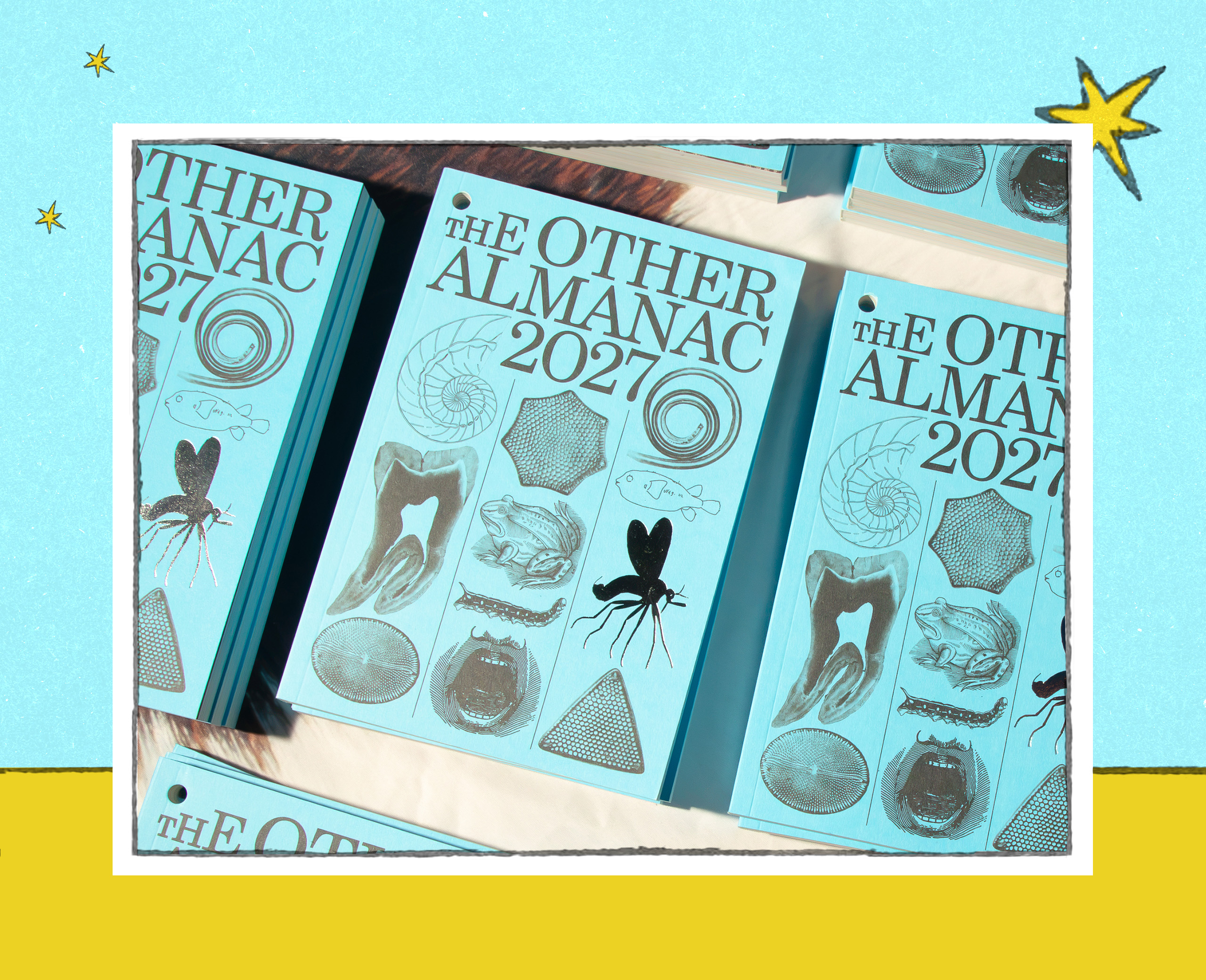
It was a fitting trophy, as the party, full of artists and other creative types, was celebrating the fifth issue of The Other Almanac, a yearly publication that reimagines the colonial almanac—a sort of folksy book of predictions and advice that first appeared in the late sixteenth century—for a contemporary urban audience. Some of the older style are still printing. The Farmers’ Almanac, founded in 1818, announced that it would be ceasing publication last year, but recently returned under new ownership. The Old Farmer’s Almanac is celebrating its two-hundred-and-thirty-fifth anniversary next year, and its tagline remains “Useful, with a pleasant degree of humor.” The Other Almanac takes a more critical approach, Ana Ratner, its founder and editor in chief, told me. In a world where climate crises and other disasters are often front of mind, she found, the lighter touch is not always possible. “I’m like, Well, you can’t only print good things if you’re talking about nature and farming,” she said.
The Other Almanac, which is published by OR Books, features stories on whales that wash up at Rockaway Beach; it questions fearmongering around an invasive fish species in Central Park. It also contains recipes, musical recommendations appropriate to each month’s weather, astrological predictions, a calendar of frog sounds, a list of community gardens in New York, and tips on how to predict temperature based on cricket chirps. Contributors include writers, artists, and scientists, such as David Abram, an ecologist; Hakim Bishara, the editor of Hyperallergic; and Silvia Federici, a Marxist scholar and activist. Issues are book-length and sell for twenty-three dollars at bookstores around the city.
The audience for The Other Almanac is technically “farmers living in New York,” Ratner said—and that includes all those who “have ever grown a houseplant” or “fed an animal in the park,” or anyone who is interested in urban ecology and the nonhuman world of cities. People tend to think of New York as a place built for humans, Ratner told me. “But actually, if you look around, there’s a plant growing through the sidewalk outside your building that’s living its entire life cycle,” she continued. “And two feet from your front door sometimes a bee will come visit, or a rat runs by.”
Ratner, who is thirty-six, was an introspective, sensitive kid. The West Village, where she grew up, was loud. She dealt with that by focusing on the small stuff: the mourning dove that rested its legs on her AC unit, the squirrels she fed peanuts to at Washington Square Park. These days that compulsion, to notice the “small moments,” lives on in the pieces she commissions. “To me, The Other Almanac is just that part of my childhood in book form,” she told me.
At the party, Lulu Miller—a cohost of Radiolab on WNYC—hosted a special live segment inspired by the story in the fifth issue on the birth and death of whales, and Phoebe Tran, a chef and artist, led an herbal-apothecary workshop. “As someone who is really connected with plants in my own personal practice, I think The Other Almanac is a really creative take on a seasonal tradition,” Tran later told me, standing near the bar at the back of the room. Other contributors read from their pieces, including Kay Kasparhauser, a visual artist and writer, who recited predictions for the upcoming year, including “embracing the possibility of being wrong about something, but reaching that wrong conclusion authentically.”
Ratner is still figuring out how to make the publication’s finances work—she ends up breaking even or losing money every year. (Funding is split between her and the publisher.) Even so, she is already brainstorming subjects she wants to include in future editions: at-home pet euthanizers, animal cloners, the people who illegally graft edible-fruit branches onto New York City trees to grow more food in the city.
For now, she’s happy with the fifth issue, which she said is her best one yet. Ratner often thinks of how caterpillars turn into goo before they become butterflies. “Before this issue, we were in the liquid stage, where I was like, Oh, is this going to be a wig? Or an antenna?” she said. “And I feel like, with this last edition, I was like, Okay, I get what shape it’s supposed to be.”
Has America ever needed a media defender more than now? Help us by joining CJR today.