Sign up for the daily CJR newsletter.
I live in Las Vegas, where it’s taken for granted that the searing-hot summers are miserable at best and deadly at worst. You look at the astonishing number in the forecast and just move on, doing what you can to avoid the heat. As a resident of this city, I worry about being lulled into a misplaced sense of normalcy; as a reporter who often writes about climate, I struggle to articulate how dire the situation is. Of all the climate disasters we face, heat is the most urgent, and its day-to-day effects are also the trickiest to talk about.
Every summer for the past half-decade has brought US news headlines announcing extreme heat. The crisis tends to be communicated in numbers: all-time temperature highs, record-breaking death tolls. Too often, stories about heat start and end with such figures, relayed with the emotional distance of a scientific paper. Extreme heat is a weather and public health emergency, but it doesn’t receive the round-the-clock coverage that hurricanes, wildfires, or floods receive. Those disasters create spectacle: visible wreckage, people fleeing their homes. But heat turns us inward, into private spaces in search of cool. Nor does extreme heat receive in-depth follow-up coverage, as we saw with the Palisades and Eaton fires in Los Angeles earlier this year. I’ve never seen a story about how cities are coping months after a deadly summer, or about the collective memorials grieving those killed by heat.
The lack of government response to heat is part of the problem. Local journalists tend to follow their city’s lead on when to inform the public about extreme heat. Clark County, home to Las Vegas, typically opens extra cooling centers when the National Weather Service issues an extreme-heat warning, but the triggers for these warnings vary. The Federal Emergency Management Agency does not even consider extreme heat worthy of federal funding. Yet heat kills more people annually in the US than any other weather-related disaster.
For journalists, communicating the urgency of extreme heat is a challenging task. The danger arrives incrementally and somewhat predictably. We know Las Vegas and Phoenix will see extreme heat in the summer; we don’t know where in California a wildfire might hit. That predictability might make the public think extreme heat is inevitable, and accept heat deaths as normal—even though they are entirely preventable.
On a Friday in late June, I joined up with Bridget Bennett, a freelance photojournalist who covers heat, to follow a handful of workers from the social services nonprofit HELP of Southern Nevada on a visit to encampments across Las Vegas’s east side. I wanted to see how Bennett, who publishes regularly in the New York Times and the Washington Post, finds ways to capture the urgency of heat in her photos.
East Las Vegas, a low-lying expanse of asphalt lacking grass or trees, is the hottest ground in a hot city. At 10am, the temperature was already in the nineties, the air thick with exhaust from the highway. The HELP team dispersed to hand out water bottles, dog food, snacks, socks, sunscreen, tarps, after-sun gel, and hand-held fans.
Bennett chatted with a man in a denim vest named Scooter, and asked if she could take his photo. He nodded, and she followed him to his tent, where she captured him pouring out some bottled water for his dog, Powder. “He gave his dog water before taking a drink,” she told me later.
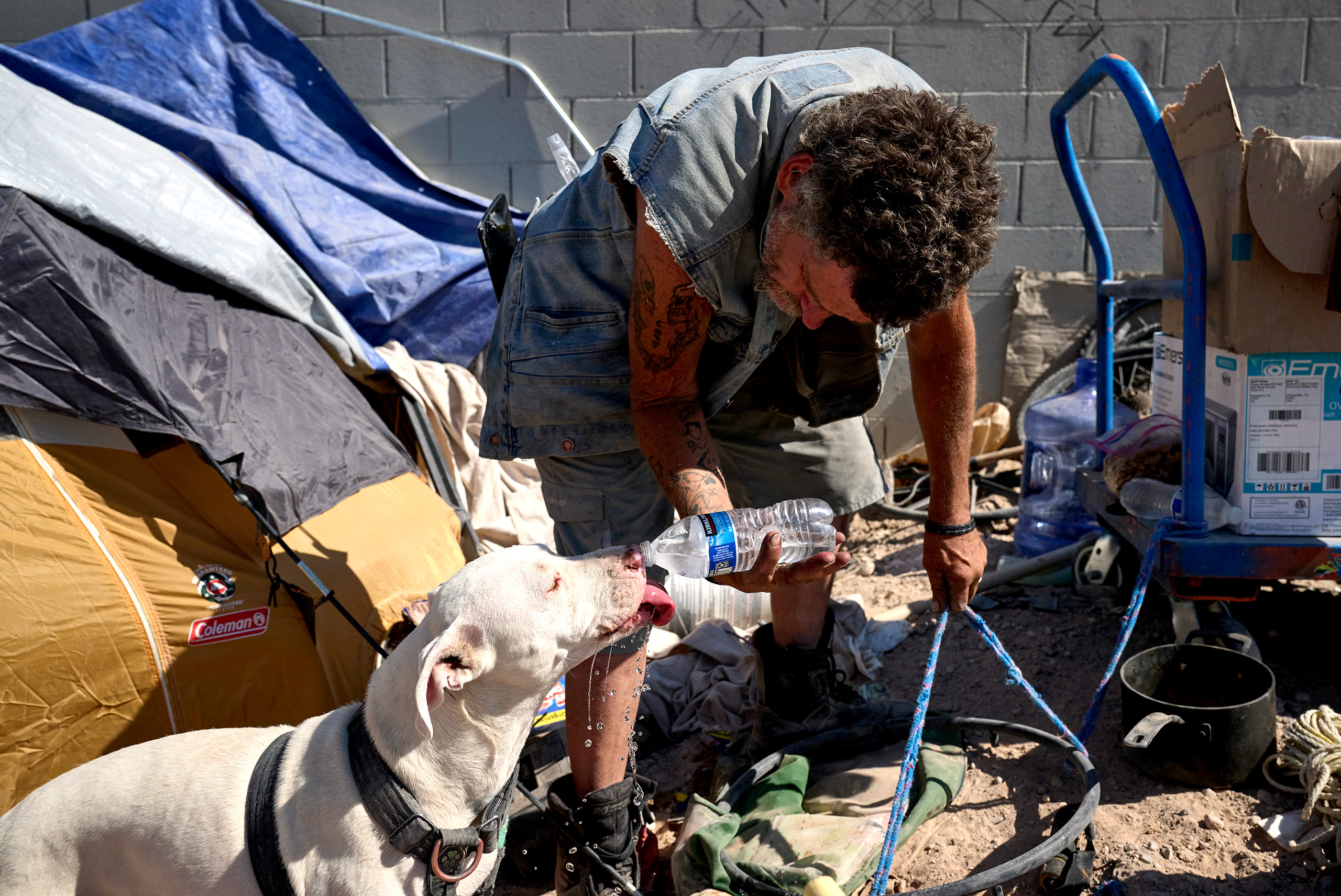
The typical visual tropes of heat include photos of children playing in fountains or tourists posing next to Death Valley’s thermometer. Such cheery imagery undercuts the gravity and scale of the problem. Bennett recognizes that extreme heat isn’t merely a temporary spike in temperatures; it’s a chronic crisis that’s exacerbated by socioeconomic inequality. In her stories, she depicts the people most vulnerable to heat: those without permanent shelter, who labor outdoors, who wait at bus stops because they don’t have cars. Bennett studies interactive heat maps to see which neighborhoods are highest risk, and has followed the HELP team twice before. “Most of the legwork is prior,” she told me of making contacts with sources. “It’s important to establish a relationship before a heatwave.”
Writing about heat has its own tropes and clichés: “It’s a scorcher”; “like sticking your head in an oven.” Kyle Paoletta, a journalist whose book American Oasis examines the environments of cities in the American Southwest, told me that writers should “work harder to describe what it feels like and what your body does.” Pavement burns, a common injury caused by high heat, blister and even blacken the skin. The most severe burns can damage bones and muscles, or even kill you, as this New York Times story describes. At the encampment with Bennett and the HELP team, I looked for ways to illustrate how heat hurts the body. A woman named Tyra gave me one idea. The heat, she told me, makes menopause unbearable.
The hottest summer days in Las Vegas—reaching 110 degrees or more—are regularly fatal; people die in their tents and on the sidewalk. The death toll of a disaster is typically the first measure of how severe that disaster is, and how seriously the public takes it. Deaths from heat, though, are tricky to count. It can take two to three months for a medical examiner to determine heat as the official cause of death. That means the tally of heat deaths from a brutal summer isn’t usually available until much later in the year, once the peak has passed. (Compounding the problem is a lack of standardization in the US around determining heat-related deaths, so death tolls are vastly undercounted.) In Clark County, totals for heat-related deaths in 2024 weren’t available until February 2025. Compare that with the floods in Texas this month, where real-time reporting of the death count immediately conveyed an extraordinary scale of devastation. And when journalists can’t access the names of people who died of heat, they miss the chance to bring their personal stories to readers. Heat’s lethal toll becomes an abstract number.
Even if you don’t die from extreme heat, your health can suffer in the long term. Studies have shown heat can exacerbate diabetes and cardiovascular disease. Extreme heat can lead to pregnancy complications, like stillbirths and premature births. Ed Kashi, a photojournalist and filmmaker who has documented the effects of extreme heat on outdoor workers, told me that heat can lead to kidney disease because people are quicker to dehydrate. His reporting described an epidemic of chronic kidney disease among sugarcane harvesters in Nicaragua—thousands of whom would eventually die from it.
Hayley Smith, an environment reporter at the Los Angeles Times, called extreme heat “insidious” for the invisible damage it causes. “During a heat wave we might see increased emergency room visits from people with underlying health issues that are exacerbated by the heat. They might not even make the connection that the heat is what triggered their health episode, and the ER visit might not be logged as heat-related by the ER staff,” she wrote in an email.
So how do you visualize a chronic, invisible crisis? The faces of Bennett’s subjects reveal exhaustion and desperation. To convey the toll that heat takes on a body, Bennett looks at people’s posture. She documents a man hunched over, a woman crouched, a elderly person sprawled flat on a mattress. She tries to capture the stark intensity of the sun—one of the HELP team calls it the “murder ball”—by playing with light and shadow. One of Bennett’s photos from June depicted riders waiting for a bus at a transit center, everyone crowded into a single sliver of shade.
Bennett also looks for places that show, as she put it to me, “how deeply heat creeps into the fabric of daily life”: food trucks, mechanic shops, delivery vans. She has photographed workers repairing power lines during a heat wave, one of the few common visual signs of heat damage to infrastructure. Occasionally, physical destruction from heat makes headlines, as with London’s Luton airport runway melting in 2022 and roads in Washington State buckling and cracking in 2021. But generally the impact is less dramatic. Power lines sag, threatening fire; increased use of air-conditioning strains the electrical grid, threatening blackouts.

When done well, journalism can convey the emotional texture of living with extreme heat. In one of Bennett’s photos from the encampment, Tyra gulps from an icy water bottle. The sky behind her is bright enough to make your eyes water; the dirt in the background is littered with a stroller, a plastic tub. Tyra’s face, shimmering with sweat, tilts upward, as if in prayer. As she drinks, the corners of her mouth stretch. The photo is tense with extremes: here is a fleeting moment of relief on an oppressively hot day.
The best heat journalism, reporters told me, provides an essential public service. “I want people to know where they can get help,” said Caitlin O’Hara, a freelance photojournalist in Phoenix. “If it’s going to be extreme heat, people should try to modify their routine in a way that they’re not in the direct sun or going out in the middle of the day. And if they have to work outside, to try to minimize risks.”
Local news stories inform readers about the signs of heatstroke, which medications inhibit the body’s heat regulation, and what legal rights they have during heat waves. A story last year in The Guardian revealed that in many states utility companies can legally cut off electricity, and thus air-conditioning, during high temperatures—though it’s illegal in some of those same states to cut off heat in the wintertime.
When I think of excellent heat reporting, I recall two series published by regional newspapers. In 2023, Joan Meiners, a climate reporter for the Arizona Republic, published multiple stories on the collision of extreme heat and housing insecurity. Even though droves of newcomers to Arizona were propelling a housing-construction boom in the state, sprawling home development did little to address the state’s affordable housing crisis, she wrote. In fact, she found that kind of development increased emissions, and therefore the city’s heat, in part because single-family homes use more energy than denser developments. As in Las Vegas, unhoused people in Phoenix bear the brunt of hotter temperatures.“The people who are contributing least to the problem, as we so often see, are the ones suffering most from it,” Meiners told me.
Two years earlier, a series from the Los Angeles Times found that California regularly undercounted its heat deaths. The series also mapped out the unequal distribution of heat across the city, with cooler temperatures in the wealthiest, shadiest neighborhoods and hotter temperatures in the poorest, most concrete-bound areas. Months after the investigation was published, California governor Gavin Newsom announced a plan to better communicate the dangers of extreme heat and more effectively monitor heat deaths.
Daily news reporting can incorporate narrative texture to make numbers come to life. A recent Associated Press story by Seth Borenstein on New York’s heat wave last month wove quotes from meteorologists into reporting from daily life around the Northeast: a canceled high school graduation ceremony, a campaigner for Zohran Mamdani powering through the day with the help of a pink electric fan, a dry-ice vendor whose phone rang with emergency orders from morning to night. (An accompanying video in which a reporter tries to fry an egg on the sidewalk detracts somewhat from the article.)
Context is crucial. While heat’s connection to climate change is relatively straightforward—hotter temperatures, caused by fossil fuel emissions, are the underlying cause of so many other of our planet’s disasters, like melting glaciers, intensifying hurricanes, and deadlier wildfires—high temperatures still get framed as a fact of summer. Meiners urges newspapers to communicate an ongoing crisis. “Local media is in decline, and sometimes all you can do is just report that a temperature record was broken, or a heat wave is coming. That could save lives,” she told me. “But I think there’s a lack of adding context. Why is this an unseasonable heat wave? Why are we having dozens of new temperature records a year?”
At the Los Angeles Times, many of the dozen or so journalists on the environment, health, and science team cover extreme heat as a climate story. “It’s one of the most effective climate change narratives in terms of explaining to the public what’s actually happening,” said Elijah Wolfson, the newspaper’s environment, health, and science editor. “It is undeniably hotter in general. And that’s a lived experience that makes climate change real, in a way that even something like a flood or a hurricane doesn’t do. Those are, in even the worst cases, still fairly geographically specific.”
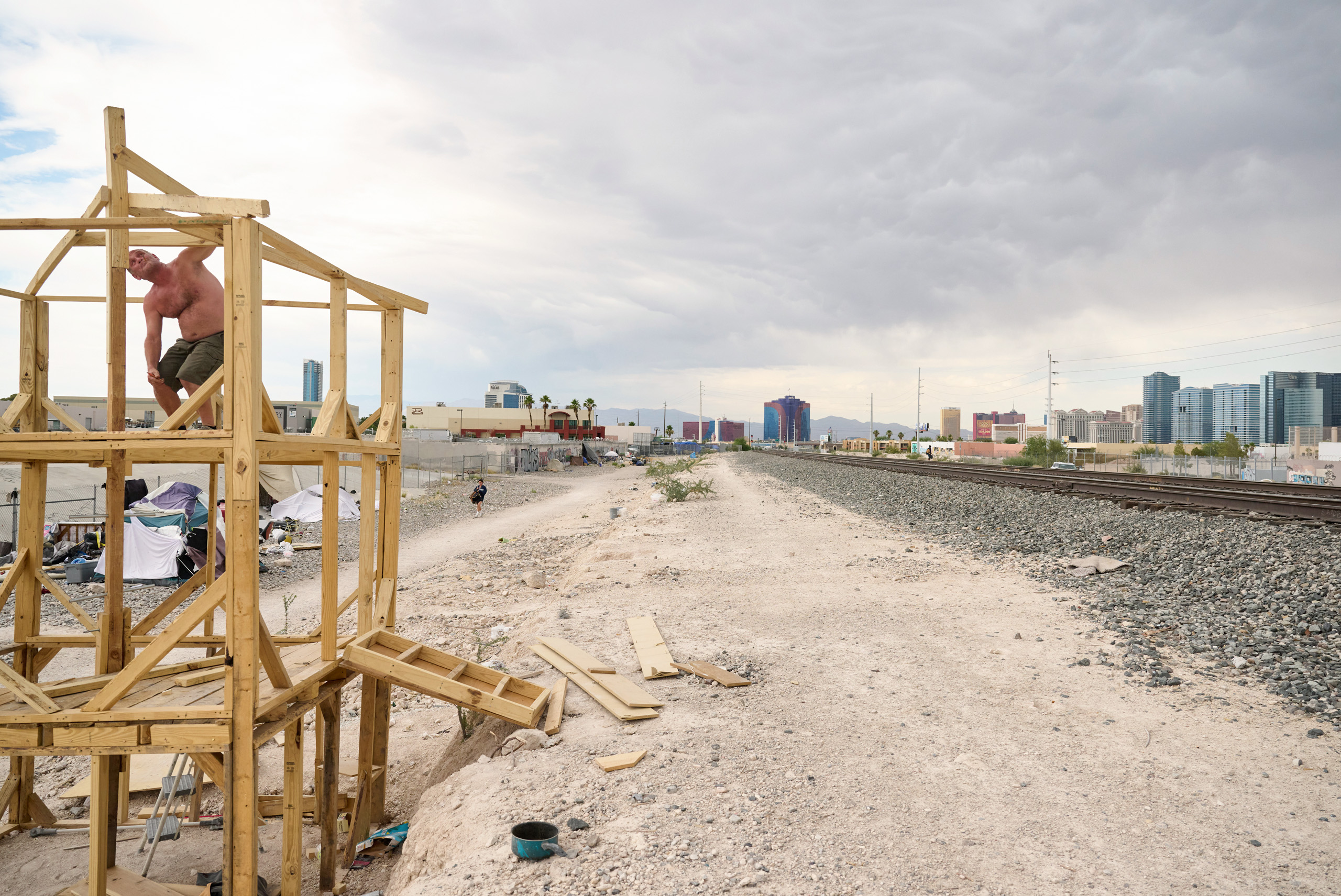
The local context also matters. There’s no single way of defining heat—what feels hot depends on where you live. Meteorologists measure regular old air temperature, apparent temperature (what heat feels like to the human body), and wet-bulb globe temperature (combining temperature, sunlight, humidity, and wind). A heat wave in Buffalo, which sees relatively high humidity, feels different from a heat wave of the same temperature in Las Vegas, as journalist Jeff Goodell wrote in his 2023 book The Heat Will Kill You First. People living in New York are also less likely than people in Las Vegas to have air-conditioning and to know how to respond to extreme heat. “Heat waves are more like stories than meteorological events,” Goodell wrote. “Each one has a particular setting, a cast of characters, and different dramatic flash points.”
National media tend to focus on extreme heat in places like Phoenix and Las Vegas. Understandably so: last year, Phoenix saw seventy days of temperatures 110 degrees or hotter. But, as Meiners put it, “Phoenix might be ground zero, but heat’s coming to a city near you. Everybody is going to have to figure out how to do this.”
Like the people in the communities they cover, journalists should take heat precautions when reporting. Bennett and I were in the sun for three and a half hours. We kept most of our skin covered. We wore long-sleeve shirts in ultraviolet factor protection fabric, hiking pants, trail runners, and baseball caps. We brought snacks and water, and packed extra batteries, because they drain faster when it’s hot out. (I’ve had my recorders die mid-interview.) Bennett told me she sometimes gets hazard pay for reporting heat stories.
“Treat it like you’re sending someone into a hurricane,” O’Hara, the Phoenix photojournalist, told me. “Your safety analysis has to be I’m going to stay hydrated. I’m going to stay cool, because once your body temperature gets up, it’s really hard to cool down, and your medications can stop working.” Sometimes, she said, it takes a full day for her body to recover from heat reporting.
Bennett and I ended our day with HELP around 12:30pm. Louis Lacey, who directs HELP’s homelessness response teams, drove us past a corner of town where junkyards rented out space to people living in their RVs. Nearby, a junk removal company contracted by the city was removing debris from an encampment, a process euphemistically called an “abatement.” In 2020, a city ordinance made it a misdemeanor to camp or sleep on sidewalks in the downtown and residential areas, a ruling that was reaffirmed by the 2024 Supreme Court decision City of Grants Pass v. Johnson.
We spotted an inflatable pool situated in the shade of a drive-through pharmacy. “It’s not where you live, it’s how you live,” Lacey said. Across the parking lot, a man in a bandanna laid out a prayer rug next to a dumpster. Behind him sat a half-full gallon of water. After the day with HELP, Bennett would brainstorm ideas for other images she’d like to make over the course of July. One solution to the challenges of covering heat is to keep covering it, I heard more than once.
By mid-June, heat was confirmed to have contributed to the deaths of three Clark County residents this year. One was an eighty-six-year-old man with an irregular heartbeat; another was a forty-seven-year-old who overdosed on methamphetamine. That number was almost certainly an undercount, and it would only go up. Summer had just started.
Has America ever needed a media defender more than now? Help us by joining CJR today.