Sign up for the daily CJR newsletter.
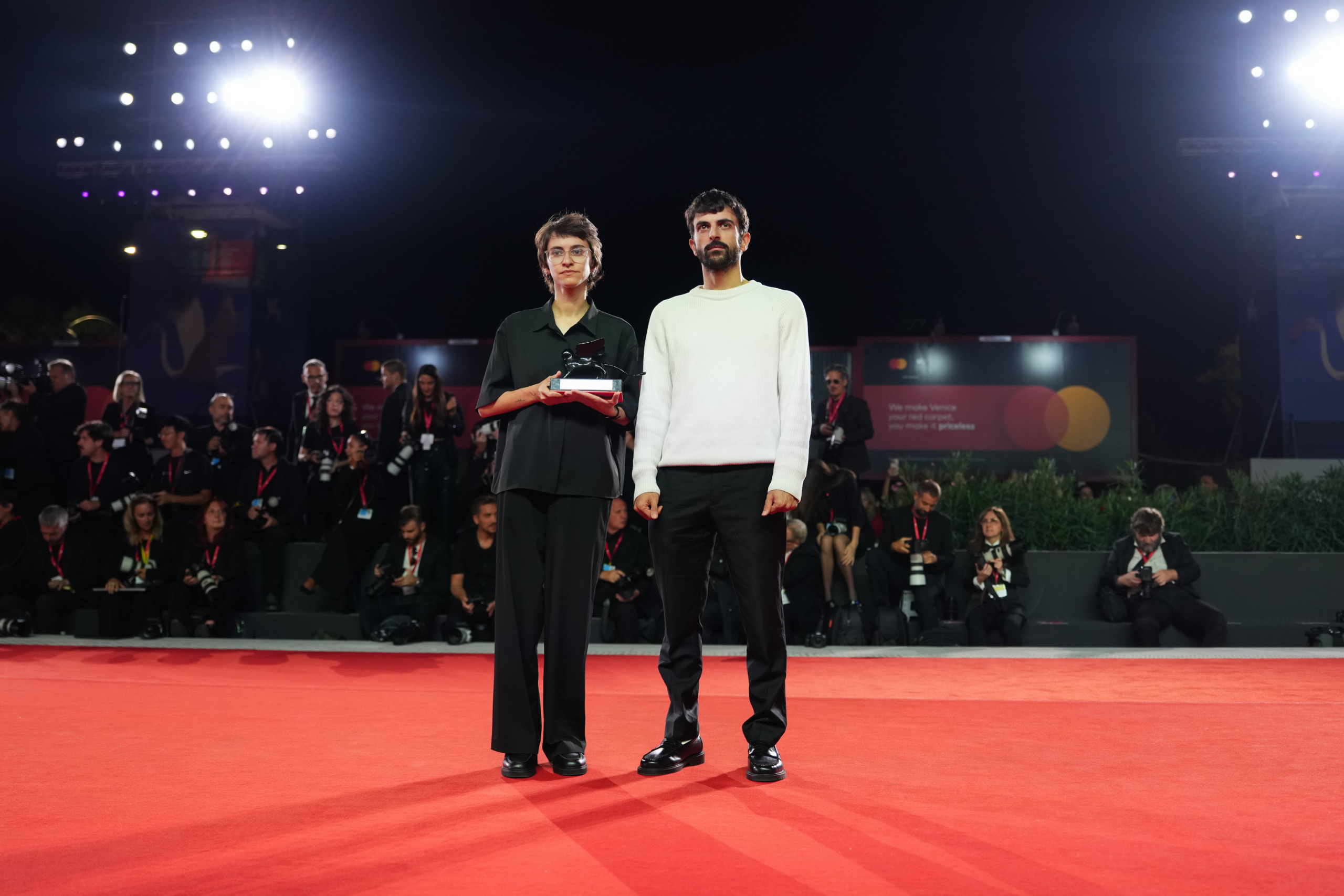
Last week, Shin Bet, Israel’s version of the FBI, contacted the Israel Defense Forces to ask if it had begun an investigation into NAZA, a new documentary about Israel’s post–October 7 assault on Gaza. Haaretz reported that the IDF had not done so, and hadn’t yet decided if it would—because officials had not seen the film. In fact, hardly anyone has. But following its premiere, at the Venice Film Festival on September 10, where it received a twenty-five-minute standing ovation, NAZA has sparked extreme, ongoing waves of attacks, from the country’s top public officials and most radical activists alike, merely by existing.
NAZA is an IDF term, shorthand for the Hebrew phrase nezek agavi, meaning “collateral damage.” The film is made up almost entirely of interviews shot on rooftops in Tel Aviv. Anonymized IDF officers and soldiers from elite intelligence units, their faces obscured by the darkness of night and voices digitally altered, describe how they acquire targets in Gaza, where more than seventy thousand people have been killed: the army gives any potential strike on an alleged combatant a NAZA number, indicating the tally of civilian deaths deemed acceptable by the IDF. There are no distinctions made for babies, children, or adults; every Gazan is one unit of NAZA.
Miki Zohar, Israel’s minister of culture, has accused Rachel Szor and Yuval Abraham, the filmmakers, of treason. Eyal Zamir, the IDF chief of staff, called the movie “an attack on the State of Israel” and said the army will fight it using “every tool at our disposal” and “examine and advance possible legal actions regarding the film and those involved in it.” In response to NAZA, Benjamin Netanyahu, the Israeli prime minister, said he planned to introduce legislation that would increase “twentyfold” the monetary damages for anyone convicted of defamation and to “revoke the citizenship of anyone who defames IDF soldiers.”
On the streets of Israel, the response has been raucous and terrifying. The Shadow, a rapper and right-wing activist, posted a mural on Facebook depicting Abraham and Szor holding mug-shot placards. Mobs have gathered outside the Szor family’s home, with some chanting “Death penalty to the traitors” and calling for the directors’ houses to be demolished, a common tactic for families of people Israel has deemed to be terrorists. In one NAZA protest video, Mordechai David, a right-wing radical with a large social media following, declares into a megaphone, “This is just the beginning,” then asks his cameraman to turn his lens on the protesters. “Let it be clear to everyone: We are the peace activists. We are the human rights activists,” he says.
Along with ten other organizations, the Committee to Protect Journalists has released an open letter calling on Israeli authorities “to protect Abraham and Szor’s fundamental rights.” The Guardian, which produced the film, released a statement supporting the filmmakers and the veracity of their work. “The interviews were given by confidential journalistic sources,” the statement reads. “We will robustly defend NAZA—and the team behind it—from any attacks or attempts at censorship.” The movie will open in New York on September 30 and expand nationwide on October 9.
The IDF has countered that the film “adopts narratives of Israel’s haters, defames our soldiers and commanders, and seeks to portray the IDF as deliberately acting unlawfully,” adding that “this is a dangerous attempt to strip us of the legitimacy to defend ourselves against the worst of our enemies, and in doing so to pose a real danger to IDF soldiers and commanders.”
After Venice, NAZA showed at the New York Film Festival, where I saw it. The movie, at just seventy-seven minutes, is lean, intense, and quietly devastating. Szor and Abraham had entered this realm before, with 2024’s No Other Land, directed and produced with Basel Adra and Hamdan Ballal, both Palestinian filmmakers and activists; that film, about the occupation of the West Bank, won the Oscar for best documentary feature. Working primarily for the sister publications Local Call and +972 Magazine, Abraham has produced remarkable investigations revealing the IDF’s use of AI to abet mass killings in Gaza and the widespread destruction of buildings and infrastructure, reporting on which NAZA is based. Specifically, he has reported on Israel’s extensive deployment of Lavender, an AI system used to compile kill lists of targets in Gaza. (David has filmed himself roaming the Tel Aviv offices of Local Call and +972 Magazine, intimidating employees and forcing staff to evacuate.)
Why have NAZA and Abraham’s reporting struck such a chord in Israel? Ben Reiff, the deputy editor of +972 Magazine, wrote recently that while “people around the world have watched in horror as Israeli ground troops in Gaza revelled in their crimes on social media,” NAZA “shines a spotlight on a very different kind of Israeli soldier: the intelligence officers considered Israel’s ‘best and brightest.’” They are largely “secular, upper-middle-class, and see themselves as liberal,” Reiff wrote. (In this context, “liberal” can largely be understood as opposed to Netanyahu.) But it is these soldiers, “sitting behind screens,” who have overseen “mass killing on a scale far greater than anything the messianic-Kahanist soldiers on the front lines could do.”
After NAZA’s Venice premiere, Abraham sat for an interview with Channel 13, an Israeli news station. His interviewer was Raviv Drucker, a respected investigative journalist known for uncovering Netanyahu’s scandals, who has both praised the film and criticized it for what he says is a lack of context. In the segment, Abraham expresses his admiration for Drucker before confronting him: for nearly three years, neither Drucker nor any mainstream Israeli investigative programs had aired anything on the subject matter that NAZA covers.
Abraham was remote for the interview, not in the Channel 13 studio. “Israel is my home,” he told Drucker. “It’s the place where I want to live, the place that’s so important to me. So of course I’m scared that I won’t be able to return. What will I do?”
Has America ever needed a media defender more than now? Help us by joining CJR today.