Sign up for the daily CJR newsletter.
Susie Banikarim is away on summer vacation, so we’ve pulled Bill Grueskin back in, Michael Corleone–style. Susie will be back next week.

For understandable reasons, many people don’t like having their picture taken by a news photographer. They may dislike it so much that they run from, or even threaten, the person holding the camera. But then, sometimes, a photographer comes upon a subject like Roswell Encina.
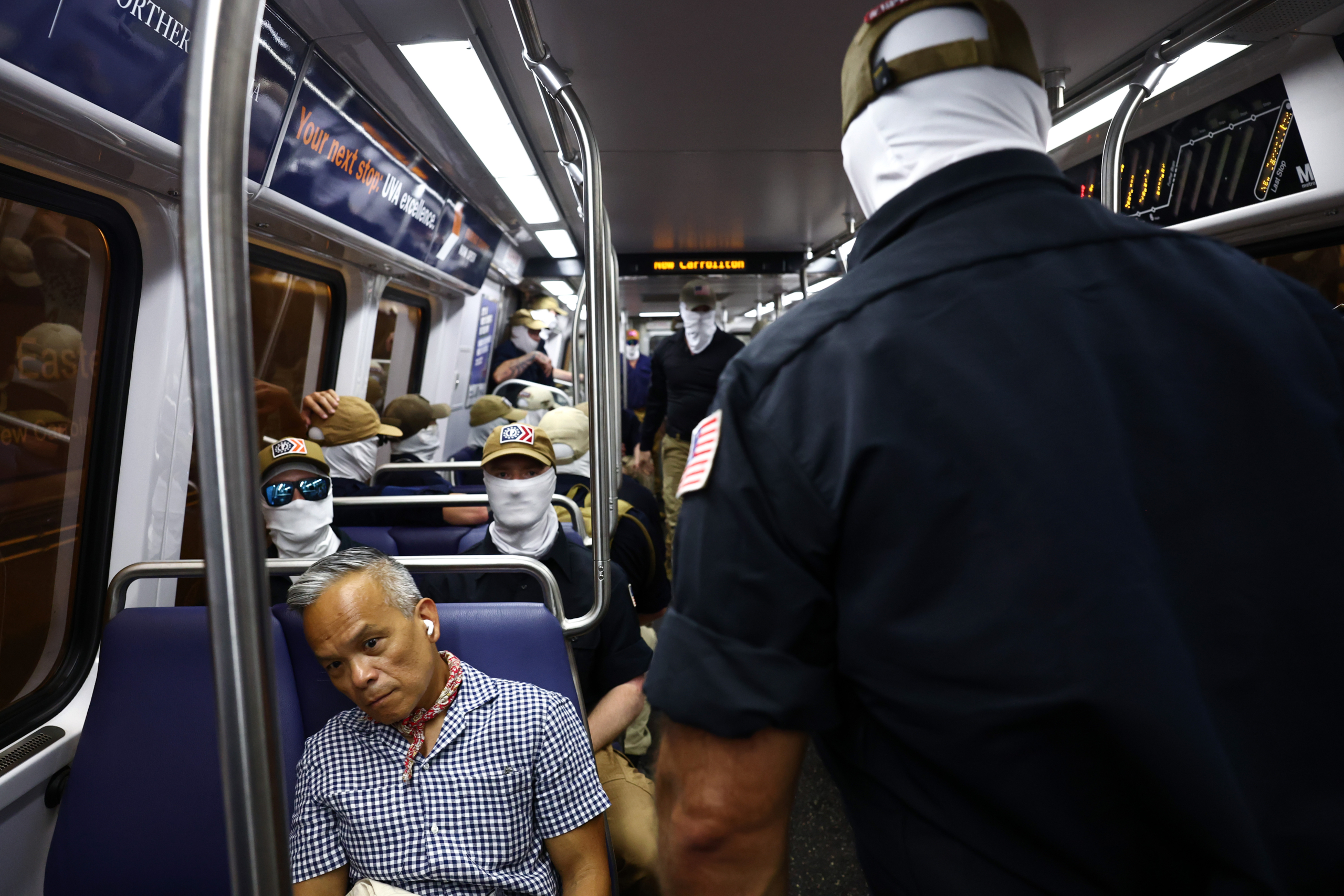
Last weekend, Encina, a gay Filipino American man, found himself surrounded by white nationalists in a crowded subway car. A young Getty Images intern captured the frightening scene in photos that spread around the globe. (You may also have seen a similar Reuters photo of Bernita Bowlding, a Black woman who found herself surrounded by Patriot Front men, on a Metro car that Saturday.)
Let’s set the scene. It’s July 4 in Washington, DC, and Finn Gomez, who is twenty-three, is finishing the first week of his internship at Getty Images. He’s on his scooter that steamy morning, prowling the streets for feature photos, when his editor texts him that a large group of masked Patriot Front demonstrators are near the Capitol. Could he check it out?
Gomez can’t find the men at first, but a helpful cop points him toward a Metro station. Then, as Gomez told me, “I get back on the scooter, and I’m just hauling. I went straight up Pennsylvania Avenue, towards the Eastern Market Metro station, and the first thing I saw was three hundred, four hundred of them.”
Gomez managed to squeeze his way into the station and onto a subway car that was filling up with the white nationalists. Encina, the president and CEO of the nonprofit US Capitol Historical Society, happened to already be in the car when the men flooded in. As Encina told Christopher Wiggins from The Advocate, he didn’t initially know who the group was. But when he saw their patches and logos, he figured it out. Wiggins asked Encina if he was scared. “I would be lying if I said no,” he answered. “I was terrified, honestly, just because I wasn’t sure what the motives were.” And indeed, their motives weren’t clear. The group formed in the wake of the 2017 Unite the Right rally in Charlottesville, Virginia, though their demonstration last weekend didn’t amount to much.
Gomez approached the scene with an empathy that belies his young age. When he saw Encina surrounded by the masked men, he introduced himself and asked if he could take some photos. “He said, ‘Okay, go ahead, do whatever you need to do.’ He understood from the get-go that I was there to document this.”
Gomez, Encina, and the Patriot Front gang rode together past seven stations, to the terminus of the line at New Carrollton in suburban Maryland. All along the ride, Gomez was snapping photos and transmitting them to his editors at Getty.
The next day, Encina posted two of Gomez’s photos on his Instagram page, noting how “unsettling” the experience was. “I came to this country as an infant and became a US citizen,” he wrote. “So sitting there, on the Fourth of July, I couldn’t help but think about the promise of America and the work still required to protect it.… The day after Independence Day feels like the right time to remember that patriotism isn’t about intimidation or fear. It is about having the courage to keep widening the circle of liberty, dignity, and opportunity.”
And then, Encina ended his post with “a special thank you” for the young photographer, “whose presence was quietly reassuring.”
He elaborated on that in a comment to Wiggins, from The Advocate, saying that Gomez offered “some comfort to me in a way that I know there’s somebody else there, but most importantly, someone who’s documenting it. So it gave me a sense of protection.”
We journalists spend a lot of time wondering what our readers think about our coverage, and appropriately so. We also should understand that many of the people whom we report upon—people like Encina—are grateful that we are witnessing and telling their stories, and they have a deeply nuanced understanding of what we do. In that moment, Encina saw this photojournalist as a protective shield, not an intrusive force. That’s reassuring, and at a time when independent reporting is under attack in the US and worldwide, we should take a moment to appreciate that.

We all have our favorite words, but if you write headlines for the New York Post, you might want to renew your love for one of the simplest: of. Turns out that, though this simple preposition is the fourth most commonly used word in the English language, all kinds of mayhem can ensue when you leave it out of a headline.
Our saga begins with a March 2026 working paper from the Federal Reserve Bank of Dallas, “The Impacts of Unauthorized Immigration on US Labor and Housing Markets: New Evidence from Administrative Microdata.” Though some of the report’s sixty-five pages seem dense for those of us without PhDs in statistics or economics, much of it is clear and salient. The authors examined the impact of the surge in immigrants from 2021 to 2024, and found a mixed bag: In many markets, employment rose without depressing wages, but the surge in new residents did contribute to price rises for housing and rentals. Much of the housing inflation we saw in those years would’ve happened anyway, given the bounce-back after the COVID epidemic. But the authors conclude that during those three years, about 30 percent of home-price rises, and 20 percent of rental-price rises, could be attributed to the influx of immigrants.
Those boldface entries are intentional, and here’s why.
On July 5, Fox Business published a story about the report, with this headline: “Biden-era illegal immigration drove up housing costs, Fed economists find.” A few hours later, the New York Post (also under the aegis of Rupert Murdoch) picked up Fox’s story verbatim but added its own zesty, typo-encumbered headline: “Biden’s illegal immigration surge triggered 30% rise in home prices, $ 20% in rents, Fed paper finds.”
In other words, the Post claimed that immigrants caused a 30 percent rise, not 30 percent of the rise. And the Post used the same wording on X, where at last count the item has racked up more than eight million views.
If you’ve ever tossed a flaming torch into a vat of kerosene, you know what happens next. President Trump pushed out a Truth Social post to his 12.9 million followers, highlighting the phony claim: “Fed Reserve working paper suggests Biden illegal immigrant wave drove up home prices 30%.” Vice President JD Vance added his two cents on X, quote-tweeting the Post and getting an additional two million views while adding this: “Despite the left’s incessant whining, Trump was right all along.” The Department of Homeland Security used its official account to cite the Post piece and added this vow: “The solution to high housing costs: mass deportations.” Markwayne Mullin, the DHS secretary, joined in, as did Scott Turner, the secretary of Housing and Urban Development.
A few numerate users of social media tried to correct the record, but they were overwhelmed by Trump followers who took the Post’s headline at face value. So, on Tuesday morning, I wrote to Alison Rudnick, a Post spokesperson, and asked whether this story would be fixed. About ninety minutes later, the Post published a corrected version, though the errant X item is still alive, getting thousands of retweets and likes by the hour.
Though the original story on Fox Business’s site wasn’t a problem, the narrative that the Post incited came back to haunt the network. Earlier this week, the network’s midday Big Money Show featured a panelist promoting the Post’s wrong numbers, claiming that “the record wave of illegal immigration from 2021 to 2024 under Joe Biden drove home prices up 30 percent and rents up 20 percent in the areas that were hit the hardest.”
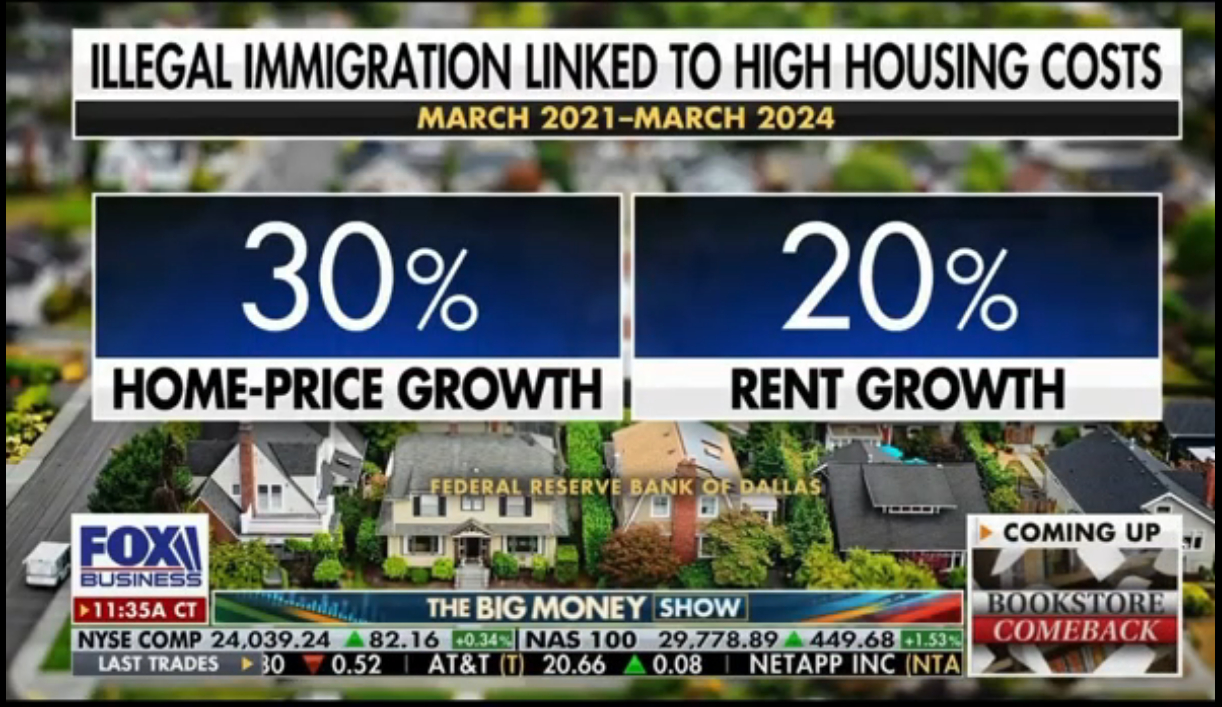
I pointed this out, citing a Big Money Show post on X, to a Fox spokesperson on Tuesday, and by the next day the post had been deleted. (Anticipating that, I had already downloaded the video, which you can access here.) The network did run a full-throated correction on Wednesday.
On Thursday, another Murdoch property weighed in. The Wall Street Journal editorial board castigated Trump and Vance for spreading falsehoods, stating that “politicians are misusing a Fed study on migrants and home prices.” (The Journal didn’t bother to mention that its sister property at the Post was the initial source.)
We should have sympathy for reporters who are asked to translate, for a general audience, studies like this one that include such phrases as “standard errors are heteroskedasticity-robust.” And this particular study could be read in several different ways. One of the authors’ conclusions is that the influx of undocumented immigration spurred a 6.6 percent rise in house prices and a 4.3 percent rise in rent prices from 2021 to 2024. Meanwhile, immigrants often work in construction, so their labor should help increase housing supply and keep costs contained. And given that most Americans live in homes that they or their family members own, a rise in real estate prices isn’t a bad thing for everyone. Good luck wrapping all of that into a compelling, accurate, ten- or fifteen-word headline. It’s also worth noting that when I pointed out the errors to the Post and Fox, corrections came pretty quickly.
But the damage from a bad headline—even one that is missing just a single word—proved to be impossible to contain. The Post’s wording showed up in the social media feed of the world’s most powerful person, and it swiftly went out of control, abetted by many of Trump’s closest aides and allies, who couldn’t be bothered to do the most basic fact-check on whether the headline fit their prior assumptions.
I did ask the Post’s Rudnick if the editors would reach out to Trump or others to correct the record. “Nothing additional,” she told me.
If you have a suggestion for this column, please send it to laurelsanddarts@cjr.org. We can’t acknowledge all submissions, but we will mention you if we use your idea. For more on Laurels and Darts, please click here. To receive this and other CJR newsletters in your inbox, please click here.
Has America ever needed a media defender more than now? Help us by joining CJR today.