Sign up for the daily CJR newsletter.
To honor the spirit of Thanksgiving, we are offering a Dart-free column this week—although, as you’ll see from the final item, this was not easy to do.

Tremane Wood had just eaten the meal he figured would be his last: fried catfish, okra, coleslaw, chocolate ice cream, and Dr Pepper. He was moments away from being administered a lethal injection to punish him for his role in a 2001 robbery that led to a man’s death.
And then the word arrived from Oklahoma governor Kevin Stitt: “After a thorough review of the facts and prayerful consideration, I have chosen to accept the Pardon and Parole Board’s recommendation to commute Tremane Wood’s sentence to life without parole.”
Wood’s near miss with the executioner’s syringe came after months of meticulous attention to his case by his attorneys, family, and advocates. He also had a reporter telling his story—Jessica Schulberg, whose coverage in HuffPost helped set the stage for Wood’s miraculous escape.
More than a year ago, Schulberg published her first deep dive on the case: “His Brother Admitted to a Murder; He Is Sentenced to Die for It.” As the headline made clear, Tremane Wood didn’t kill anyone. He was a participant in the robbery, but his brother was the one who put the knife into the victim. Nevertheless, Wood was sentenced to death under a felony murder statute that holds that someone involved in a significant crime that leads to a homicide can be convicted of murder—and face the death penalty.
Wood’s case was especially tragic because his court-appointed attorney was an incompetent mess. The lawyer rarely met with Wood before trial, admitted to drug and alcohol abuse, and would eventually have his license suspended after the state bar charged him with eleven counts of misconduct based on his neglect of clients. Watching the trial, another brother of Wood’s (who was not involved in the crime) was mortified. As he told Schulberg, “I’m sitting there, looking at my mom, going, ‘This is the fucking lawyer?’ I wanted to get up and say, ‘Can I represent my brother? Because this asshole has no clue what he’s doing.’”
There were other issues, too: a juror’s regrets over her decision to endorse the death penalty; some weird coziness between a judge and prosecutor; and the feelings of the victim’s mother, who didn’t favor the execution. Last week, the Oklahoma Pardon and Parole Board voted 3–2 to recommend clemency for Wood, and the governor endorsed the decision.
Schulberg, who has been at HuffPost for more than a decade, covers incarceration and criminal justice. She heard about Wood’s case from his new lawyer and then spent more than a year, on and off, working on that first big takeout in October of 2024. “I was really drawn to this case because the legal standard for proving ineffective counsel is so high,” Schulberg told me. “It’s not enough to just show that they did a bad job. You have to be able to prove that, with a better lawyer, the outcome would have been different.” She spent months poring through trial transcripts and other court documents, as well as managing the delicate task of reaching out to relatives of Wood and of the victim. As Wood’s November 13 execution date neared, Schulberg wrote several other stories to highlight inconsistencies and contradictions in the case.
She was able to obtain permission to view the execution, so she flew to Oklahoma City and woke up at 4am last Thursday to drive the two hours to the penitentiary in McAlester. She and others close to Wood then waited in a “gathering zone” in the predawn hours, where “very nice, friendly” staff from the Department of Corrections made small talk while offering them “chips and crackers and coffee.”
They expected to be loaded into a van about an hour before the 10am execution, but nothing was happening. “I just kind of obsessively was refreshing my phone and trying to get in the mental headspace of ‘You’re here—you’ve got to do your job.’” Then, at 9:58, a message popped onto everyone’s phones: the governor had stopped the execution. Said Schulberg: “To experience that level of relief, and to see other people experiencing that level of relief—it was the most intense happiness I’ve ever felt in my life. I was like, this is ecstasy. Like, I’m never going to feel this happy again.”
Schulberg’s decision to go to Oklahoma for the execution hadn’t come easily. Her brother and mother advised her not to. “You’re never going to be able to unsee this,” her brother told her. But when it was over, her brother said, “Your willingness to witness the worst thing ever meant that you got to see the most wonderful thing ever.”
HuffPost churns out a lot of copy every day—a requirement for a free site. So it’s to the credit of Schulberg’s bosses that they gave her the space to undertake this coverage. She cites two of her editors—George Zornick and Ani Vrabel—in particular, along with top management. As Schulberg notes, most coverage of death penalty cases begins a few days before the prisoner goes to the chamber. “To do these stories well,” she said, “you have to be given the time and space to investigate them, to read all the documents and to build trust with the individual and the family. That takes a really long time, and it’s really hard to do that at the last second when execution is imminent.”
“When I win, I will immediately bring prices down, starting on day one,” Donald Trump promised a few months before the 2024 election. Most prices haven’t dropped, even as the rate of inflation has slowed from the post-pandemic binge.
That hasn’t stopped Trump and his lieutenants from claiming that prices are lower. One of their favorite examples is the “Walmart Thanksgiving Meal,” which, ostensibly, has dropped from around $7 per person in 2024 to about $4 in 2025. White House economic adviser Kevin Hassett gave it a try this Sunday while being interviewed by Jonathan Karl on ABC News’s This Week.
This was, as Hassett would find, a grave error.
Here is how that dialogue went:
Karl: The president claims that Thanksgiving costs are down twenty-five percent. I mean, does he know that’s not true?
Hassett: Well, if you look at Walmart and the few places that put out their prices, Thanksgiving prices—
Karl: Wait—wait a minute, I’ve got to stop, because the Walmart comparison’s, like, not a thing. I mean, Walmart had a Thanksgiving package last year. They’ve got a Thanksgiving package this year. The one this year contains much less than the one last year.… So that’s why the price is less.
And then, with the trapdoor squeaking to a close, Karl said, “Look, we got a chart here.”
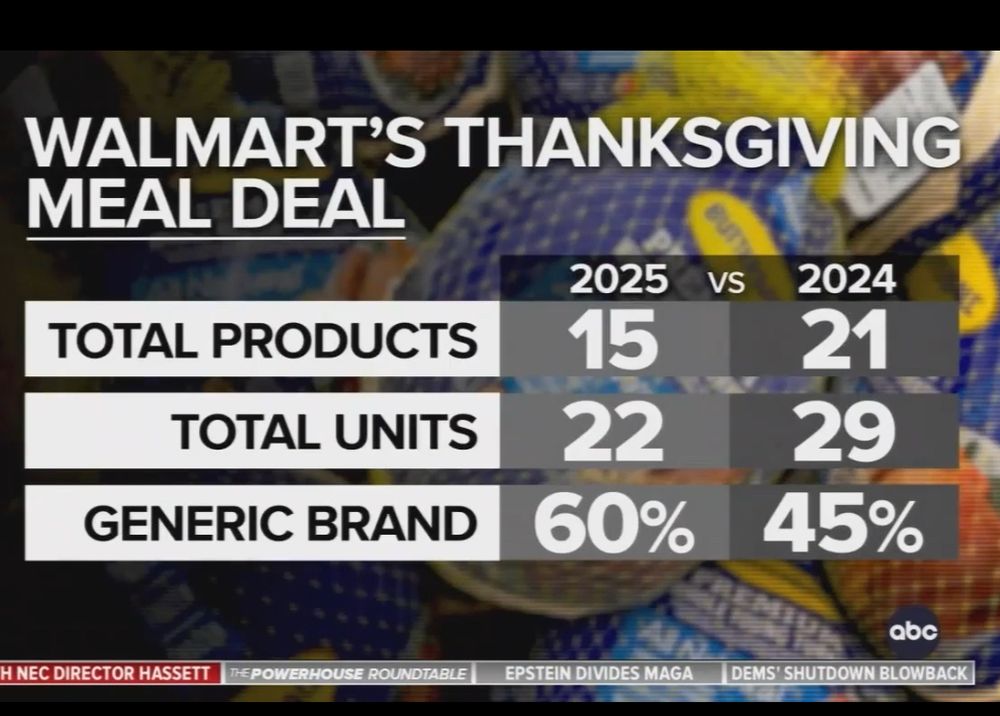
As you can see, Walmart was not exactly comparing cranberries to cranberries. The company removed a half-dozen items from the 2024 cart—everything from a pecan pie to fresh celery and sweet potatoes. So, voilà, this 2025 cart got a lot cheaper because it got a lot smaller. Fortunately, Karl and the ABC News crew must have had an inkling that Hassett might use this example on air. But since they did their homework, ABC viewers got the full story in real time, and not in a fact-check segment running days later.
Other Sunday talk shows, take note!
For many years, there was this thing called the International Imitation Hemingway Competition, a contest that invited people to parody the Nobel Prize winner’s spare, crafted style. (Those two adjectives would have been two too many for him.) Judges would receive thousands of entries, many of such high quality that the sponsors even published an anthology of the best. Among the most memorable was this one, about a beautiful woman on a paid highway: “I do not ask for whom’s the tollway belle. The tollway belle’s for thee.”
Perhaps someone might resurrect the idea, but rename it as the International Imitation Nuzzi Competition, in honor of Olivia Nuzzi, the former New York magazine writer who has written an autobiographical account of, among other things, her distant love affair with Robert Kennedy Jr. An excerpt appeared this week in Vanity Fair.
The problem with renewing the contest, though, is that it would be difficult to parody lines such as:
He desired. He desired desiring. He desired being desired. He desired desire itself.
I loved that he was insatiable in all ways, as if he would swallow up the whole world just to know it better if he could.
The moon was big and gold and we marveled at this. “I do pay attention to the moon,” he told me once. We had been born under the same kind of moon, the January waxing gibbous in Capricorn, 97 percent illumination, 39 years apart. “Do you think this means we’re compatible?” he asked me. “I don’t know,” I said. “Maybe.”
Alas, we already have a winner this year: Nuzzi herself, when she wrote this: “I mean to tell you that this is more meaningful and more meaningless than you might think.”
(And for the best take I’ve seen on the whole mess, please read this Colby Hall piece from Mediaite: “The Olivia Nuzzi Comeback Is Everything Wrong with Modern Media.”)
Your Laurels and Darts team will be too busy digesting the Grueskin Family Thanksgiving Meal Deal to write a column next week; we’ll return December 5. If you have a suggestion for this column, please send it to laurelsanddarts@cjr.org. We can’t acknowledge all submissions, but we will mention you if we use your idea. For more on Laurels and Darts, please click here. To receive this and other CJR newsletters in your inbox, please click here.
Has America ever needed a media defender more than now? Help us by joining CJR today.