Sign up for the daily CJR newsletter.

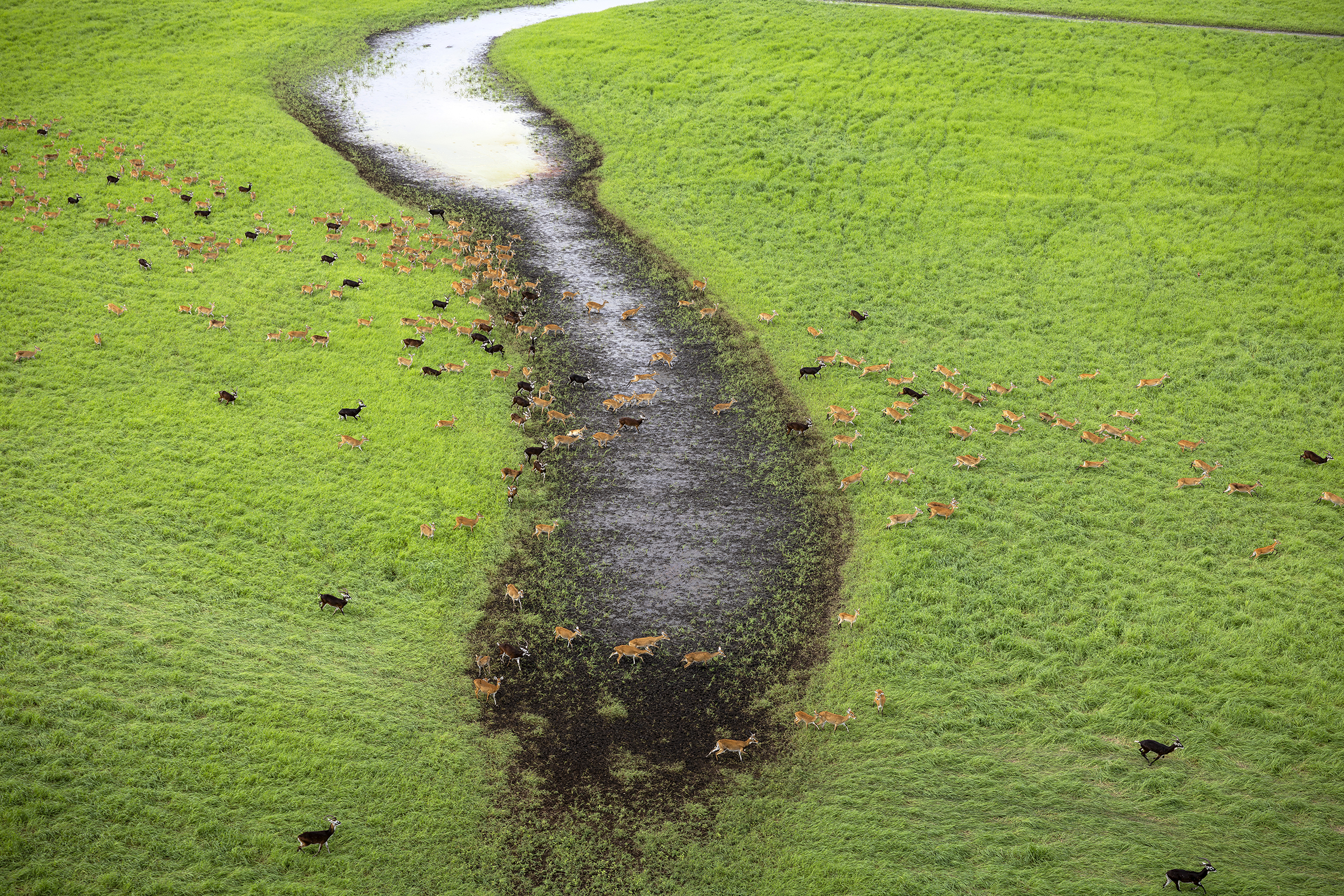
“The animals storm through sparse forests and open savannah, trickles of antelope merging to become streams, streams swelling and spreading until the landscape is filled with thundering rivers of white-eared kob, tiang, Mongalla gazelle and Bohor reedbuck. A single herd can number 100,000 antelope, or more. ‘This is the greatest migration of large fauna in the world, including the oceans,’ says naturalist Mike Fay. ‘The entire planet should be amazed that this exists.’”
So opens one of the most gorgeous stories you’ll read this year, thanks to an expedition by the Wall Street Journal’s Michael Phillips to South Sudan to capture this spectacle. Because the area is so remote, and is surrounded by warring factions, murderous gangs, and poachers, few humans ever see this wildlife cavalcade. But Phillips, aided by photos from Brent Stirton and illustrations by Annie Ng, brings the migration to life while warning of the risks that humans pose to the herds. “Hunters armed with military-grade weapons have been mowing down entire herds of antelope,” Phillips writes, adding that officials tallied fourteen thousand dead antelope in one town, where the carcasses go for fifty dollars apiece.

On Sunday, a day after he wrote that “Chicago about to find out why it’s called the Department of WAR,” President Trump stepped outside the White House and addressed the press. One of the reporters was NBC’s Yamiche Alcindor, who asked a perfectly reasonable question: “Are you trying to go to war with Chicago?”
Trump responded with this: “When you say that, darling, that’s fake news. I don’t go to war. Listen. Be quiet. Listen. You don’t listen. You never listen. That’s why you’re second-rate.”
And what did the rest of the reporters do? They moved on, just as Trump knew they would. The White House press gaggle will rarely defend their colleagues or challenge the president on his personal attacks, no matter how often the White House gives them wedgies, shoves them into the janitor’s closet, or glues “KICK ME” signs to their Spider-Man backpacks.
Trump has treated Alcindor, and other Black women journalists, this way before. He’ll do it again. And while there was a time when reporters would stand up for their colleagues (including coming to the defense of Fox News), those days are mostly behind us now.
And if you wonder why I keep coming back to the White House press corps, it’s because of this: Most Americans don’t have the opportunity to see reporters doing their work—covering meetings, digging through court files, interviewing businesspeople or schoolteachers. What they do see are the gaggles in front of Trump and the press conferences in the briefing room. And it’s not always a pretty sight.
If you’ve ever had the great good fortune to cover a utility’s rate-hike hearing, you know that most people who show up are opposed to paying more for electricity or natural gas.
But when Florida Power & Light held a series of hearings across the state, something odd happened. Dozens of folks came to support the utility’s plea for more money.
Weird, huh? Fortunately, Tampa Bay Times reporter Emily L. Mahoney decided to dig into this, and found that more than four dozen of these everyday, salt-of-the-earth citizens had ties to FPL. One of the speakers was Deborah Koch, who praised the FPL’s customer service at a hearing. Koch, as it happens, is also the executive director of the American Red Cross’s Miami chapter, which has received more than $230,000 from the utility since 2019. Another loyal supporter owns a warehouse company that lists FPL as a client.
There were, of course, plenty of unaffiliated customers, who tended to oppose the increases. “I am going to go home tonight and cuddle up to an ice pack because I can’t afford to turn the air-conditioning on,” said one. As for the utility, a spokesperson said, “FPL has helped power Florida for nearly a century and has a long tradition of giving back to the communities we serve.”
In a more perfect world—say, one in which the executives governing CBS News hadn’t already bent themselves to the president’s whims—the decision might not be that earthshaking. But at this point, CBS gets no benefit of the doubt.
Like a pup tent on a windy promontory, the network folded swiftly under pressure after Kristi Noem complained that her remarks on Face the Nation had been selectively edited. Her Department of Homeland Security said that CBS cut “more than 23 percent of Secretary Noem’s answers” from an interview that was taped prior to the broadcast. Among the items left out was Noem’s unproven allegation that immigrant Kilmar Abrego Garcia “solicited nude photos from minors. And even his fellow human traffickers told him to knock it off.”
Now, if the government had charged Abrego Garcia on allegations involving the sexual exploitation of children, she might have a point. More broadly, if CBS News hadn’t posted a full transcript of Noem’s comments just hours after the broadcast, she might have a point. Or if politicians of all stripes didn’t use the time limits inherent in live interviews to filibuster their way through difficult questions, she might have a point.
CBS said its change came as a “response to audience feedback over the past week” and characterized it as “a new policy for greater transparency in our interviews.” It came, of course, just weeks after network executives agreed to pay sixteen million dollars to settle a bogus lawsuit by Trump over CBS’s editing of a Kamala Harris interview. And as the Los Angeles Times’ Stephen Battaglio notes, “the no-editing policy also raises the risks that interview subjects will demand the same treatment on other programs. 60 Minutes, which lands the biggest news makers and reaches a large audience, depends on taped interviews.” (For more on CBS’s recent history of capitulation, read this week’s deeply reported Adam Piore piece in CJR.)
Over the years, some network interviewers have shown us how to do live Q&As. Ted Koppel, host of ABC’s Nightline, often elicited excellent responses in limited time frames. The same went for reporters at other networks, including NBC’s Tim Russert and CBS’s own Mike Wallace.
And we realize that news organizations make policy changes all the time, which we can agree or disagree with on the merits. But when media executives do something so transparently timed to appease leaders—much as Jeff Bezos did when he announced, a few days before the 2024 election, that the Washington Postwould stop making presidential endorsements—we have every right to feel betrayed by the very people whose trust, they claim, is core to their mission.
If you have a suggestion for this column, please send it to laurelsanddarts@cjr.org. We can’t acknowledge all submissions, but we will mention you if we use your idea. For more on Laurels and Darts, please click here. To receive this and other CJR newsletters in your inbox, please click here.
Has America ever needed a media defender more than now? Help us by joining CJR today.