Sign up for the daily CJR newsletter.

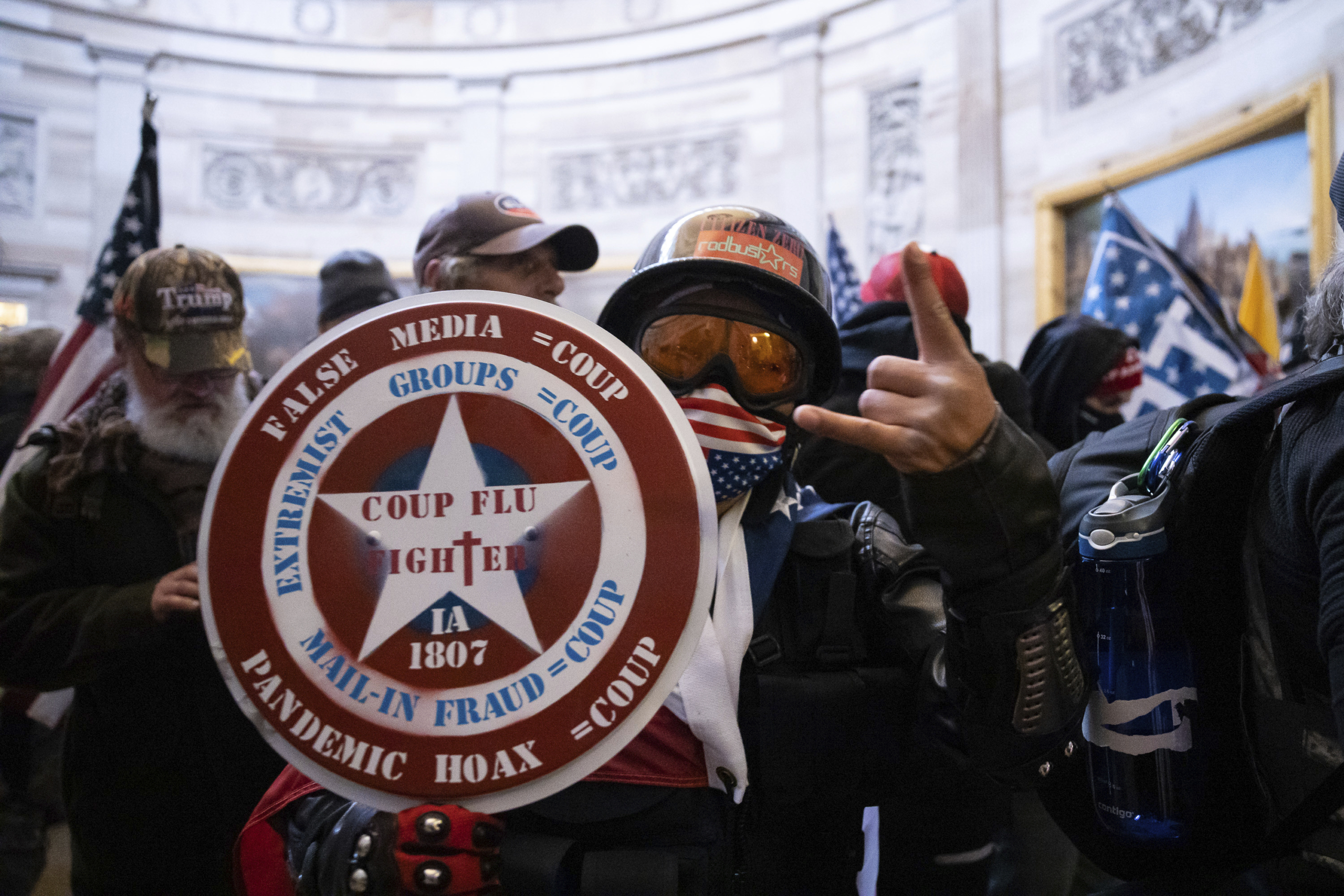
When Donald Trump walked out of his now-infamous interview with Kristen Welker, the host of Meet the Press on NBC News, the conclusion became the story, overshadowing a remarkable exchange in which Welker had consistently fact-checked the president, pressing him on the subject of January 6, 2021. Asked whether people who pleaded guilty to assaulting police officers should receive compensation through the Justice Department’s proposed $1.8 billion “Anti-Weaponization” slush fund, Trump defended the rioters he pardoned. “The people were destroyed by dirty cops and by weaponization. Many of those people should be compensated,” Trump told Welker, claiming, falsely, that the FBI had ushered them into the Capitol.
Trump’s extraordinary assertion raises an obvious question: Who exactly are the people Trump describes as victims of a corrupt justice system? An impressive new report from Katherine Pompilio at Lawfare provides some answers. In the most comprehensive study yet of the post-pardon records of January 6 rioters, Lawfare researched more than fifteen hundred individuals granted clemency by Trump, by reading news reports, monitoring social media, mining public dockets, and calling county clerks’ offices. The data was particularly difficult to compile because, as Pompilio notes: “Unlike parolees, there are no means of tracking these individuals, many of whom have common names and end up in routine criminal proceedings in county-level courts with no reference to their participation in Jan. 6.”
Pompilio found that at least ninety-seven people have been arrested for, charged with, or convicted of unrelated crimes since the riot. One was recently convicted of child molestation and sentenced to life in prison. Another was convicted of reckless homicide in 2025. “The cohort also has no shortage of other sex crimes,” Pompilio writes. “Four of the Jan. 6 defendants have been charged with possession of child pornography, as well as crimes such as online solicitation of a 15 year old, secretly filming naked women in tanning beds, and sending explicit images to a 13 year old online.”
Those are some of the most extreme cases. The alleged crimes range from relatively minor offenses such as property damage and drug paraphernalia possession to serious crimes like grand larceny, stalking, defrauding government agencies, and plotting to assassinate law enforcement officials and politicians. “Perhaps most strikingly, five recipients of presidential clemency were arrested in connection with conduct that occurred at least in part subsequent to Trump’s freeing them from prison,” the report notes, “meaning that Trump’s clemency order on the first day of his second term may have actively facilitated criminal conduct.”

Now that Spencer Pratt’s Los Angeles mayoral run is all but over—he hasn’t conceded, but the Associated Press has called it—the right-wing outrage machine is predictably pushing bad-faith claims that the election was somehow rigged or stolen.
“No one is going to trust this outcome,” Megyn Kelly posted on X.
“Not possible for Spencer Pratt to have lost the L.A. runoffs after the big lead he had,” Trump posted on Truth Social. “3rd World Nation. Rigged Elections!”
Never mind that Pratt, best known as a former reality show villain and influencer whose house burned down in the Palisades Fire, was running in a heavily Democratic city in a state Trump lost by more than sixty points in the 2024 election. And that Pratt never built a real campaign with a manager or staff, traditional TV ads, or a turnout operation. What he did do effectively was craft a sympathetic media narrative and generate attention. Lots and lots of attention. The kind of attention that chronically online national political reporters find irresistible.
“He is just naturally an attention hacker, and that is why so many reporters wanted to cover him,” Peter Hamby, a political correspondent at Puck and a California resident, told me. Pratt’s effort played out almost entirely on X, where he posted outrageous videos and AI-generated slop that went viral and inevitably led to significant national coverage. “As much as people postured about going to Threads and Bluesky back when Elon took over, we’re all still hanging out on Twitter,” Hamby said. “He was able to sort of inject himself into people’s feeds and get in front of journalists’ eyeballs.”
Though it may be MAGA media fueling Spencer Pratt conspiracy theories, mainstream coverage is ultimately to blame for building the Pratt hype machine, through months of breathless coverage that often confused virality for viability. “Is Spencer Pratt for Real?” the New York Times asked in a profile. Semafor framed his rise as a lesson in “AI-age campaigning.” “Spencer Pratt, Self-Described ‘Full Villain’ of The Hills, Says ‘Energetically’ He Feels He’s Going to Win the LA Mayor’s Race,” Vanity Fair informed its readers, just days before the election.
“It made for this cartoon version of Los Angeles that made sense to somebody who might live in the Acela corridor, right? Like, ‘Oh, it’s the city of entertainment, and they’re not very smart out there,’” Hamby told me. “If you actually just go talk to people and listen to people, there is an enduring disconnect between what’s happening online and what’s happening in the real world.”
In 2024, Narges Dehghani fled Iran for the United States. She had been a dissident, fighting against the regime, and had been detained, violently interrogated, and sexually assaulted by Islamic Republic agents. In America, she hoped to finally find freedom. Instead, she has been held for fourteen months at an Immigration and Customs Enforcement (ICE) detention center.
When Dehghani arrived at the Eloy Detention Center, in Arizona, she was “emotionally, mentally and physically wrecked” from her journey to the US-Mexico border. During her intake assessment, she told a psychologist that she was having suicidal thoughts and was immediately put on “suicide watch” in solitary confinement, where she remained for three days. “It’s not like a treatment; it’s a punishment,” Dehghani told the Arizona Daily Star. “That place is not a place you should put a human being.”
Dehghani shared her story with Emily Bregel and Emily Hamer for their excellent series “Inside ICE Detention,” produced by the Daily Star and Lee Enterprises, which examines the impact of detention on immigrants without criminal records. Bregel and Hamer’s reporting found that “ICE is misusing and overusing solitary confinement in ways that violate immigrants’ rights and ICE’s own policies.” Over the past seven months, they have interviewed more than thirty detainees.
“The people who are in detention centers are largely not criminals—about 70 percent of them have never been charged with any kind of crime at all,” Hamer told me. “We wanted to look at the conditions that people are facing in detention because it’s civil detention. It’s not criminal. The conditions are not supposed to be as bad as prison, legally, and yet Eloy Detention Center in Arizona basically looks like prison.”
Last week, the pair published a piece documenting the increasing use of solitary confinement in detention centers to coerce detainees into self-deporting. “ICE is subjecting them to really harsh conditions so that they’ll just give up,” Hamer told me. “We have had detainees tell us that guards are telling them, ‘That’s my whole objective, is to make your time in here as miserable as possible so that you self-deport,’ which is unconstitutional.”
Maksim Borisov, a twenty-two-year-old who faced persecution in Russia for being gay, spent more than a year in ICE detention. At one point, a guard presented him with papers and repeatedly pressured him to self-deport. When he refused, he was thrown into solitary confinement. “This is torturing. They’re torturing me,” Borisov said. “I never broke any law, and I’m being punished because I don’t want to die in my country.”
If you have a suggestion for this column, please send it to laurelsanddarts@cjr.org. We can’t acknowledge all submissions, but we will mention you if we use your idea. For more on Laurels and Darts, please click here. To receive this and other CJR newsletters in your inbox, please click here.
Has America ever needed a media defender more than now? Help us by joining CJR today.