Sign up for the daily CJR newsletter.
On Monday, the BBC released its long-awaited report into a documentary about life inside wartime Gaza, which the British public broadcaster retracted in February, after it was revealed that its narrator was the son of a Hamas official. The review pointed the finger at the independent production company that produced the film, for failing to inform the broadcaster of the relationship—but it also acknowledged key failures on the part of BBC leadership in vetting the project.
The handling of this crisis—along with the broadcaster’s more recent stumbles, including a canceled subsequent documentary about Israeli attacks on medics within Gaza (recently aired by a competitor, Channel 4) and the livestream of the Glastonbury Festival, during which a performer led the crowd in a chant of “Death to the IDF”—has left something for pretty much everyone, across the political spectrum, to dislike.
For Alan Rusbridger, who was for two decades the editor in chief of The Guardian, and now edits Prospect magazine (and cohosts the excellent Media Confidential podcast with Lionel Barber), the problems at the Beeb go much deeper—and are going to be much harder to root out. This conversation, adapted from a recent episode of The Kicker, has been edited for concision and clarity.
JH: The BBC has faced criticism for years, but its three recent major challenges all seem to align on one topic: Gaza. In your view, is the story here about how they’ve handled these particular cases, or is it more about the intensity of the public response?
AR: It’s a bit of each, I would say. The organization is under the microscope in a way that most media organizations would hate, I think. There are more or less around-the-clock lobbying groups who are examining every single second of footage. The Israeli side of the argument, if I can put it like that, claims that the BBC is institutionally biased against Israel. There’s been recently a report claiming the opposite, that the BBC is institutionally biased in favor of Israel.
This is reminiscent of how the New York Times often gets viewed here.
Yes. And of course, depending on which narrative you prefer, these three examples are shining examples of whatever it is that you’re trying to prove about the BBC. I mean, the BBC is slightly on the back foot because its director general—who is effectively the editor in chief; it’s an enormous and difficult job because there are just hundreds of hours of broadcasts going out every week—hasn’t got a journalistic background. He came from a marketing background. And so some people are complaining he doesn’t have the sure touch that would have enabled him to grip these problems earlier.
Are you among those people?
I think it’s a very, very difficult job. The budget is something like three billion pounds. So that’s well over four billion dollars. And you need somebody with an enormous commercial and managerial experience to run an organization of that size, and to expect someone also to be the editor in chief and to be making sometimes minute-by-minute decisions on content is a big ask of anyone. I think Tim Davie, who has the job—I think the sure touch has been lacking.
You have written that the leadership of the BBC has a “conflict of interest” when it comes to Gaza. But I wonder if the real issue here is just in the nature of trying to be a truly neutral, state-supported media institution.
Twenty-five years ago, at the time of the Iraq War, a reporter made what you could casually call a mistake at six o’clock in the morning. That mistake resulted in a judge-led inquiry costing three million pounds and the dismissal of the director general and the chairman. And I think when that kind of pressure is put on an organization by the government of the day…the incentives within the organization become, you know, ass-covering.
Was this the David Kelly story?
It was the David Kelly story. It was an awful story. Somebody died, the BBC refused to apologize, and it led to a gigantic standoff between the Labour government and the BBC and this enormous judge-led inquiry.
Just to be clear, we are not talking about a conservative Tory government. This was a Labour government.
Right. And my feeling is that the BBC has never really recovered its nerve since then. And that’s why you really need a strong leader, a strong editorial leader who is going to back the journalism. And fourteen years of governments threatening the BBC with cuts or with—not abolition, no one’s quite gone that far—but the sense that a government can really rein the BBC in is really problematic.
So is this a problem that can be fixed by addressing the specific leadership conflicts you’ve written about, or is there something more fundamental about the nature of the BBC that is harder to address?
I think it’s fundamental. The [Primer Minister Keir] Starmer government has gotten off to a very bad start and has had its hands full in many ways, but it has four more years, and it should put the BBC onto a proper footing, work out its funding arrangements, change the governance arrangements so that you get rid of this ludicrous aspect where the government can appoint directors to the BBC, and free it up—make it truly independent. And then hope that the BBC can find a leader strong enough to lead it into a brighter future. Because it feels really beleaguered at the moment.
I suppose I wonder how far a state-backed media organization can really go these days. There are so many subjects now where the ideal of neutral, both-sides journalism is just not up to the task. I’m thinking about Brexit, for instance.
Brexit was a time where what you wanted from journalism was to present both sides of the argument, point out the pitfalls as well as the opportunities. And then if you wanted, as a final thing, to say, “By the way, this is what we think,” that would have been a nice cherry on top. Most newspapers did the exact opposite. They said, “We know how you should vote, and we’re gonna use our front pages for the next six months to ram that home week after week, and we are not gonna give both sides, because we don’t believe in the other side.” And so to me it was a massive failure of journalism, and we really needed the BBC to do a job of doing what journalism should have done. I think the same is true of climate change, by the way. And so the role of an organization like the BBC becomes more essential in a world in which there’s a very different idea of what journalism is in much of the press.
It’s easy to read your columns and think, Oh, this is a critic of the BBC. But I think fundamentally you are a believer in the BBC.
Oh, absolutely. I love and cherish the BBC and believe it is vital. So my criticism of it comes from a position of love and respect. But I think it’s not distinguishing itself at the moment.
How concerned are you about the state of press freedom in America?
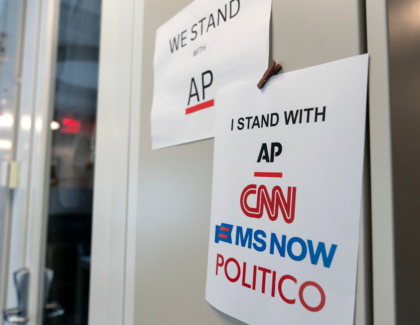
I’m really quite concerned, as the economic threat to the local press is dire. The cave-ins by the major broadcasters are dismaying. Lack of solidarity around the position of AP in the White House pool. I mean, I think there should have been much more concerted pushback so that if the Trump administration tries to pick off individual players, there should be, I think, a concerted pushback. So I think there are alarming signs of loss of nerve, clearly deep problems around the questions of corporate ownership. I’m thinking of the Washington Post, and CBS, some of the big social media players. So I think it’s a very bleak time.
Loss of nerve seems to be a crucial litmus test for you.
Yes, and I had the good fortune to spend twenty years at The Guardian, which had no proprietor and had a trust to protect the journalistic work, and so I feel wonderfully privileged. I don’t want to lecture people who work in a less privileged way. But I do think when you look at the equivalent attack on law firms, I think people now think if only the law firms had [bound] together and presented a unified front and defied the kind of pressure that they’re coming under, that we would all be in a much better place today, and I sort of think that about the media companies as well. It’s difficult because journalists are very competitive and their natural inclination is not to combine or collaborate. But I think maybe we have to change our ways a bit.
Has America ever needed a media defender more than now? Help us by joining CJR today.