Sign up for the daily CJR newsletter.
In the end, it had little impact on Belgium’s 4-1 thrashing of the United States men’s soccer team. But when the New York Times revealed that Donald Trump had made a successful appeal to the head of FIFA to reinstate Folarin Balogun, the US’s suspended top scorer in the World Cup, the public saw, not for the first time, how casually soccer’s governing body flouts its own rules under political pressure.
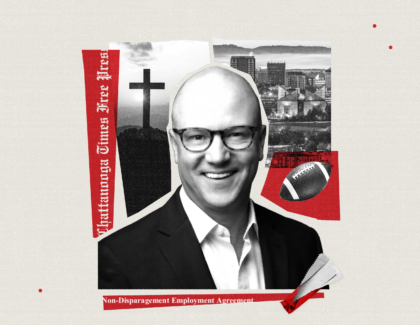
Ken Bensinger, a media and politics reporter for the Times, has covered FIFA for more than a decade. In 2018, he published Red Card: How the US Blew the Whistle on the World’s Biggest Sports Scandal, recounting the Justice Department’s investigation into FIFA, which led to the arrests of top officials. He believes that both FIFA and the US have entered a new age of corruption, one in which everything happens out in the open. “In the past, a journalist could say: ‘Look, here’s the bank statement showing that this person was paid this money that shouldn’t have been paid,’ and that was proof that a corrupt act had happened. Those kinds of aha moments don’t exist anymore because corruption is no longer secret,” he said. Our conversation has been edited for length and clarity.
ILN: Walk us through how Trump intervened in Balogun’s suspension—and how this was different, as a news story, from other instances of unfair play.
KB: FIFA has a long, and pretty bad, history of corruption, but they tend to be the kind of things that come out long after the fact. They aren’t as right-in-your-face as this was: FIFA makes a decision to allow a player to play despite a fifty-six-year-old rule about red cards coming with automatic suspensions, and the US president claims credit for calling Gianni Infantino, FIFA’s president, to make it happen. It wasn’t shady. It was bold and direct.
What has your experience been like reporting on FIFA?
FIFA was always difficult to cover—it’s an organization that seems to be based on secrecy. Their Swiss headquarters is essentially a subterranean bunker with no signal getting in and out. And it’s representative of their view that they don’t feel beholden to anybody.
I’ve been covering FIFA since 2014, under the previous administration of Sepp Blatter. It was famously corrupt. But they still had press conferences and answered questions. After 2015, when the US criminal investigation of FIFA broke out, officials were arrested and Blatter resigned. Gianni Infantino came in promising to be extremely transparent, clean, and ethical. But anyone who’s covered FIFA over the years can tell you that he has pretty much removed any transparency. There are almost no press conferences, and when there are, the people who are allowed to ask questions are very carefully selected. Any journalists who want to cover the organization itself get totally shut out. They sometimes even assign security guards to prevent a single reporter from getting anywhere near Infantino to ask questions. And unlike other organizations, there’s no other person to talk to. It’s Gianni Infantino and an army of faceless people who don’t make decisions.
You published a book based on interviews with people inside those walls. How do you build sources? How does this differ from, say, reporting on a Fortune 500 company?
A Fortune 500 company is a good comparison: FIFA is a nonprofit sporting organization that behaves like a corporation. You can report on it using some tried-and-true tricks of journalism, like finding former employees who can give you a glimpse inside the castle walls. In my case, there was one employee who reached out to me after seeing the announcement that I’m working on a book about this. We corresponded with each other, and when I eventually visited Zürich, he snuck me into the FIFA building and gave me a tour. So I was very fortunate—beyond that, it was taking people to coffee and traveling quite a bit for nuggets of information. Lots of people flat out refused to talk to me. But once my book came out, they were suddenly all too eager to speak.
No other topic that I’ve ever covered has involved so many people popping out of the woodwork and trying to offer you secret documents that they claim show this or that kind of corruption. It’s very exciting, as a reporter, to go to a hotel where a guy says, “Under your chair is a flash drive, and that has all the stuff you need to know.” But because there are so many conflicting interests, when things seem too good to be true, you should be really careful.
Do you think there is a public appetite for coverage of corruption? Can people in power still be held accountable by the press?
Originally, FIFA wasn’t a corrupt organization: up until the late 1970s, before the age of big sponsorships and television money, it wasn’t very rich. But then the first corrupt era of FIFA began, with behind-closed-doors deals for broadcasting, sponsoring, and hosting rights—literal envelopes stuffed with cash handed to people.
That substantially ended with the criminal investigation, ushering in a new era of corruption—more open and public. There’s just no more shame about it. If the deal is to ensure that Saudi Arabia gets the 2034 World Cup, then the Saudi state-owned oil company will be the next top sponsor of FIFA, in a tier of its own. It’s the same way that Donald Trump puts out his financial statement and we can see that he has made two-plus billion dollars off crypto since becoming president, and here are all the receipts. They claim that there’s nothing corrupt because they did it openly; it’s a corruption of conflict of interest.
I think you still have to connect the dots and put it out there, hoping that the public understands that these are huge conflicts of interest. With Trump’s control over the Justice Department, there’s no expectation that investigations would follow something that a journalist uncovered. You just have to keep hammering your way out, knowing that there’s no one behind you.
Has America ever needed a media defender more than now? Help us by joining CJR today.