Sign up for the daily CJR newsletter.
Bloomberg Markets’s Stephanie Baker-Said has a nice cover story
this month about Nassim Taleb, author of “The Black Swan: The Impact
of the Highly Improbable.” His book, which was published almost a year
ago and is still number 24 on the New York Times Hardcover Nonfiction Best
Seller list, is giving Taleb, a former options trader and hedge fund
manager, the opportunity for some victory laps because he seemed to be way ahead of the curve about the current financial crisis.
The Lebanese-born Taleb, a balding man who labels himself
a philosopher of randomness, has an eerie knack for timing things
right. His most recent book, The Black Swan: The Impact of the Highly
Improbable (Random House), came out in May 2007, just months before
the subprime fiasco rocked global markets and led banks to announce at
least $188 billion worth of writedowns. The book’s message offered
something of a preview of the crisis: that we’re all blind to rare
events and routinely fool our-selves into believing we can predict
risks and rewards.
The “Black Swan Theory” is the talk of Wall Street trading rooms and hedge funds. He now
commands more than $60,000 speaking fees and just earned a $4 million
advance for a follow up book.
The media adore people who say the right thing at the right time. But we hold a special place for the rare people who say right thing before the right time.
Some of Taleb’s ideas:
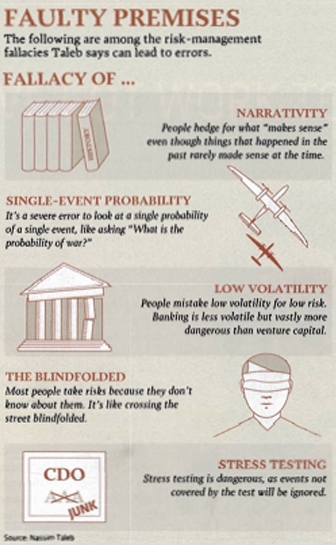
Listen, you can overstate this whole prescience thing. Taleb doesn’t really account for what can be seen as the heart of the problem: lenders pushing idiotic loans on people who couldn’t pay them back and bankers bundling them together with little thought to their quality. He says the problem was that the stress-testing model could not accommodate that scenario. In fact, he thinks most models banks use are bunk. Still, that’s not a bad thought, and a great idea for a story.
Has America ever needed a media defender more than now? Help us by joining CJR today.