Sign up for the daily CJR newsletter.
The day I began writing this newsletter, in October 2018, Donald Trump was the president of the United States, it was the sad Monday morning after a barely processable attack on a house of worship, and the press, I wrote, needed urgently to grapple with “how to report on an intensifying and obvious politics of hate.” Nearly seven years later, it can sometimes feel as if time has stood still—and yet it’s also true that the media landscape has changed enormously since then. I’ll be stepping down as the writer of this newsletter after tomorrow’s edition; I’ll have some more personal reflections to share then. For today’s newsletter, I wanted to look back on those seven years, where we were then, and where we are now.
The current news cycle contains all sorts of echoes from my early years in this space: a government shutdown appears imminent (see this from 2018), Pam Bondi is on Fox talking about James Comey (see this from 2019), Trump just gave breathtakingly irresponsible medical advice (see this from 2020; it really does a number on the lungs). In many ways, though, riffling back through editions from the first Trump presidency feels like reading dispatches from a different planet. Shortly after I started, I wrote about the debate over the media’s hesitation at calling Trump’s messaging “racist,” in a newsletter about a pre-midterms ad claiming an invasion of migrants at the southern border (which I had, to be honest, completely forgotten about); a few months later I wrote—in two consecutive newsletters, to be precise—about the debate as to whether the media should carry Trump live, given his propensity to lie. In the weeks leading up to the presidential election of 2020, I collaborated with Pete Vernon, the former writer of this newsletter, on a detailed accounting of all the pathologies that we’d observed in coverage of Trump. We wrote that his first presidency had seen some very smart work, namechecking influential essays by Adam Serwer and Ta-Nehisi Coates by way of example, but also plenty of “bothsidesism,” credulous hopes of a new presidential “tone,” breathless obsession over tweets, civility policing, judgment of optics over substance, and so on. “The act of bringing together our daily doses of media criticism,” we wrote, painted a clear picture of an industry whose basic rhythms “conspired, time and again, to downplay demagoguery, let Trump and his defenders off the hook, and drain resources and attention from crucial longer-term storylines.”
Above all, the media, at the time, seemed to be grappling with how to bend its normal way of covering politics to a president who blitzed through norms on an hourly basis; in a 2019 newsletter (specifically about bothsidesism), I quoted the media critic Dan Froomkin as saying (specifically about the New York Times, but broaching a wider point), “If you’d asked NYT editors five years ago whether people who deny basic facts, traffic in conspiracy theories, demonize immigrants, and otherwise fight against a pluralistic society should be given equal (or more than equal) time in their news columns, they would have said no.” And yet there were lines back then. According to my debut newsletter, Fox Business condemned a guest for bashing the liberal Jewish financier George Soros in a segment on the late Lou Dobbs’s show that subsequently reaired on the day that a gunman murdered worshippers at a synagogue in Pittsburgh; Fox News, NBC, and others eventually dropped the 2018 midterms ad, while CNN declined to air it at all. In 2020, James Bennet was ousted as editor of the Times’ opinion section after it published an op-ed (which, it transpired, Bennet hadn’t even read in advance) in which the Republican senator Tom Cotton called for Trump to dispatch troops to quell the unrest that followed the murder of George Floyd in Minneapolis; that broader moment led to a reappraisal, across the media business, as to the meaning and appropriateness of traditional notions of journalistic “objectivity,” as well as failures of representation within newsrooms. That summer is often remembered in isolation, but recently, Perry Bacon, of the New Republic, zoomed out to situate it in the context of two broader “reckonings” that, in his view, defined the seven-year period from 2014 to 2021 in media: one over race, not only post-Floyd, but via, for instance, Nikole Hannah-Jones’s “1619 Project” for the Times; the other over coverage that downplayed the radicalism of the Republican Party, and a gradual shift to a more pro-democracy orientation.
If my seven-year stint atop this newsletter began at something like the midpoint of this period, it has since taken in a very different moment. Bacon suggested recently that the reckonings he observed are effectively now dead, giving way, respectively, to a hostile moment for Black journalists (he wrote after the Washington Post, where he worked until this year, fired Karen Attiah from its opinion section over tweets about race following the recent assassination of Charlie Kirk) and coverage of politics that has swung closer to Trump’s own terms. As I wrote earlier this year, parts of the media business now seem to have recast the summer of 2020, in particular, as the storming of the journalistic firmament by Jacobins who have, thankfully, now been put back in their place. As far as political coverage goes, many journalists are currently watching Trump’s nakedly authoritarian behavior without then writing up stenography about the emperor’s fine new clothes. (Last week, for what it’s worth, Froomkin pointed to signs that the Times might finally be “getting real” about Trump.) On the whole, though, it increasingly strikes me that the political press is adrift—visibly grappling with how to cover a president who not only blitzes norms by sending mean tweets, but was widely condemned and written off after his shameful lies about a fair election led to a violent attack on the seat of government, then ushered back into office by a near majority of voters in what, among other things, amounted to an existential challenge to the media’s self-conception as an arbiter of political accountability. The killing of Kirk has intensified this sense of disorientation; the sorts of figures—or, at least, figures with the sorts of views—that the mainstream press might have declined to “platform” even in the first Trump era are now sitting for soft-focus interviews and profiles. (Not that the latter are a wholly new development when it comes to the far right, as Vernon and I observed in 2020.) Over the weekend, Hannah-Jones reckoned with all this in an essay for the Times. “Espousing open and explicit bigotry,” she wrote, “no longer relegates one to the fringe of political discourse.”
In an abstract sense, the shifting of societal consensus is an eternal challenge for the mainstream news media, which has long claimed to sit above society—parceling out marble-carved truths from on high—but is, of course, of society, or at the very least shifts violently when the ground underneath it does likewise. Far from the caricature of uncouth young journalists demanding rampant left-wing subjectivity, this reality was what the 2020 objectivity debate was actually about (at its best, anyway)—and it is a reality, whether you are the type of journalist who thinks it is a good thing or not. Over time, debates that once felt very urgent—Should the networks broadcast Trump’s lies without live fact-checking?!—can come to feel quaint, and old practices get cast off, for better or worse reasons. The impulse for media institutions not to platform lies or hateful views came from a better-faith place than many critics allow—and the objection that free speech somehow demands giving particular individuals a particular, privately funded job or platform is stupid now, just as it was stupid before. And yet the basic premise here—that the mainstream media could effectively contain the worst of America by treating it as radioactive—has, at minimum, clearly not worked. If CJR stands for anything, it’s that the media reevaluating how it covers society can be a sign of strength.
And yet we must be clear-eyed, now, about who is moving the lines within which the media does its job. The first answer is clearly Trump, whose first-term assaults on the media—always worse than the minimizing gloss of hindsight allows (part of a broader pattern of Trump 1.0 amnesia among members of the press)—have morphed into something very overt and very scary, as I wrote last week. Throughout my time writing this newsletter, I’ve warned about threats to democracy in the US, and tried to bring perspective by covering its retreat around the world, even if such warnings were sometimes written off as hysteria. Recently, I’ve noticed headlines attesting to how Trump’s attacks on speech “mirror” the “playbooks” of authoritarian leaders. I’d probably have praised such framing as perceptive in 2018. Now I think we’re past talk of mirrors; it is already happening here—or, at least, being attempted. A second answer is media corporations themselves, vastly too many of which have recently bent to Trump’s will, either preemptively or at the feel of a presidential push, out of cowardice at best or rank greed at worst. This year, I’ve gone back and forth on whether journalists are standing up to Trump’s new, more blatant style of authoritarianism strongly enough. But it’s been clear throughout that many of their paymasters aren’t, and that this is a dire problem. Their recent behavior should shatter the peculiar American creed that consolidated megacorporations are reliable stewards of public-interest journalism, even if public media is hardly in a good place either. (When the editor of Semafor is quoting Noam Chomsky, you know times are strange.) This, too, is part of a broader pattern of capitulation. As Serwer put it last week, in The Atlantic, those with the most resources to resist Trump’s abuses have often declined to do so. “They are, in a word, chickenshit.”
But there’s a reason why I wrote “or, at least, being attempted” above. Part of the reason the capitulation is so dangerous, as Serwer noted, is that it has “effectively multiplied Trump’s attacks on constitutional government, by enhancing a false sense of inevitability and invincibility.” To return to the abstract, if media types do their work against a shifting societal baseline, they’re not always very good at seeing where that line is at a given moment. The narrowness of Trump’s victory in 2016 probably did lead many in the media to underappreciate the rupture he represented, or to see him as an aberration. But if that’s the case, then his narrow victory in 2024 has for some reason been interpreted as grounds for a massive collective overcompensation. Even if he had a mandate to behave like a king, the law would prevent that—but it’s nonetheless worth stating that he does not have a mandate to behave like a king. And refusing to be subjected can work. I wrote last Monday about ABC suspending Jimmy Kimmel—and Nexstar and Sinclair preempting his show on their ABC affiliates—after he made unhelpful comments about Kirk’s death; one week and some (fairly mild; we’re not talking about mass civil disobedience here) public pressure later, and Kimmel is back not only on ABC but, as of Friday, on the affiliates, too—and Brendan Carr, the bureaucrat whose threats were widely perceived as triggering Kimmel’s initial canceling, is pretending he never made the threats at all. At the broadest level, the First Amendment remains an extraordinary gift to the US press, one that many journalists around the world would die to have—and all too often die without.
Maria Ressa, the crusading Filipino journalist who has lived through sharp authoritarian threats and become something of a global press-freedom cause célèbre, likes to say that we must “hold the line” against such threats. It strikes me that the sort of media executives who would surely clap along to such sentiments at a charity dinner without batting an eyelid are now being confronted by what it means in practice. Sometimes, it involves uncomfortable choices. But I’d ask you to ask yourselves: What is the alternative, really? Pushing back on authoritarian threats to free speech is not an affront against pluralism, even if you might imagine that half the country is okay with it. It remains an essential precondition of pluralism.
After Kirk was killed, Ezra Klein, the influential liberal columnist at the Times, wrote a piece praising the way he had practiced politics, and Coates pushed back in an essay for Vanity Fair. Klein invited Coates onto his podcast to discuss it; the episode dropped yesterday. At one point, Klein expressed a palpable disorientation as to how the lines of acceptability have shifted in US politics in recent years, noting his belief that the way Trump conducts himself should have put him “on the other side of the line” long ago, and how that belief clearly has “no relationship” to today’s reality. “What I see is any line that existed at all collapsing,” Klein said. “I’m watching, like, Holocaust revisionism on the biggest right-wing podcasts. I’m watching Tucker Carlson turn into what I would describe as a white nationalist and become an absolute dominant force on the right—bigger than he ever was in his smarmy libertarian phase.” Klein now recognizes, he said, that “I don’t get to draw the line.”
Klein is right that he doesn’t get to draw the line. No one person does; certainly no one journalist. Even Trump doesn’t, though he has pushed at it with tectonic political force. But I wholeheartedly believe that the news media—even in this age of right-wing podcasts, and left-wing podcasts for that matter—has a big say in where the lines lie; we are, or should be, a collective mechanism of democratic self-expression, in what is, or should be, still a democracy. If the media landscape has changed in my seven years writing this newsletter, a large part of that has been downstream of what appears to me to be a loss of self-confidence in our power to reach people, our ability to keep gates, our ability, yes, to draw lines. But those were always powers the media should have wielded diffusely, in partnership and community with people, not over their heads. And the very real pressures on those powers—from Big Finance, and Big Tech, and AI, and so on and so on—haven’t eroded their potential altogether. What we report—what we say—matters, still.
In my essay with Vernon in 2020, we referenced the old saw that history is written by the winners, and noted that it was hard to conclude that the press were the winners of Trump’s first term. This seems even more obvious in his second. But if winning isn’t forever, neither is losing. I was struck by something that Coates told Klein yesterday, when Klein asked “Why are we losing?,” and Coates replied, “We’re losing because there are always moments when we lose.” He was referring to the political left, not the press. But the basic logic is worth heeding. History rhymes, but it is not linear. Lines move. And our first draft has a lot to say about how it all happens.
Other Notable Stories…
By Jem Bartholomew
- President Trump signed an executive order on Thursday that helped clear the path for a coalition of investors to run a US version of TikTok, separate from Chinese owner ByteDance, which could be valued at around fourteen billion dollars. Potential investors include tech billionaire Larry Ellison, whose son David is the founder and chief executive of Paramount Skydance (which owns CBS), and media mogul Rupert Murdoch and his son Lachlan. The question of who runs TikTok is an increasingly important one for journalism; according to the Pew Research Center, almost half of people under thirty in the US get their news from the platform. Margaret Sullivan, executive director of the Craig Newmark Center for Journalism Ethics and Security at Columbia Journalism School, wrote for The Guardian that the deal would hand even more control over the media to the super-rich. (You can read Sullivan’s recent work for CJR, on journalism ethics, here.)
- Kimmel drew record ratings when he returned to air on Tuesday last week, clocking 6.26 million live viewers as well as a further 21 million views on his show’s YouTube channel. After Kimmel was pulled off air indefinitely by ABC’s owner, Disney, on September 17 following pressure from FCC chairman Brendan Carr, the episode became a flashpoint in a national debate around free speech. A flurry of pieces made comparisons between the Trump administration and authoritarian regimes around the world, such as Vladimir Putin’s Russia, regarding the crackdown on acceptable speech. (“We have to speak out against this bully,” Kimmel said on his return. “He’s gunning for our journalists too. He’s suing them, he’s bullying them.”) After Disney reversed its decision, last Monday, the episode was interpreted by some observers in the media as highlighting the power of public pressure—from ordinary ABC audiences to major celebrities to trade unions across the US standing behind Kimmel.
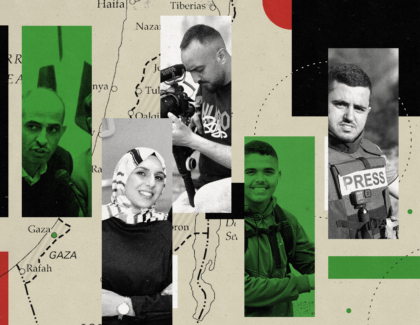
- On Thursday, one month on from the Israeli killing of five journalists in the bombing of Nasser Hospital in Gaza, AP and Reuters issued a joint statement. It again demanded explanation and accountability over the strike, saying: “We remain devastated and outraged by their deaths.… We again call on the government of Israel to explain the deaths of these journalists and to take every step to protect those who continue to cover this conflict.” Following the statement, Reuters published an investigation documenting how the Israeli military’s narrative of the killings did not match up with the visual evidence on the ground. The Committee to Protect Journalists (CPJ) says that 235 journalists and media workers have now been killed by Israel since October 7, 2023. But CPJ’s regional director for the Middle East and North Africa, Sara Qudah, said that Israel has never published the results of a formal investigation or held anyone accountable for IDF killings of journalists. (ICYMI, Jon Allsop wrote for CJR on the Israeli claim that it does not target journalists “as such.”)
- When the deputy editor of The Spectator, a British conservative magazine edited by former Conservative Party cabinet minister Michael Gove, interviewed influencer Andrew Tate and his brother in Bucharest, Romania, the subsequent piece sparked fury and disgust from four alleged survivors of sexual abuse by Tate. The four women accused the magazine of glamorizing the brothers, who are staples of the so-called manosphere, and misrepresenting the criminal charges against them. The journalist, Freddy Gray, who is a former literary editor of the American Conservative, suggested that he believed the charges were likely to “melt away.” The two men are charged with human trafficking and money laundering in Romania and face extradition to the UK (expected after the Romanian case concludes), where Andrew Tate faces ten charges connected to three alleged victims, including rape, actual bodily harm, human trafficking, and controlling prostitution for gain, and Tristan Tate faces eleven charges connected to one alleged victim, including rape, actual bodily harm, and human trafficking. The four women lodged a complaint to Britain’s independent press regulator, IPSO. “How can The Spectator think it’s appropriate to interview these men but fail to ask them one question about the allegations against them?” they said.
- Back in August, after prison officials with the Kansas Department of Corrections canceled subscriptions for incarcerated people from outside parties, they raised a few eyebrows by citing “dangerous contraband” as the reason for the decision. Reporting from the Kansas Reflector got further details about the ban. “The impetus for this policy is an increase in drug-soaked material, such as books and newspapers, being transmitted to residents through the USPS,” a spokesperson told the paper. It follows the struggle by prison officials in New Jersey to combat mail sprayed with spice, a synthetic cannabinoid. Emily Bradbury, the executive director of the Kansas Press Association, said the case raises serious concerns for journalism in the state. It’s “in our best interest as an industry to have an engaged and informed citizenry,” she said, “and that includes those living in correctional facilities.”
- In other news, the nonprofit Salt Lake Tribune said it’s launching the Southern Utah Tribune, a free newspaper that will be mailed to forty thousand homes and businesses. Elsewhere, PBS North Carolina said it had laid off thirty-two employees this month, due to a budget shortfall driven by the loss of federal funds (which CJR has covered here). Meta unveiled a new AI video feature, Vibes, in which users can make videos from scratch and share them on newsfeeds. (Mashable pointed out that a name for Vibes was catching on: the “infinite slop machine.”) Former vice president Kamala Harris released her memoir, 107 Days, which features her account of the defeat to Trump last year—one critic says she displays an “aversion to reflection.”
- And Mel Taub, the longtime creator of the Times’ Puns and Anagrams puzzle, died this month at his home in Texas, aged ninety-seven. Taub majored in English at Brooklyn College, hoping to be a comedy writer, according to his Times obituary, but when that didn’t work out he went into insurance, where he worked until his retirement. He devised his puzzles over nights and weekends at the dining-room table in his family’s Brooklyn apartment. Over the years he became known for his anagrams and wordplay. Some examples of his clues: “Salad ingredient on the Titanic” (iceberg), “Companion of iff or andd” (butt). Deb Amlen, lead columnist of the Times’ Wordplay, said that “his puzzles were designed to put a smile on your face.”
Has America ever needed a media defender more than now? Help us by joining CJR today.