Sign up for the daily CJR newsletter.
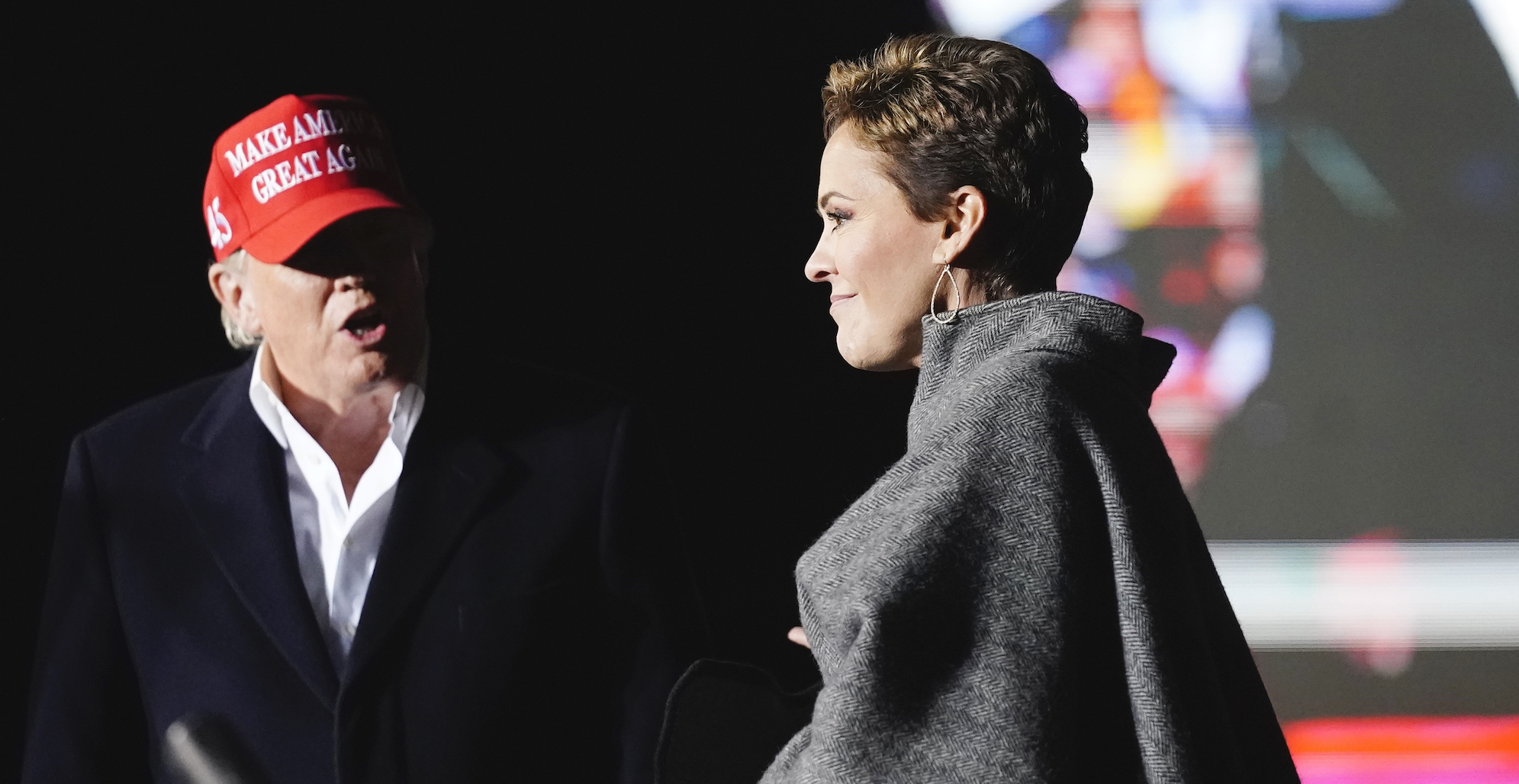
Late last month, we learned of three consequential pieces of personnel news related to Voice of America, the overseas broadcaster that is funded by the US government but designed to be editorially independent of it. First, it was announced that Kari Lake—a local news anchor turned 2020 election denier and failed Republican candidate for office—would be joining the US Agency for Global Media, the body that oversees VOA, as a special adviser; Trump had tapped her to lead VOA outright, but her appointment had stalled. The next day, USAGM placed Steve Herman, a high-profile VOA journalist, on “excused absence” pending an HR probe that would, it seemed, decide whether his social media activity was excessively anti-Trump. The same day, Patsy Widakuswara, VOA’s White House bureau chief, was involuntarily reassigned to a new beat. Her last day on White House “pool duty” came last week, when she covered a St. Patrick’s–adjacent Oval Office visit by Micheál Martin, the Irish taoiseach. Widakuswara asked Martin to respond to Trump’s plan to expel Palestinians from Gaza, but before he could respond, Trump interjected, denying that anyone was expelling Palestinians and asking Widakuswara who she worked for. When she replied, Trump visibly scoffed. “No wonder,” he said, then flicked his hand dismissively.
All this rhymed with the end of Trump’s first term, when he called VOA’s reporting “disgusting” and tapped Michael Pack, a right-wing filmmaker and Steve Bannon ally, to lead the USAGM, which he was then widely accused of attempting to politicize; back then, too, Herman was reportedly investigated for supposed anti-Trump tweets and Widakuswara was taken off the White House beat after challenging a senior official. (On that occasion, she had asked Mike Pompeo, the outgoing secretary of state, to respond to the January 6 attack on the Capitol; Widakuswara was reinstated shortly after the Biden administration took office and Pack was asked to resign.) There were key differences this time, though. As David Folkenflik, who covered the Pack era in depth, noted recently, a federal judge ruled back then that the investigation of Herman violated his First Amendment rights and breached a legal firewall intended to protect VOA from political meddling. This time, journalistic leaders at VOA—including Michael Abramowitz, its current director, who formerly worked at the Washington Post and, per Folkenflik, “is not seen as an ideological figure”—approved the probe. The leaders “told associates they are simply basing the review of Herman’s work on journalistic concerns,” Folkenflik wrote. But there were clearly internal concerns as to Trump and Lake’s designs for the outlet and wider agency. David Enrich, of the New York Times, reported yesterday that even prior to Lake’s arrival as an adviser, VOA leaders “began discouraging its journalists from saying or writing things that could be construed as critical of Mr. Trump,” in an apparent attempt to “fend off attacks by the president.”
If this was the case, it didn’t work: on Friday, Trump signed an executive order mandating that USAGM be gutted. The agency was one of seven targeted—others included the Woodrow Wilson International Center for Scholars and the Institute of Museum and Library Services—and the order was cast as a continuation of the Trump administration’s “reduction of the federal bureaucracy,” a grand slashing of government that has been spearheaded by Elon Musk and his memeily named Department of Government Efficiency, or DOGE. On Saturday, however, the White House put out a press release, headlined “The Voice of Radical America,” that ticked off examples of supposed VOA “propaganda,” from its reluctance to routinely characterize Hamas as “terrorists” to a 2019 segment “about transgender migrants seeking asylum in the United States.” A USAGM press release went further, alleging (vaguely) that the agency had engaged in “eye-popping self-dealing” and even been infiltrated by spies. Lake shared the release on X, while endorsing the idea that USAGM is “pound-for-pound the most corrupt agency in Washington DC.” Musk, for his part, posted that USAGM would be renamed the “Department of Propaganda Everywhere,” or “DOPE,” while it is wound down, alongside a “logo” featuring a wide-eyed cartoon cat with a US flag.
The reality for USAGM staffers was a lot less cute, and a lot more real. On Saturday, all full-time employees at VOA and the Office for Cuba Broadcasting, which seeks to serve people in that country, were placed on administrative leave, effectively shuttering them in the process; meanwhile, contracts funding the rest of USAGM’s core broadcasting offer—Radio Free Europe/Radio Liberty, Radio Free Asia, and the Middle East Broadcasting Networks—were canceled. Abramowitz said that VOA had been “silenced” for the first time in its eighty-three-year history and that he was “deeply saddened” by the development; VOA “needs thoughtful reform and we have made progress in that regard,” he said, but the mass suspensions will leave it “unable to carry out its vital mission.” Grant Turner, a former USAGM executive, was blunter, referring to the cuts as “Bloody Saturday.” Sunday was bloody, too—according to Agence France-Presse, USAGM began laying off staffers who had worked on a contract basis. Among those fired was Liam Scott, a VOA reporter who had done excellent work covering global press freedom—a dedicated beat, he noted, that is rare among newsrooms. Scott wrote online that he had stayed on at VOA because he wanted to fight to protect its editorial independence and “document the unprecedented threats facing press freedom in the United States from the Trump administration,” only to ultimately fall victim to them. In his time covering press freedom globally, he added, he has “never seen something like what’s happened in the US over the past couple months.”
Various observers, including the heads of other USAGM broadcasters and at least one Republican member of Congress, criticized the gutting of the agency as, among other things, a boon to America’s geopolitical adversaries, which have typically disdained the broadcasters’ dogged reporting on their countries, where the domestic press is often neutered. (Herman echoed the point in a “requiem” that he posted to Substack.) As I’ve written before, some defenders of VOA and its sister broadcasters have characterized them as normal news organizations, but that isn’t quite right—they were created to be instruments of American soft power abroad, and have retained that function to this day. Other defenders have argued, however, that they achieve this by exporting independent journalism to closed societies, and there is no question that the broadcasters have done vital work that has not only shined light into those societies and reached residents in their own languages, but informed readers all around the world about routine goings-on in countries that otherwise scarcely get covered in Western media. As Scott pointed out over the weekend, a number of USAGM journalists have so angered foreign despots that they have paid for such work with their freedom. Perhaps ironically, Trump had only just won plaudits, from RFE/RL brass and press-freedom watchers, for getting one of them out of jail in Belarus, as I reported last month. That journalist, Andrey Kuznechyk, had been looking forward to getting back to work.
Trump, seemingly, has always envisioned a bluntly propagandistic role for the broadcasters; at least, that’s long been the fear. Now that he has actually moved against them, however, it isn’t quite clear what future role they’ll play or whether they’ll even be around to play it; if, as I argued back in 2020, the Pack-era chaos at VOA could be seen through the prism of Trump’s fitful, amoral approach to foreign policy as much as his animus toward the press, the current chaos can also be seen through the prism of Musk and co.’s seemingly totalizing desire to set fire to the federal government. The Washington Post reported yesterday that Lake once spoke as if she intended to retool VOA, but Musk had called for it and its sister outlets to be shut down, and Lake’s allies are reportedly now claiming that there is “no daylight” between the pair; yesterday, she practically said as much on X, claiming that she would stay in DC only as long as was needed to help Trump “root-out fraud, waste, and abuse and reduce the size & scope of the federal government.” For now, some VOA frequencies around the world are apparently just playing music (which has a whiff of the late Soviet about it).
There are also—as with so much of Trump’s agenda—outstanding questions as to the legality of what he just did to USAGM; his executive order spoke of minimizing the agency’s operations to the fullest extent possible within the law, though NPR’s Folkenflik noted on Saturday that the “scope and legality of these acts are not yet in full focus,” and that Lake appears to have signed off on some of the cuts without having the statutory authority to do so. There are already indications that some idled VOA staffers might take the government to court. And USAGM has a complicated structure, with the aforementioned legal firewall designed to protect its programming from politicization, and layers of other checks governing its governance. (Lake’s formal appointment to VOA had been held up because both the head of USAGM and members of a bipartisan board overseeing it have yet to be confirmed by the Senate; Trump fired the previous board after taking office.) The agency’s work is, ultimately, mandated by Congress. On Meet the Press yesterday, Chris Murphy, an increasingly outspoken Democratic senator, described the USAGM cuts as unconstitutional since funding for the agency had just been reauthorized by Congress as part of a stopgap bill that it passed to avoid a government shutdown.
The interview with Murphy soon moved on to discuss whether he still has confidence in Chuck Schumer, the Senate minority leader who roiled the Democratic Party when he smoothed the bill’s passage last week, arguing that a shutdown would give Trump and Musk even more license to slash away. (Murphy voted the other way.) The episode fed into a broader story about the current rudderlessness of the Democrats, one that has hogged many headlines of late; in many ways, the focus feels urgent, given the stakes of the policies that the Democrats must decide whether (and how) to resist, but in others, it feels process-y and small. (Is it so surprising that a party that just lost a crucial election is rudderless?) There is a risk, in any case, that the stakes themselves are getting diluted when they demand laser focus, amid a cascade of news about the detention of students, legally dubious deportations, and possible administration violations of court orders. The stakes are growing for press freedom, too. The hammer falling on USAGM is one manifestation, even if, again, that move can be seen through various lenses. Another came on Friday, when Trump spoke at the Justice Department—an alarming development in itself—and effectively declared basic acts of journalism on the part of various major news outlets to be “illegal.”
The next day, media elites met in DC for the Gridiron Dinner, a yukky white-tie affair at which politicians and the press roast each other; typically, the president and/or a senior surrogate shows up to speak and is toasted, but this year, Trump stayed away, and the toast was to the First Amendment instead. (Scott Turner, the housing and urban development secretary, did at least attend the dinner; so did Daniel Driscoll, the Army secretary, though he reportedly walked out after a joke was told about Vice President J.D. Vance.) All this attracted coverage, including in the Times, which paired a story about the dinner with one about the USAGM cuts on its homepage yesterday, and in Politico’s influential Playbook newsletter, under a headline—“white-tie media snubs the president”—that seemed entirely the wrong way around. (Even aside from his recent aspersions of criminality, Trump was invited but declined.) Politico noted that Trump had shown up back in 2018—and praised members of the media—calling those remarks “a time capsule of just how much the rift between him and the press has grown.” Of course, Trump’s anti-media animus was evident even then. His anti-press moves now don’t constitute a break with his first term so much as a sharp escalation of the same trends. Look no further than Exhibit VOA.
Other notable stories:
- On Friday, the faculty of Columbia Journalism School put out a statement responding to the recent detention by immigration authorities of Mahmoud Khalil, a recent Columbia student and US green card holder who participated in campus protests against the war in Gaza but has not been charged with any crime; the statement noted that many international students in the Journalism School “have felt afraid to come to classes and to events on campus,” and that the detention of Khalil and other actions jeopardize First Amendment principles. The statement also noted reports that officials are trying to deport Mosab Abu Toha, a Palestinian poet and journalist who has written for The New Yorker about threats to journalists in Gaza, among other topics. Over the weekend, yet more journalists were reportedly killed in Gaza.
- Politico’s Michael Schaffer explores how the Dallas Express, a small website run by a conservative operative, managed to beat the entire congressional press corps to an explosive story about Kay Granger, a powerful Republican lawmaker who began struggling with dementia and eventually moved into an assisted-living facility. It’s tempting to view the Express’s scoop as “a fable about idealistic outsiders beating entitled insiders,” Schaffer writes, but it actually reflects a more specific dynamic: while “politics- or policy-centric outlets with a national focus have established major footholds” in DC, “there’s been a hollowing out of the hometown outlets who once sent reporters to Washington with orders to watchdog their local lawmaker.”
- Recently, Sling TV, a subsidiary of Dish Network that offers online access to TV channels including the big three cable news networks, has been running an ad titled “Paperboy,” in which a bicycle-riding news carrier is depicted throwing newspapers to residents who throw them straight back. (They don’t need them because they have Sling, you understand.) Erik Wemple, a media critic at the Post, was unimpressed, arguing that the ad makes fun of a noble, sometimes dangerous job while ignoring the fact that newspaper scoops still fuel a lot of cable coverage. (Wemple referenced a 2018 article that I wrote on the “dangers of the paper route”; you can read it here.)
- For the Times, Martin Fackler profiled Makoto Watanabe, a reporter who quit his job at the Asahi Shimbun, a major newspaper in Japan, after it retracted an explosive story about the Fukushima nuclear disaster under political pressure, then founded the country’s first nonprofit investigative outlet, known as Tansa. Challenging official narratives “remains rare in Japanese journalism,” Fackler writes, but Watanabe’s outlet “is finally starting to stand out in a media landscape that has long been dominated by legacy newspapers and television networks.”
- And K.W. Lee—who, in 1956, became the first Korean immigrant to work for a major mainstream newspaper in the continental US, and would later become known as the “godfather of Asian American journalism”—has died. He was ninety-six. Lee, who founded the Koreatown Weekly in LA to counter unfair media coverage of Koreans, was perhaps best known for investigating the murder conviction of a Korean immigrant who would go on to be acquitted. The LA Times has an obituary.
Has America ever needed a media defender more than now? Help us by joining CJR today.