Sign up for the daily CJR newsletter.
CAIRO— The revolution in Egypt belongs to brave, stubborn Egyptians who faced down the clubs, gas, and gunfire of Hosni’s henchmen. Many Egyptian journalists also helped usher in a new era for the world’s largest Arab country, transparently reporting the brutality and back-alley thievery of a shrivelled tyrant who met his deserved end.
One reason Egypt’s uprising took thirty years to mobilize was that foreign governments and observers paid oppressed Egyptians scant attention. Now, as Egypt hopefully moves from a massive, top-down autocracy to a citizen-driven government, Egyptian journalists deserve a number of specific policy changes—and media professionals inside and outside of Egypt need to see that they get them. Hosni Mubarak has fallen—and so, too, must the country’s laws that put executive power above freedom of the press.
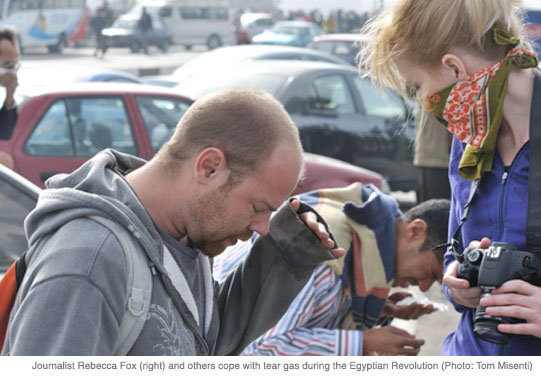
Needed Changes:
An End to All Journalistic Licensing. For decades, journalists in Egypt have worked at the pleasure of the government, which bestows licenses to report, photograph, and film in Cairo upon journalists it approves. One journalist friend of mine has four separate government permits to take pictures and capture video in Cairo, and one of these documents has to be renewed in person every thirty days. Journalistic licensing is one of the most common ways Arab governments monitor and incapacitate newsmakers. The abolition of journalistic licensing in Egypt must be broad and inclusive; print reporters, bloggers, broadcasters, filmmakers, essayists, biographers, tweeters and Facebookers must all be freed from any government approval necessary to do their work. I don’t have Egyptian press credentials and have been reporting outside the law, but while I’ve gone un-harassed, other writers in Egypt haven’t been so lucky.
Privatization of Major Egyptian News Outlets. Egypt’s Al-Ahram is one of the most circulated dailies in the Arab world, and it is state-owned. Until February 11 it was Hosni Mubarak’s cheerleading rag. For years, Mubarak had the privilege of appointing a crony as Al-Ahram’s editor-in-chief. This paper needs to be privatized, and turned into the people’s watchdog instead of the president’s lapdog. Similarly, state television networks like Nile TV need to be transformed from the regime’s adoring bullhorns into privately groomed pit bulls.
Elimination of Executive Immunity from Criticism. Like those of most Arab regimes, Egypt’s penal code prescribes jail time (up to five years) for criticizing the head of state. Not only should Egyptians eliminate this medieval threat, they should go further. In the U.S., many government officials, including the president, are more exposed to public criticism than ordinary citizens, due to a 1960s Supreme Court decision making it extremely difficult for public officials to sue news outlets for defamation. At this point in Egyptian history, power rests with the masses to tell public officials that they’ll be mercilessly scrutinized, and to deal with it.
Withdrawal from, and Explicit Condemnation of, the Arab Satellite Broadcasting Charter (pdf). This blessing of censorship was kissed and signed by a vast majority of Arab dictatorships—and, I’m sad to say, was primarily authored by Hussein Amin, an Egyptian and tenured professor from the academic department in which I teach. The document stipulates that Arab satellite TV networks must “protect the supreme interests of Arab countries” and may not transmit messages that disturb “social peace, national unity [or] public order.” What makes this document particularly insidious is that it’s not only a noose that was fastened on the Egyptian people; Egyptian officials also persuaded other Arab countries to tie it around the necks of their people. When, say, Syria or Saudi Arabia jails a broadcaster, they can point to an external political agreement that was adopted by more than a dozen countries. The new Egyptian system must remove this stain the old regime smeared on the Arab world.
Elimination of Any Reference to Censorship in the Egyptian Constitution. Article 48 of the (currently suspended) Egyptian Constitution expressly permits the direct government censorship of news media when the country is in a state of emergency law (which was the case for Mubarak’s entire thirty-year reign). “In a state of emergency or in time of war, a limited censorship may be imposed on…mass media in matters related to public safety or purposes of national security.” Of course, under martial law or in times of war, journalistic scrutiny is even more important. Constitutions need press freedom guarantees, not exceptions.
Certainly, Egyptian journalists are aware of these needed improvements, and I’m not writing this column as a reminder to them. It’s just that much of the world went about its business during the thirty years Mubarak brutalized journalists. Egypt finally has the world’s attention, and anyone anywhere with any say needs to lend their voice so that Egyptians may always freely raise theirs.
Has America ever needed a media defender more than now? Help us by joining CJR today.