Sign up for the daily CJR newsletter.
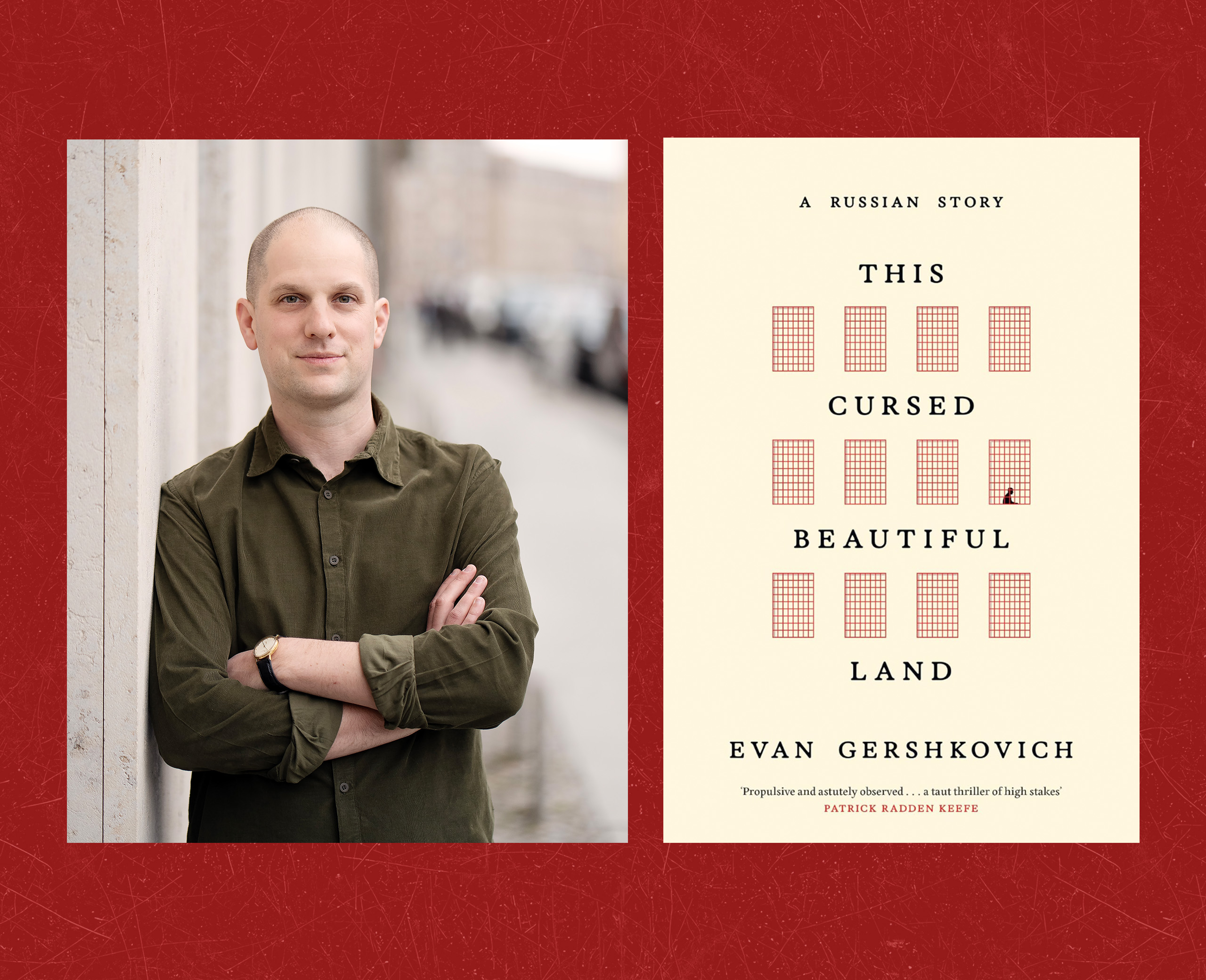
This Cursed Beautiful Land, the new book by Evan Gershkovich, opens in March of 2023, more than a year after the Russian invasion of Ukraine. He has traveled to the city of Yekaterinburg to report a story about the arms industry. His source asks to meet in a steakhouse and hands over a document about Russian tank production. Gershkovich barely has time to register what he’s looking at before he hears the sound of thumping boots. FSB agents handcuff him and put a sack over his head. They trundle him into a van, where they pummel him with their fists and demand to know who he has been working for. “The Wall Street Journal,” Gershkovich blurts out. This is not the answer the agents want.
Accused of espionage, Gershkovich is transported to Moscow and taken to Lefortovo Prison. The two FSB agents “delivering” him joke that they work for the Russian postal service. “I can see you starting your memoir with that quote,” one says.
This Cursed Beautiful Land conforms in important ways to the structures of an unfortunately crowded genre: the journalist hostage memoir. A dramatic opening scene is followed by a description of the journalist’s background—Gershkovich grew up in an immigrant family in Princeton, New Jersey, speaking Russian at home, and moved to Moscow to pursue journalism, taking a job at the English-language Moscow Times. The book chronicles his arrest, life in prison, release, and effort to come to terms with his experience. Other journalists have written similarly about imprisonment in Iran, being held hostage by the Taliban, being kidnapped by Somali pirates, and being ransomed by ISIS.
But Gershkovich was, uniquely, the first American journalist to be imprisoned in Russia in nearly half a century. The circumstances were terrible, the access extraordinary. “I get to see the system from the inside,” Gershkovich writes. “I’m a reporter after all—a voyeur—and this is the ultimate voyeurism.” It’s rare, as he notes, for an American journalist to speak to a Kremlin official, much less an FSB agent or a prison guard. His book takes the opportunity to report on the situation in which he is trapped—and in doing so, offers a sympathetic rendering of the agents circumscribed by the reality of their country. “It’s a captivity memoir,” he told me. “But it’s also about memorializing another autocratic turn in Russian history.”
He meets an agent who shares his passion for soccer, and who tells him about an FSB team in a local league. Gershkovich asks for the name of the team; the agent laughs. His cellmate, Seryoga, who had pleaded guilty to producing illegal weapons, schools Gershkovich on the mores of Russian prison life, including use of the toilet and masturbation. At one point, Seryoga’s mother passes away; Gershkovich embraces him in their cell and tells him it’s okay to cry. Seryoga declines. Gershkovich attests to never succumbing to despair, either. “I hadn’t allowed myself to cry,” he writes. “I felt that if I did, I would break down, so I had to stay tough, keeping all my emotions pent up.”
He captures his observations in three crammed journals. He reads widely, about Russian history, the prison system, and the nature of the regime, retrieving books from a prison library that, at least initially, is remarkably uncensored. His reading list is supplemented with books sent by friends. He scours newspapers delivered freely to the prison and records messages on blank sheets of paper he mails to his lawyers. Gershkovich’s bunk becomes a workplace, with a large Russian–English dictionary serving as his desk.
When we spoke, Gershkovich contrasted his treatment with that of Viktoriia Roshchyna, a Ukrainian journalist who was allegedly tortured to death, and whose body was returned to her family without her internal organs. “I was taken specifically for a swap as a valuable hostage to be kept pristine,” Gershkovich told me. In Lefortovo, he was fed regularly, provided medical attention, and granted access to an outside exercise cell. Outside of his initial arrest, he was never abused.
Eventually, the United States was able to negotiate a complex deal that included American and European prisoners along with Russian dissidents who were exchanged for eight Russian spies held in prisons around the world. Among them is Vadim Krasikov, an FSB assassin and alleged friend of Putin’s, who was imprisoned in Germany for the murder of a Chechen dissident. After being subjected to a fake trial and whisked to freedom, Gershkovich was left consumed by an unanswered question: Did the people who set him up, imprisoned him, and then traded for his release actually believe he was a spy?
Years ago, while researching a book on hostage policy, I read every captivity memoir I could, particularly those written by journalists. The first example I found was from 1981, when Jacobo Timerman published Prisoner Without a Name, Cell Without a Number, an account of his forced disappearance in Argentina. Timerman was the publisher of La Opinión, a conservative newspaper that had originally supported the junta. Then he became critical of the regime. Timerman would have surely been killed in prison had it not been for an international campaign to win his freedom. His account of his own torture and the fascist regime helped expose the depravity of a military government that sought to hide its repression from the world. Timerman’s book was so influential that it helped give birth to the modern human rights movement.
Four years later, in 1985, Terry Anderson, a correspondent for the Associated Press, was kidnapped by Hezbollah and held for six years. His book Den of Lions, published in 1993, was a national bestseller. The fallout—and negative publicity—was so great that Hezbollah largely forswore hostage-taking as a strategy. But the risk to journalists emerged again in 2001, when Daniel Pearl, a Wall Street Journal reporter, was kidnapped and murdered by Al Qaeda militants in Pakistan. Pearl’s videotaped beheading video sent a message to Islamic militants around the world that Western journalists were fair game. Hostage-taking surged in Iraq, Somalia, and Afghanistan. In 2008, David Rohde, who was then a New York Times reporter, was kidnapped by Taliban militants, who held him for seven months. His remarkable escape is recounted in A Rope and a Prayer, coauthored with his wife, Kristen Mulvihill.
After the demise of ISIS, hostage-taking by terror groups subsided, but the threat of state hostage-taking surged. Iran has been particularly committed to the strategy, called hostage diplomacy, of leveraging the wrongful detention of Americans to extract concessions. Among a series of journalist arrests, and books, is the story of Jason Rezaian, who served as the Tehran bureau chief of the Washington Post and in 2014 was detained by Iranian authorities along with his wife, Yeganeh. His book, Prisoner, told of his five hundred and forty-four days in captivity and his extraordinary release—achieved, like Gershkovich’s, as a result of a diplomatic deal.
Unlike Gershkovich, however, Rezaian was not allowed to write in prison, so he had to use reporting to construct his experience. When we spoke recently, he said that because he was the focus of a global advocacy campaign and negotiations involving Barack Obama and John Kerry, who was then the secretary of state, he was motivated to tell his own story. “I spent a lot of time reading news stories written about me or watching television interviews by people who presented themselves as lifelong friends,” Rezaian told me. “It was incredibly important for me to reassert my own voice.”
Michael Scott Moore was taken hostage by pirates in Somalia in 2012, which he later wrote about in The Desert and the Sea. Moore told me that he started out his reporting trip, and his captivity, planning to write a book. But as months turned to years, he was so overcome by despair that he could only focus on survival. Once freed, he found the writing process to be therapeutic, though it was less about emotional release than organizing his experience into a coherent narrative. Gershkovich met Moore twice in 2025 in Berlin, where Moore spends time and where Gershkovich moved to be with his girlfriend, Masha. Moore told him, he recalled, that while recovery seems like a gloomy process, “the most essential thing is joy. You have to find things that remind you of what ecstasy was like.”
Several months after Gershkovich was released from prison, he got up the strength to read his journals. He was living in Berlin. Masha found him hunched over the notebooks in a trancelike state, weeping convulsively. The journals had brought back the pain of prison and helped him process the pent-up emotion—and finally release it. “I’m forcing myself to read them,” he told me, recalling that time. “Then I’m forcing myself to write. And with time, it gets easier.”
In the final section of This Cursed Beautiful Land, he is back to being a reporter. He is traveling, researching, unearthing the motivations of those who took him hostage. He uncovers evidence that the FSB had worked assiduously to lure him into a trap and suspected that they had convinced Putin that he was a spy. This is what Putin believed when Tucker Carlson asked about his case in an interview in February of 2024. Gershkovich came to understand that the prison guards and his FSB minders also thought he was a spy of some sort, though they didn’t seem to hold it against him. Using him as leverage to secure the release of Krasikov had been the goal all along.
Gershkovich’s sleuthing helped him uncover some level of truth, though it is ultimately impossible to make sense of his ordeal. Others with whom I have spoken over the years have told me similar things about the process of coming to terms with their experience. Gershkovich said that he approached his book less as a prison memoir than as a story by someone who participated in historical events, in the style of George Orwell’s Homage to Catalonia, which he described as a major influence. “I wanted it to be a book taken seriously on its own terms,” he told me.
The process of writing the book helped Gershkovich heal, and he is looking forward to telling the world his story. But he is also eager to get it all behind him. After taking time off to write, Gershkovich is once again reporting for the Journal. “I believe that it’s important for people who are at the center of big news events to answer questions and be available,” he told me. He sees the book as part of a transition, he said, “then I’m back to life, which is just being a reporter again.”
This Cursed Beautiful Land, the new book by Evan Gershkovich, joins a host of memoirs by journalists who have been held hostage. Here are a few we recommend:
- Prisoner Without a Name, Cell Without a Number by Jacobo Timerman (1981)
- Two Lives, One Russia by Nicholas Daniloff (1988)
- Forty Days by Bob Simon (1992)
- Den of Lions: A Startling Memoir of Survival and Triumph by Terry Anderson (1993)
- American Hostage: A Memoir of a Journalist Kidnapped in Iraq and the Remarkable Battle to Win His Release by Micah Garen and Marie-Hélène Carleton (2007)
- Days of Fear: A Firsthand Account of Captivity Under the New Taliban by Daniele Mastrogiacomo (2010)
- Between Two Worlds: My Life and Captivity in Iran by Roxana Saberi (2010)
- Captive: My Life as a Prisoner of the Taliban by Jere Van Dyk (2011)
- Then They Came for Me: A Family’s Story of Love, Captivity, and Survival by Maziar Bahari (2011)
- A Rope and a Prayer: The Story of a Kidnapping by David Rohde and Kristen Mulvihill (2011)
- A House in the Sky: A Memoir by Amanda Lindhout and Sara Corbett (2013)
- The ISIS Hostage: One Man’s True Story of 13 Months in Captivity by Puk Damsgård with Daniel Rye (2016)
- The Desert and the Sea: 977 Days Captive on the Somali Pirate Coast by Michael Scott Moore (2018)
- Prisoner: My 544 Days in An Iranian Prison by Jason Rezaian (2019)
- Blindfold: A Memoir of Capture, Torture, and Enlightenment by Theo Padnos (2022)
Has America ever needed a media defender more than now? Help us by joining CJR today.