Sign up for the daily CJR newsletter.
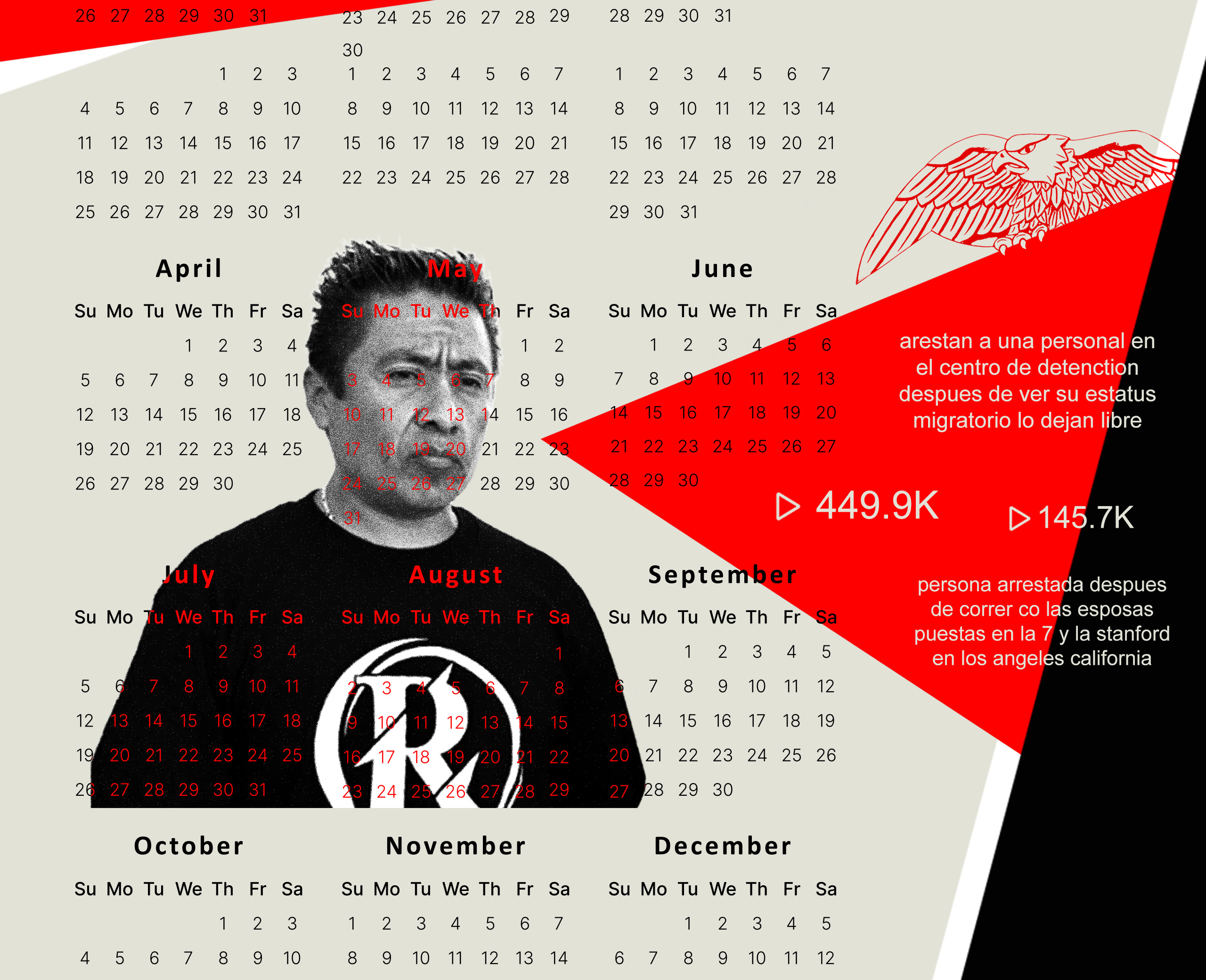
When Carlitos Ricardo Parias told his family that he wanted to become a social media creator, they were confused. “I told him, ‘You can barely put in the Wi-Fi password,’” his son Ulises recalled.
Parias, who is forty-four and originally from Mexico, moved to Los Angeles in 2002. Most of his life, he worked in construction. Then an accident injured his lower back, and he needed a career change. Three years ago, he began reporting on predominantly Hispanic neighborhoods under the TikTok alias Richard LA. He covered car crashes and police activity, Immigration and Customs Enforcement (ICE) raids and protests. He also shared practical information—who to contact if you need an electrician, or someone to clean your garbage bins. It wasn’t long before Richard LA became an important news source, racking up more than a hundred and thirty thousand followers. He managed to bring money in through donations from viewers of his livestreams.
Then, on a Tuesday morning in late October, Ulises, a twenty-year-old college student majoring in electrical engineering, was getting ready to leave home when he heard a commotion outside. He wasn’t worried. All kinds of things happened in his neighborhood, he told me. Then a neighbor knocked on his door and delivered the bad news: ICE agents had booked his father, who had been pulling out of his driveway.
Ulises hoped there had been a misunderstanding. He put on his sandals and rushed outside, where he saw shards of broken glass—an agent had smashed the passenger window of his dad’s car. His dad’s belongings were splayed across the ground. Ulises couldn’t make sense of what had happened. “Then one officer told me, ‘He got shot,’” he said. “That’s when my heart dropped.” A United States marshal, it turned out, had also been injured by a ricochet bullet.
From there, Parias, who had sustained a wound on his left arm, was taken to a hospital, and later to jail. He made bond, then was moved to an ICE processing facility northeast of Los Angeles, in Adelanto, where he has remained for more than three hundred days. His legal team, now seeking his release, argues that he has not received adequate medical treatment there. The Department of Homeland Security, for its part, has said that Parias is in the country illegally, and has started removal proceedings against him. The government also argues that he has been evaluated by medical professionals. “Any claim that there are subprime conditions at Adelanto ICE processing facility are FALSE,” a DHS spokesperson told me in an email. “All detainees are provided with proper meals, water, medical treatment, and have opportunities to communicate with their family members and lawyers.”
Parias is among several journalists who have been detained by ICE. Mario Guevara, an Emmy winner originally from El Salvador, spent more than a hundred days in custody before DHS deported him. Estefany Rodríguez, a Colombian journalist working for a Spanish-language outlet in Nashville, spent fifteen days in detention. In August, Wilmer Solano, who had been a journalist in Venezuela, was detained in Miami. And this month, ICE agents booked Luis Galeano, a Nicaraguan journalist, in Orlando. Most of them had covered ICE raids.
“This, certainly, from an outside observer’s perspective, looks like retaliation for him committing acts of journalism,” Adam Rose, the deputy director of advocacy at the Freedom of the Press Foundation, who has been following the case from the start, told me. He believes Parias came onto ICE’s radar a few months prior to his arrest, in June, when federal agents stopped him and a few other citizen journalists. Parias was in the passenger seat of a car, wearing a marked press vest, when an agent pulled him out. Parias’s leg got stuck in the car, according to Carlos Jurado, his attorney, and he came down knee-first onto the ground. The agent left him on the street, hugging his injured knee to his chest; Parias remained on the curb until a bystander took him to the hospital. (DHS claims Parias evaded arrest.)
Jurado, who runs an immigration law firm in Long Beach, California, told me he doesn’t believe citizen journalists can have any “sort of positive relationship with an ICE agent, because journalists are the enemy of this administration, of the Department of Homeland Security.” Independent creators such as Parias, many of whom closely cover law enforcement in their communities, are especially vulnerable to retaliation. “ICE, in particular, are very aggressive in what they do, and when they do that, it’s important they do it in the shadows, when no one is watching,” Jurado said.
DHS claims its agent shot Parias because he feared for his life. The week Parias was detained, the US Attorney’s Office for the Central District of California charged him with assault of a federal officer, alleging in a Department of Justice press release that he had rammed law enforcement vehicles in an attempt to “dislodge his car during an immigration arrest.” A video obtained by the Los Angeles Times in December complicates that narrative, however—and suggests the officer may have opened fire accidentally.
“Oh,” the agent says in the video after the initial bang of the gun rings out. “Fuck.”
“Who shot?” his colleague asks.
“I shot,” he replies.
Fernando Olguin, a US district judge, dismissed the criminal case against Parias, finding that the government deprived him of access to legal counsel when it moved him into ICE detention immediately after his release from jail. Olguin also ruled that the government failed to comply with discovery request deadlines, including for the release of body cam footage.
Parias’s immigration case is ongoing. Jurado has filed multiple immigration applications on his behalf, all of which have been denied. Most recently, his appeal to the Board of Immigration Appeals was dismissed; Jurado is now preparing an appeal to the Ninth Circuit. Parias also has a U-visa petition—which is typically granted to victims of crimes—pending with US Citizenship and Immigration Services.
For now, the most pressing concern for Parias’s legal team is his wound. On a recent visit to Adelanto, Jurado noticed troubling signs in his arm, which was in a sling. Each time Parias moved his left hand in conversation, Jurado noticed his fingers turning different shades of blue and purple. “We just believe that if he continues to be held there, his health is going to continue to dwindle,” Jurado said.
In spite of his poor health, Parias has been reporting from Adelanto. This summer, he made headlines in The Guardian by recording the conditions at the facility: wormlike creatures in the drinking water, cockroaches in the cells. “He’s using his instincts, his savvy, his communications ability to ensure that story gets told,” Rose told me. Still, among those who know him, there is a sense that Parias has changed. “The Richard that everyone knew was just a happy guy, a father, a husband, who was able to make ends meet through his reporting,” Jurado said. “It’s tough for me to come out and talk about what he’s like now, because that’s not really him, you know?”
Has America ever needed a media defender more than now? Help us by joining CJR today.