Sign up for the daily CJR newsletter.

In July, we gave a dart to the White House Correspondents’ Association (WHCA) for forging ahead with its rescheduled annual dinner. The event, ostensibly a celebration of the First Amendment, ultimately took place weeks after the Trump administration subpoenaed New York Times journalists. “The WHCA represents the interests of the press,” I wrote at the time. “Its role is not to preserve access to the administration at all costs, but to use its collective power to ensure that the White House doesn’t decide what the American people deserve to know.”
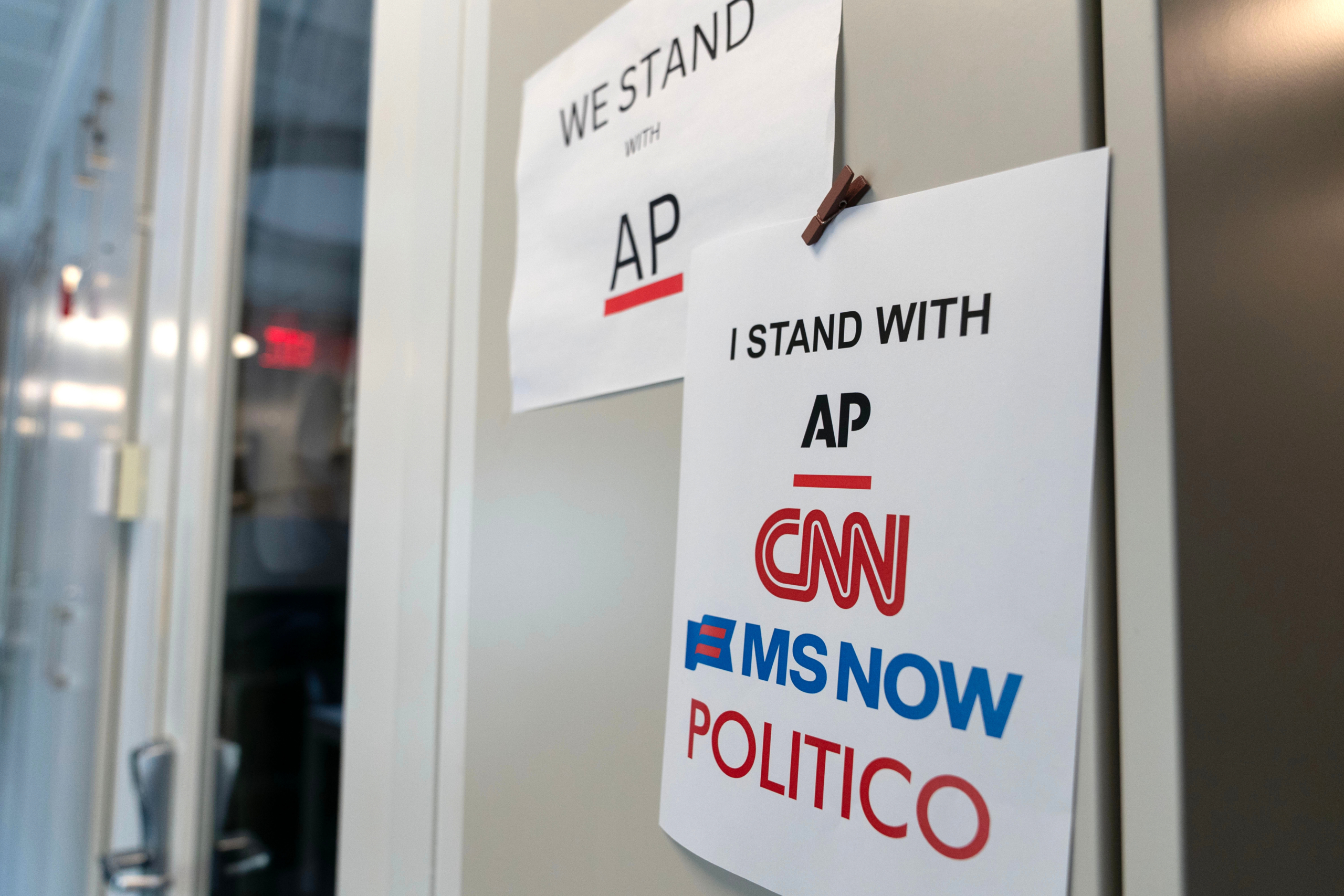
This week, that collective power has finally been on display in a striking and heartening show of solidarity from the White House press corps. After President Trump banned CNN, MS Now, and Politico from the White House in a fit of pique, the WHCA was quick to issue a statement. “The Constitution protects the freedom of the press from government interference,” Jacqui Heinrich, a Fox News correspondent serving as the group’s president, wrote. “The WHCA stands in defense of our colleagues.” When the three booted outlets filed a lawsuit protesting their banishment, forty‑nine media organizations filed an amicus brief backing them.
On Monday, the other networks in the press pool—ABC, CBS, Fox News, and NBC—collectively declined to replace CNN in the rotation, suspending coverage of the White House. “No administration should restrict a news organization because it objects to its reporting,” as they put it in a statement. Peter Baker, the chief White House correspondent for the Times, noted just how extraordinary the blackout was, writing, “for the first time in my 30 years of covering the White House, the president will not have a network TV camera covering his everyday official actions and travels.”
Other news organizations found ways to show their support. NPR announced it would not be using audio from White House events until further notice. The Times and the Washington Post joined photo agencies in temporarily withholding photos of Trump’s events. An open letter organized by the Committee to Protect Journalists and signed by twenty-eight newsrooms stated, “We stand together as news organizations in our firm defense of a free press and in condemning any attempts to restrict their ability to report on the government.”
Whether this incredible display of fellowship will force the White House to stand down remains to be seen. After a hearing Wednesday, a judge issued a temporary restraining order stipulating that access be restored for fourteen days and said that barring certain journalists was likely unconstitutional. There was some chaos at the White House on Thursday morning when the administration appeared to defy the order. Reporters were ultimately allowed in around noon, though some were turned away from the evening’s state dinner.
A cynic might say the solidarity, however encouraging, had less to do with principle and more to do with a recognition that appeasement buys no protection from the Trump administration. Regardless, we are happy to give a laurel to everybody who showed up to support their colleagues this week. Given the judge’s response, one can hope that the show of unity won’t be needed again soon. Then again, Trump is known to break rules—and he has already said he will appeal.

When California’s Rob Bonta and other state attorneys general announced this week that they had settled their antitrust lawsuit against Paramount, it was hard not to see the deal as more of a surrender. The result is that “a string of major entertainment and news entities—including CNN and CBS—will be under the control of one corporate behemoth controlled by the Ellison family,” as Amos Barshad wrote for CJR on Tuesday.
Given the Ellison family’s ties to Trump and the changes to CBS News under the family’s ownership, serious concerns had been raised about putting CNN under the same corporate roof. Even some of the attorneys general involved in the litigation expressed dissatisfaction with the outcome. “I was pushing for a spin-off of CNN, untethered from the mother ship,” William Tong, the attorney general of Connecticut, which was a member of the coalition of states that sued Paramount to stop the merger, told Barshad. The way Ellison has run CBS, he said, is “pretty ugly.”
The deal attempts to assuage those concerns by establishing an “Editorial Independence Board” responsible for ensuring “accuracy, independence, fairness, and journalistic integrity.” The panel, which will consist of five “established journalists” with a minimum of ten years’ experience, will be tasked with resolving any disputes over “alleged reporting bias or failure to meet agreed reporting fairness standards.” The deal also specifies that “no more than two” of the members may be affiliated with the same political party, whatever that means, since most credible journalists do not make their political views public. Who will appoint this impartial and independent board, free from corporate pressure? The combined Paramount–Warner Bros. board of directors, chaired by David Ellison, the chief executive.
Skepticism abounds. Kara Swisher, a CNN contributor, said she will quit. “CNN is not going to be protected. As someone recently told me: Always some fuckery,” she wrote on social media; on her podcast, she called the Ellisons “terrible media owners.” Jessica J. González, a co–chief executive of Free Press, a journalism nonprofit, said in a statement: “A fake bipartisan oversight committee won’t save CNN. We have all the evidence we need from the Ellisons’ destruction of CBS about what they do to warp journalism at Donald Trump’s request.” A concerned CBS News staffer told Jeremy Barr of The Guardian that the proposal “sounds like utter garbage.”
A former executive at CNN told me that staffers there have serious reservations about the board. It feels “performative,” this person said. “Nobody thinks it’s going to be some sort of actual firewall.” Part of the concern at CNN may be that little is known about Ellison’s plans for the network. He has said that he believes its independence “needs to be maintained,” but there have been reports that Bari Weiss, the editor in chief of CBS News, could oversee CNN—a worrying prospect given compounding accusations that she has inappropriately interfered with coverage. (Some of the complaints have come from Scott Pelley and Sharyn Alfonsi, who until recently were correspondents at 60 Minutes; they are now journalists in residence at Columbia Journalism School.) Can an Editorial Independence Board really control what happens in a newsroom? As Laura Martin, an entertainment industry analyst at Needham & Company, told Kyle Paoletta for CJR in the spring: “We know what’s going to happen under the Ellisons. Either the network gets shut down—which would be the worst case for CNN—or it’s going to turn into what’s happening at CBS, which is a nightmare.”
In 2017, Joe Sexton, who was then a reporter at ProPublica, received a tip from Eileen Umbehr, a stay-at-home mom and true-crime enthusiast in Alma, Kansas. Umbehr was writing to alert him of a grave injustice. A wrongful conviction. A double homicide in Topeka. A woman named Dana Chandler, accused of having killed her ex-husband and his girlfriend in 2002.
After a perfunctory Google search for information about the case, Sexton sent Umbehr a polite response: “Thanks, but no thanks. Good luck.” But the emails kept coming. “I’m unashamed of saying that the whole story begins with a moment of personal embarrassment,” Sexton told me. “I gave this woman short shrift.”
After thousands of emails, Sexton came to affectionately refer to Umbehr as “Pen Pal,” but for years, he mostly ignored her missives. Then came email No. 2,714. Umbehr wrote that the Kansas Supreme Court had thrown out Chandler’s murder convictions. “I was like, Okay, well, now at least you got my attention, because it’s just unusual to have state murder convictions overturned,” Sexton said. “They had reversed it unanimously.” Sexton wrote back: “Perhaps I should come see you.”
That visit, and the investigation that followed, are the subject of A Killer Story, an absorbing and quirky three-part HBO documentary that aired its final episode last night. Sexton said he pitched the project upon meeting Umbehr and her husband, Keen, who at that point had devoted years—and significant financial resources—to proving Chandler’s innocence. Sexton described that first trip to Kansas as “wildly cinematic and crazy and, in the best sense of the term, made for TV.” The filming process took six years.
The series is a fascinating look at a confounding murder case with twists that raise important questions about America’s criminal justice system and seemingly endless appetite for true crime. “It doesn’t seem at its core to be a fundamentally healthy curiosity or delight,” Sexton told me. “I hope to some degree this series, while of course having to acknowledge it feeds the appetite for true crime, has a little cautionary element to it that can have some corrective good for all of us. But maybe I’m a dreamer.”
If you have a suggestion for this column, please send it to laurelsanddarts@cjr.org. We can’t acknowledge all submissions, but we will mention you if we use your idea. For more on Laurels and Darts, please click here. To receive this and other CJR newsletters in your inbox, please click here.
Has America ever needed a media defender more than now? Help us by joining CJR today.