Sign up for the daily CJR newsletter.
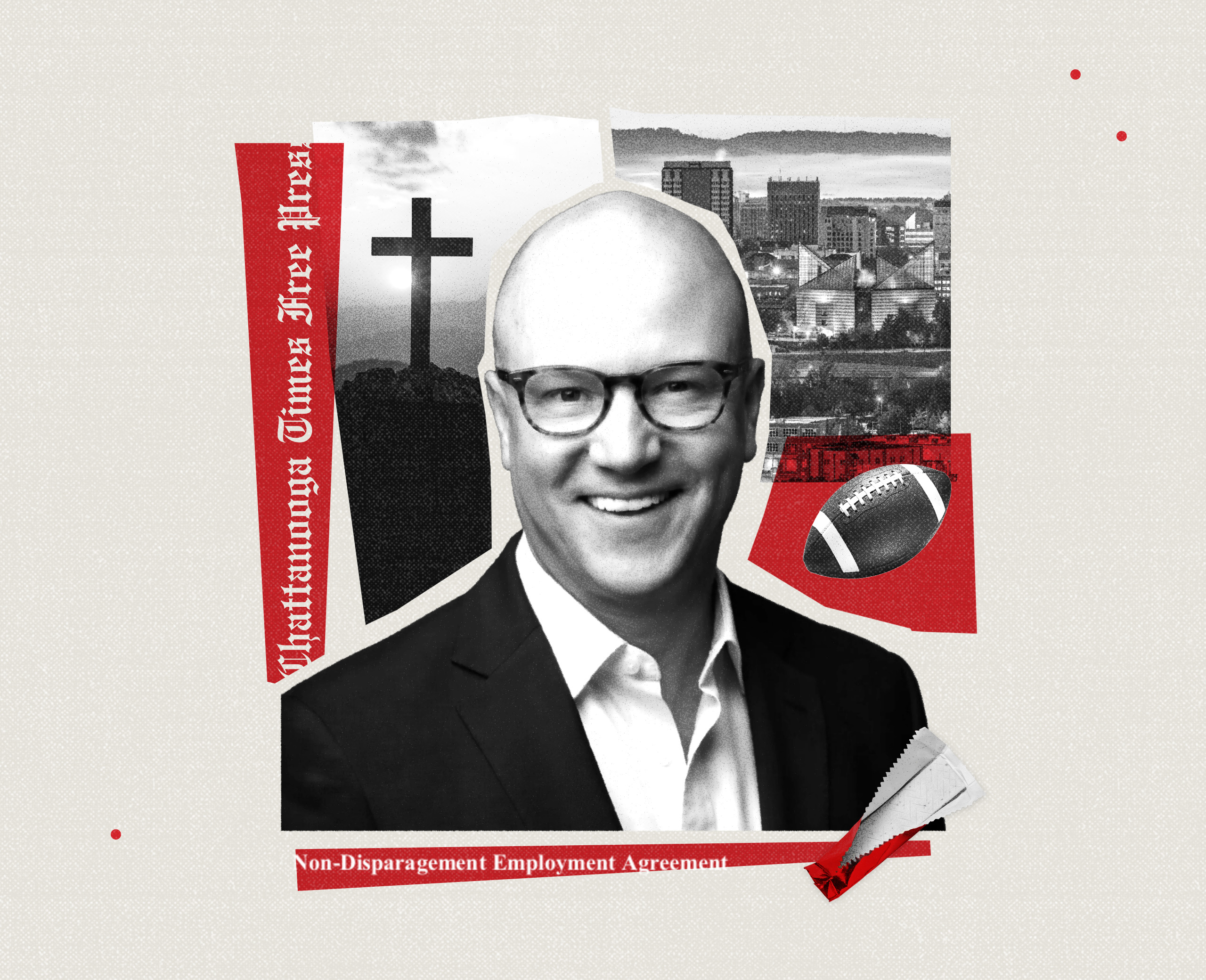
Since taking ownership of the Chattanooga Times Free Press, on July 31, Craig Fuller has felt amazing. “I wouldn’t have sought out a newspaper in another community,” Fuller, a Chattanooga native, who bought the paper with his dad, Max, told me. But he was moved by a sense of duty to save the TFP, as it’s known, which was suffering losses under WEHCO Media Inc., its previous owner. He has big plans for coverage of football, family, faith, food, and finance—what he calls the F’s. The newsroom has just moved into a new headquarters, which includes a bar, in the same building that houses FreightWaves, a supply-chain-logistics publication, one of the more than fifty outlets Fuller owns. In his first month at the TFP, he’d projected a half-million-dollar loss, he said, but has ultimately generated some two hundred and seventy thousand dollars in operating cash flow. “We’re super happy,” he told me. “We’re well ahead of plan.”
Many of those who work for Fuller, or did so until recently, feel otherwise. When Fuller took the helm of the TFP, he addressed the newsroom: “It’s going to be uncomfortable,” he said, according to a leaked recording of the meeting. “It’s going to be chaotic. You’re going to get very frustrated.” Of the paper’s hundred and twenty-eight employees, WEHCO laid off about fifty as part of the sale; seven more decided to leave immediately. Among the latter camp was Mary Fortune, an editor, who first encountered Fuller in 2020, in the course of reporting a story. “One of the things he told me in that interview that I never forgot is that he’s a terrible boss: he’s hard to be around, and his employees are better off away from him.” When she found out he was going to be in charge, she told me, “there was no way I was coming back the next day.”
Fuller has been known, people who have worked for him told me, to call senior-level staff at all hours of the night and to ask employees to sign non-disparagement agreements; in at least one case, he told someone in a meeting, while yelling profantities, “I could kill you.” When I asked Fuller about this, he said, “I hold people to high standards and can be blunt. But I do not threaten my employees. I want them to be successful.” Responding to general complaints about his management style, he told me: “I’m not going to deny it. I am a founder that has a lot of passion. I do change my mind a lot.” He said he “of course” calls and emails people late at night. “I personally don’t believe in life–work balance.” He has also scolded employees for chewing gum. Fuller told me he doesn’t have an anti-gum policy, but he doesn’t like it. “If you’re working for me,” he said, “then the expectation is you work for the pirates and not the Navy, and things are fluid and subject to change, and I’m passionate and I can get really pissed off about things.”
At the TFP, Fuller has provided his new employees some unconventional incentives. In an email to staffers on August 13, shared with me, he said, “I am offering $1,000 for the best idea to cut costs. It could be software, systems, processes, wire feeds or everything else. Every idea has merit.” In another email sent the same day, also shared with me, he announced he was giving all staffers two-hundred-dollar bonuses for “rallying to get shit done.” He has also offered hundred-dollar monthly reimbursement for employees who buy GLP-1s through FreightWaves Health (an initiative under Fuller’s FreightWaves that provides “weight loss, longevity, and whole-body care to the people who keep freight moving,” a reference to truck drivers) as part of what he described in an August 21 email, shared with me, as a “Bad Ass” employee benefit program. He has said on X that he plans to bring chefs into the office to cook for the staff on a weekly basis: “We will create a TV series and cover it through our properties.”
Under WEHCO, life at the TFP was far from perfect: Fortune described the company as “absentee landlords” who “sent edicts down from on high” instead of asking for feedback. (WEHCO did not respond to requests for comment.) Employees said that subscription prices—thirty-nine dollars a month for digital and print—were prohibitively high and that the company failed to make the TFP profitable. Still, the staff felt proud of their paper. “In addition to covering the daily beats, we did a lot of in-depth reporting and enterprise reporting,” Alison Gerber, the paper’s former editor, said. “It takes a talented group of editors and reporters to make that happen, and that’s all just been blown to smithereens.”
Following, he says, the example of Elon Musk, Fuller, who once pitched himself on social media to be Donald Trump’s transportation secretary, said his priority is shedding what he regards as needless bureaucracy. On August 20, after the initial round of layoffs, Fuller let go another thirteen employees, describing them in an email as the “final reduction in force necessary to right-size the organization.” Through a combination of layoffs, firings, buyouts, and new hires, the publication now has fifty-seven employees; most of the reporters who were in the newsroom prior to the acquisition are gone, and six new employees have been hired, with seven more in the pipeline, Fuller said, most of whom are reporters. “We’re now adding people that we want to add in the roles that we want to add for, and it’s been pretty awesome,” he told me. He said his goal is to have more journalists than the paper started with, “but I don’t need layers. That’s the whole thing, is not having a very top-heavy newsroom, but having a really bottoms-up newsroom. Frankly, journalists aren’t expensive. It’s all the layers that you put on top of it that makes it expensive.”
He hopes to have TFP writers contribute to his other publications, and vice versa. Success, he told me, is measured by an increase in subscriptions and revenue-per-employee—a number that Fuller said has grown from around a hundred and twelve thousand to two hundred and ninety thousand dollars per employee since he took over. “We’re probably six months to a year ahead of where we had projected to be,” he told me.
Fuller’s vision for the TFP includes artificial intelligence. Using Anthropic’s Claude, he ran staffing and financial models and researched consumer feedback to draft a business plan. Doing so without the help of AI would have required “a million dollars of somebody at McKinsey to say ‘This is what you should do in six months,’” he said. He has also made use of AI to write several columns for the paper, he said, as well as to help with copyediting and ideation. “Hell yeah, I used AI,” he said. “I’m so proud of it.” (Fuller has prohibited his reporters from disclosing the use of AI in their stories, a policy that has rankled some in the newsroom.)
He noted that since he acquired the paper, there has been an all-local first page; before he came, the TFP sometimes published wire stories there. (“The front page is basically all their actual content that they have reporters doing,” said Raymon Troncoso, a former growth and development reporter at the TFP who was laid off during the sale. Much of the rest of the paper is filled out by stories from wire services, he told me. “But that’s a given when you’re down so many reporters.”)
Fuller has said, too, that he is reshaping the paper’s faith coverage. On X, he has criticized the publication’s handling of faith in the past: “Can’t have a thriving community newspaper in the South if you hate Christians,” he posted. He has since hired a faith and family editor. But in a letter to the editor published by the TFP, Andrew Schwartz, a former religion reporter for the paper, called Fuller’s critiques inaccurate, pointing to articles on Christian life published during his tenure. “Fuller touts his pivot to down-home journalism, but the fact is, under him, the TFP has half as many staff devoted to local newsgathering as before,” Schwartz wrote. “The paper was never perfect, and fresh ideas might help. But if Fuller deserved the benefit of the doubt, he’s quickly squandering it.”
Fuller is making other moves. He has introduced a discounted ten-dollar digital subscription and said he is preparing to start a daily streaming service to highlight the TFP’s long-form reporting. At the end of this football season, he said, he plans to give fifty thousand dollars to the school with the highest percentage of subscriptions relative to enrollment.
In January, he hopes to roll out a college student internship program. To foster local journalism talent across the seventeen counties in the TFP’s market, he’s trying to build a high school campus reporter program. For a rate of thirty dollars an article, they’ll start out by covering high school football “because it has a sexy, rabid fan base, and creates a call of action,” he wrote in an email to staff. (“Thirty dollars felt like a fair number,” he told me. “I was like, I don’t need to be accused of child labor doing this.”) He intends for their stories to be copyedited using an AI-based system, then go on to a human editor for final approval and publication. So far, though, Fuller has had a hard time finding students who will reliably respond to calls regarding the program.
“Only entrepreneurs will understand the dopamine hits of a really hard problem to solve, and that’s exactly what this offered,” Fuller said of acquiring the TFP. “I just thought it was an interesting problem to solve and an interesting challenge that we thought we could solve for, and we were uniquely positioned to do something about, and it’s in our backyard, and it’d be fun. It’s not more complicated than that.”
Has America ever needed a media defender more than now? Help us by joining CJR today.