Sign up for the daily CJR newsletter.
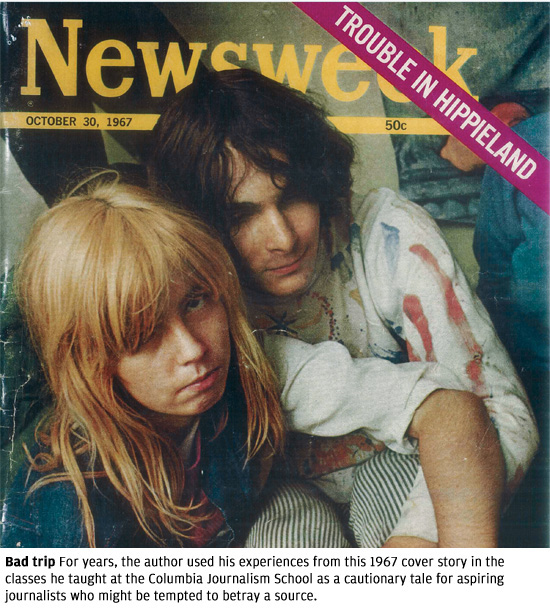
On October 27, 1967, senior editors gathered for the Thursday story conference to see how things were shaping up for the coming issue of Newsweek. A scrim of cigarette smoke hung over the room. Foreign had the Vietcong ambush that nearly wiped out a US Army company north of Saigon; Nation, the 100,000 peaceniks noisily besieging the Pentagon. Back-of-the-book was selling a think piece on how poorly the media had covered the riots in Detroit and Newark that summer. Eyes glazed over. Ho-hum news fare for the ’60s. That stuff might do for inside, grumbled executive editor Osborn Elliott, in his honking Upper East Side accent. “But, c’mon boys, what’ve we got for the cover?” Unease pervaded the room.
That’s when Shew Hagerty, noted for his smoldering pipe and sense of irony, spoke up. You guys obviously aren’t into it, he said, but it’s the Summer of Love out there. Kids from all over have been flocking to Haight-Ashbury and the East Village, crashing in hippie pads, spacing out on the sidewalks. And things haven’t gone well, especially in the East Village. Along with tolerating loose living, the place is a dangerous slum. There’ve been assaults, rapes; emergency rooms are bulging with overdoses. Parents are taping notices up on light poles, searching for missing children. There was that story in the Times last week about the rich girl, Linda Fitzpatrick, from Greenwich, and her boyfriend Groovy—bludgeoned to death in a tenement basement on East 10th Street.
Oz’s eyes lit up. “That’s it,” he exclaimed. “That’s our cover. We’ll call it ‘Trouble in Hippieland.’ ” Nothing did better on the newsstand than scaring the shit out of mom and pop out there in Middle America. But the Times already had Linda Fitzpatrick. Newsweek, he said, needed a runaway of its own.
Time was short—deadline loomed late the next day. Hagerty fired off queries to all domestic bureaus, ordering them to scrape up bummer hippie stories. The magazine’s star writer, Harry Waters, would do the survey piece. Finding our runaway? That job was handed to me. Yes! Just 28 and freshly hired, salivating for a coup—Columbia J-School, The Providence Journal. Now, Newsweek. This would be the day I arrived.
It seemed late to go hunting for the girl myself, much quicker to work through someone with contacts. That would of course be Abbie Hoffman, the counterculture impresario with the tumbling hair. Sure, Abbie said on the phone, he could get us a runaway; would there be, like, some payment? Over an expensive lunch at the Gloucester House, a Newsweek hangout on 49th Street off Madison, I laid out our requirements: mid-to-late teens, a good talker, should come from somewhere beyond the Hudson River, photogenic. And, most definitely, she must be having a bad time with the Flower Child experience. This story was an object lesson, not a siren song.
Two hours later, Abbie called back with the goods. She’d be waiting at a place called the Something Coffee Shop on Second Avenue at 10th Street. Look for blond hair and a gray-and-green-striped sweater. Her name was Marcy.
I found her sitting in a booth staring glassily out at the sidewalk scene—girls in long dresses, boys wearing headbands and surplus Army jackets. Jefferson Airplane was softly rocking over a scratchy speaker. Marcy had straight, streaked hair hanging to her shoulders. Her face was slightly pudgy but pretty, in a malt-shop way. Abbie had explained our mission: I was writing a story about runaways and wanted to interview her. Sure, she said. Just don’t use her name. “Oh, we won’t,” I assured her, clicking my ballpoint into operation. She was high from a steady intake of speed, stp, acid, codeine—whatever friends gave her—and her words gushed out in a breathy voice, with no periods or paragraphs.
Marcy said she had run away from Flint, MI, after lengthy warfare with her father. To punish some transgression, she said, he had killed her pet turtle and torn up her vegetable garden, and was not nice to her boyfriend, a drummer named Twig. That May, before her 17th birthday, Marcy packed her clothes and, with her pet cat, caught a ride to Detroit, where she fell in with a motorcycle gang called The Outlaws. Marcy grew frightened of the guys’ carousing, and she moved in with a 28-year-old pusher she called the Walrus, from her favorite book, Alice in Wonderland. Stoned one day, she injured her leg jumping out of a moving car, and developed an infection after the Walrus treated her with morphine. She said it turned “beautiful colors, but it hurt.” He got her to a hospital in Windsor, Ontario; she spent two weeks recovering, and then hitchhiked to the Newport Folk Festival. “After that,” she told me, “I ended up here.”
Since then, she had lived in two-dozen crash pads, slept on park benches, and was trying to lose weight by taking speed. Someone beat her up with a milk crate in Tompkins Square Park. She became pregnant during drug-fogged sex and borrowed $200 for an abortion, then illegal, which was performed in an apartment by a woman who was just out of her teens and made crude jokes during the procedure. Her idea now was to earn money to help friends buy a bus and go see the Grand Canyon.
I’d become dazed by all her distress, having had little experience with people lost and in pain. But, never mind, I knew what I’d been sent for, and deadline loomed. I handed her the few dollars in my pocket, said to wait there for the photographer—don’t worry, he’d do a profile shot, not her full face—and split for the office.
Writing the piece, I wondered what to call her. I’d used “Marcy” in the draft because that was her name, but told Shew Hagerty I’d promised not to identify her. He said he liked the sound of “Marcy,” so let’s keep it. There are hundreds of Marcys running around, he reasoned, and besides, we’re not using her last name. “Fine with me,” I said.
Headlined “Gentle Marcy: A Shattering Tale,” the story blew everyone away. It earned me a write-up in the front of the magazine. I got a scribbled “Hear, hear!” from Oz on his special notepaper—he wasn’t too free with those. It also created a sensation among readers. Hundreds of letters poured in, many of them with checks for Marcy. One little girl from San Francisco sent a quarter and a dime. “I have enclosed my week’s allowance,” she wrote. “Please give it to Gentle Marcy.” To top it off, Reader’s Digest said it would pay $1,500 to reprint the story, a giant fee back then.
After a few days, the glory faded. Then a researcher at the magazine told me she’d just heard a radio interview with Marcy on the New York rock station WNEW. I got the tape. The interview was conducted by a newsman named Steve Young, who opened with some commentary trashing the hippie movement, how unwashed they were, and deluded. A case in point was this girl Marcy, whom he claimed to have found at the Diggers Free Store—no mention of the Newsweek piece. He’d persuaded her to talk by letting her and some friends sleep on the floor of his apartment.
He titled his bit “Marcy, a Child Again.” When she came on the air, you could tell from her speedo speech she was flying high. Much to my dismay, she led off by saying how devastated she’d been by the Newsweek article. This reporter had paid her for the interview, she said, and promised not to use her name, only he did. I’d also mentioned Flint, so her parents could easily identify her, something I hadn’t bothered to consider. Her mother would be crushed; she’d thought Marcy was working at Macy’s.
Young then cut in, his voice lowered to a whisper, like some guy in an alley selling a hot watch. “Would you like to call your parents?” he asked. “Oh, wow, you don’t mean it!” she said. “It’s early in the morning, but I’d love to talk to my mother.” He slid the phone to her, and you could hear her dialing. Her mother answered, but you could catch only Marcy’s end of the conversation.
“Momma, this is Marcy,” she said in a rush. “Momma, you know Newsweek, you haven’t seen it, have you? Don’t let Daddy read it.” She then broke into sobs and had difficulty getting words out. “Please, Momma, please still love me when you read it. Oh, Momma, I really love you. I thought you wouldn’t love me anymore. I told them I loved you but they didn’t print that. It wasn’t like they said. Oh, Momma, don’t cry. Don’t cry.”
The conversation went on for five minutes, and I was feeling lower and lower. Young ended the program by saying that the next morning he drove Marcy and her friends over the George Washington Bridge and got them maps of the United States. “I last saw Marcy on the ramp of the New Jersey Turnpike,” he said. “Those maps don’t show where Marcy [big pause for dramatic effect] can be a child again.”
What a creep! I thought. But then, how did his interview differ from what I’d done, using her like some disaster mannequin? I’d given no thought to what it really must have been like jumping out of that car, venturing alone into an apartment for a botched abortion. I felt deeply crummy for caving to Hagerty, using her name, and her city. He’d said the story would have lost credibility without those details, but I should have argued, “So what?”
The years rolled by. I left Newsweek, became a magazine writer, and taught journalism. Now and then I’d think of the Marcy story, and the tape: “Please, Momma, please still love me when you read it.” Sometimes I’d play it for my class, as an ethics exercise, always hoping students would find some saving grace in what their professor had done. I mean, parents had to hear this stuff, didn’t they? I got few takers.
Then, a couple of years ago, after retiring as a professor at Columbia Journalism School, I ran into the documentary filmmaker Dan Loewenthal at a party in New York. I forget why, but I told him about Marcy, that I couldn’t get her out of my mind. “Well, why don’t you go out and find her?” he said. “And apologize.” He’d help me. And he’d make a film about our search.
Other than her first name, all we knew was that she had a brother, Arthur, and a sister named Jeanie. And there was that telephone call over the old rotary phone. We thought if we slowed down the tape and counted the clicks, we could come up with her number. Then, we’d look that up in a reverse phone directory from 1967, find the family’s name and address. They’d be long gone, of course, but we could nose around the neighborhood, locate someone who knew them, and maybe learn what had happened to Marcy. Piece of cake.
Not actually. There are no audible clicks. Rather, it’s a time-lapse thing—the number of milliseconds that elapse between dialing a nine, say, and when the rotary winds back to zero. The nine and zero are easy to distinguish, but not the nine from an eight, or a five from a four. Computer experts we found on Craigs-list translated the sound impulses to digital images, but none was confident he had the golden number.
There were other avenues, one of which was her high-school yearbook. A Flint librarian told us that back then she would have attended one of three high schools, and been listed as Marcy somebody-or-other in the freshman class entering the fall of 1965*, when she was 14. That intrigued us enough that in January 2011, we flew to Detroit, rented a car, and drove the 50 miles up to Flint. It was cold, with about a foot of snow on the ground. Before leaving, we’d called the Flint Journal and convinced them to do a story about our search, hoping to reach someone who had known Marcy. We got to Flint on a Friday, and the story was scheduled to run that Sunday.
One of Flint’s misfortunes was to have been the birthplace of Michael Moore, whose documentaries regularly paint it as the unhappiest place to live in America. Beyond a couple of ritzy neighborhoods filled with Tudor mansions, it’s dominated by one-story frame bungalows that house the former work force from the abandoned Chevrolet and Buick plants. Aside from unemployment numbers, bad news in Flint comes in the form of arson and violent crime. The city averages 300 to 400 fires a year. And as Dan and I drove around, we saw plywood signs nailed up on trees saying things like, “No Hoes Allowed. Children At Play.”
At the Flint Central Library, the yearbook gambit also proved a dead end. No Marcys in the 1965* books, or the classes on either side. “Marcy,” we figured, could well be a nickname for Marsha, Martha, Marjorie, Margaret, or Mary. It seemed hopeless. We also tried checking the “Marcy” birth announcements that the Flint Journal used to run in the ’40s and ’50s. No luck.
We ended Friday in low spirits.
Saturday morning, we were back at the library. I was up in the microfilm room, and Dan was downstairs at a table poring over more yearbooks, when a presence loomed in his peripheral vision. He looked up to see this aging biker dude with a gray ponytail, his wallet secured to his blue jeans by a chain. “You the guys looking for Marcy?” he asked in a challenging voice. He’d seen the story in the Sunday issue of the Journal, which had appeared online that day, ahead of schedule. “I knew her back in the ’60s. Her real name is Margaret. The last name is *Bachmann.”
“Whoa, whoa, wait a minute,” Dan sputtered. “Wait, wait.” He said he needed to get his camera operational, go find Bruce. No, the biker said he wasn’t going to wait.
“Well, what’s your name?” Dan asked.
“Call me ‘Moon,’ ” he said.
“Is that your name?”
“No, but you can call me Moon.” Moon then spun on his heel and walked out of the library.
From then forward, our search unfolded in a rush. Through the obit registry at the Journal, we found Marcy’s father and mother, Reinhold and Edith Bachmann, who had died in the ’90s. The old man had run a hobby shop in downtown Flint, The Hobby House. The family had lived in the west end of town. We also learned that Marcy now resided in Hawaii, of all places, and that she had four children. Via Google satellite, we zeroed in on their house, a big-looking spread outside Waikiki. Could Marcy be a well-off matron? Was a trip to Hawaii in the offing? Piña coladas in a Tiki hut, watching the curlers roll in? We felt like dancing a jig.
There was still daylight left to Saturday, so we drove out to Marcy’s old house to film the street for background, and talk to whoever was now living there. It was a white bungalow, surrounded by a chainlink fence, looking forlorn in the dirty snow.
I went up and knocked on the storm door while Dan shot me from the sidewalk. Deep-throated barking exploded from within the house, and a large-ish, middle-aged woman appeared, shouting at the dogs to stay back. She had glasses and a head of curly brown hair, and was smiling inquisitively. I told her we were looking for someone named Bachmann who had lived at this address a long time ago.
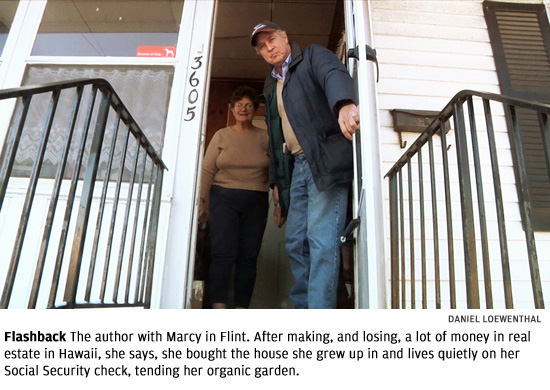
“Well, I’m a Bachmann,” she said.
“You’re a Bachmann,” I said, uncomprehending.
“Yes, I’m a Bachmann. I’m Margaret Bachmann.”
“Margaret Bachmann? You mean . . . you’re Marcy?!”
“Yes, I’m Marcy.”
Speechless for a second, I quickly recovered and told her I was the guy who’d written the Newsweek story so many years ago, about her running away to New York, did she remember? Did she remember! She immediately lit into me as if she’d been waiting all these years for that guy to show up at her door. That was an awful, awful thing I did to her, taking advantage of a young girl, how painful it was, how horrible it made her feel, and how it had so upset her family, how embarrassing with friends and neighbors reading it. And she was 19, not 17 like I’d written, and she didn’t even know what STP was, although she did admit to a liking for LSD.
After agreeing that I’d done a terrible thing and apologizing a dozen times, I told her this man with the camera who was coming up the walk right now was my associate, Dan Loewenthal, and that we were here to do a film about the consequences of such careless and thoughtless journalism, hoping to make amends and be forgiven. And on and on.
Eventually she relaxed, and invited us into her living room, now a little crowded, what with us and her large rescue dogs, including a boisterous Rottweiler she’d acquired to scare away criminals. Speaking in a voice you could probably hear several houses away, she ran briefly through her life after being dropped off that day at the Jersey Turnpike. She and her friends hitched to Haight-Ashbury, she worked as a waitress, attended and then dropped out of college, knew Country Joe and the Fish and Timothy Leary, was present at Altamont. She then moved to Hawaii, where she got married and had three boys and a girl, made and lost a lot of money in real estate and the restaurant business, and, after getting divorced, moved back to Flint in the late ’90s. She bought out her sister’s share of her parents’ house, and was now settled into a quiet retirement, living on her Social Security check and tending her organic garden.
As it grew dark, we said we had to go, but made a date for lunch the next day. It wasn’t until we reached our motel that I realized I’d forgotten to tell her about the story that was running tomorrow on the front page of the Sunday Journal. Thanks to the digital age, it would include not only the reporter’s interview with Dan and me, but also the original Newsweek story, as well as the radio interview on WNEW. All of Flint would now listen in as Steve Young slid that old phone over to the clueless flower child and asked in his unctuous fashion: “Would you like to call your parents?”
It was as if I’d never learned a thing. Oh, Marcy, I thought, I’ve done it to you all over again!
Has America ever needed a media defender more than now? Help us by joining CJR today.