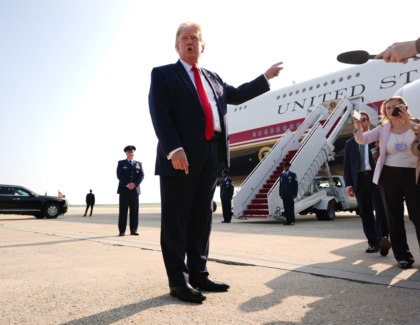
These factors would not be crucial in shaping coverage of Romney—if he were perceived as a winner. But campaign reporters are sycophantic about candidates on the way up and sarcastic about those on the way down. For better or for worse, any reporter who has covered a state auditor’s race and been to a national convention believes that he or she is a great armchair political strategist. So when Romney puts Eastwood on stage without a script, releases an intemperate statement before the American ambassador is murdered in Libya, and is accused by Politico of running a dysfunctional campaign, the press invariably will pile on.
(For my own critique of Romney’s management style, see my column this week for Yahoo News.)
The biggest gap, though, between Romney and those who chronicle his political fortunes is cultural. Michelle Obama, during her speech to the Democratic convention, spoke about how her husband had “started his career by turning down high-paying jobs.” Everyone wearing a press credential in Charlotte could relate to Obama’s economic choice, since no one brighter than a dead flashlight battery goes into journalism for the money.
Romney, in contrast, predicated his life before politics on profit maximization. So did George W. Bush (the only other presidential nominee with a Harvard MBA), but back in 2000 most reporters could understand his years as a scapegrace son and envy him for owning a baseball team. Even the fabulously wealthy presidential contenders of yesteryear (JFK, Nelson Rockefeller) had an insouciance about money that came from having inherited it. But for Mitt Romney, the road to riches was, by all accounts, paved with humorless dedication.
This is all about values, not conservative political ideology. Campaign reporters can relate to a career politician like Paul Ryan who has been drawing an upper-middle-class salary on the congressional payroll since he was 28 years old. What matters here are not Ryan’s views on the optimum level of taxation and government, but rather his life choices. By running for Congress in 1998 after a youthful career in Washington think tanks, Ryan radiated his belief that an influential career in public service was far more important than amassing a nine-digit investment portfolio.
“Bias” is an explosive word to use in describing the media’s attitudes toward Romney, so I want to be precise about what I mean. I am not describing any deliberate effort by the media to “get” Romney, or to reelect Obama. It’s just my sense that—like watching a smug banker slip on a banana peel in an old-time silent movie—campaign reporters appear to derive a special glee out of every Romney pratfall. The best remedy is some simple self-awareness, and a moment of hesitation and reflection before trotting out the parallels to the 1988 Dukakis campaign.
Related posts:
“Embracing the myth of the campaign wizard, again”
“After Charlotte: baffled by the horse race”
- 1
- 2
But Mitt does feel entitled to be President. He said as much in the same video'd speech everyone's been clucking about.
Mitt said: "if we win on November 6th, there will be a great deal of optimism about the future of this country. We’ll see capital come back and we’ll see—without actually doing anything—we’ll actually get a boost in the economy."
Without actually doing anything.
I tried to wrap my head around this assumption: tinyurl.com/9trovkp
#1 Posted by Edward Ericson Jr., CJR on Fri 21 Sep 2012 at 11:45 AM
Greatest difference between Mitt and reporters covering him is that Mitt has an R after his name and reporters have a D.
#2 Posted by Dan Gainor, CJR on Fri 21 Sep 2012 at 01:02 PM
Oh, the Heavy Irony (KGB, 'conspiracy', etc.) tack for responding to the obvious - that the culture of political journalism in the big media organizations is reflexively anti-Republican in its story selection and framing, for some fairly obvious demographic reasons. (The other tack is the Huffy Indignation response.)
Walter Shapiro does not mention to his credulous readers his own history as a Democratic Party activist and functionary. Irony, indeed. Why is it that stereotypical political journalists (urban-oriented, fairly affluent in family background, etc.) can be shrewd about some things, but seldom about themselves?
#3 Posted by Mark Richard, CJR on Fri 21 Sep 2012 at 01:03 PM
I am the author of this article. And, yes, Mark Richard is totally correct, I have a "history as a Democratic Party activist and functionary." I ran for Congress in a Democratic primary in 1972 and I served as a speechwriter for Jimmy Carter. And since I have the left White House in 1979, I have engaged in absolutely no partisan activity. So forgive me for not disclosing this information (which I often disclose in print) in this particular article. But it has been 33 years since I left the Carter White House.
#4 Posted by Walter Shapiro, CJR on Fri 21 Sep 2012 at 01:13 PM
I'd say this Walter Shapiro column does a better job in explaining why reporters have been right to be tough on Romney than in explaining why they need to be less tough. As I've said before, human being will find a way to express their feelings despite journalism conventions about "objectivity," and Shapiro points out in passing many factors that incline reporters to dislike Romney. The lack of access, the lack of likability and relatability, the lack of policy content, etc. And reporters are just responding the same way as ordinary voters are.
#5 Posted by Harris Meyer, CJR on Fri 21 Sep 2012 at 01:17 PM
I appreciate Walter Shapiro's gesture of response. I'm afraid that an issue remains, which is the much stronger presence in and entree to mainstream journalistic organizations on the part of or nominally ex-Democratic Party activists and how it has affected the journalism produced by those organizations. Some non-Democrats, vituperative or not, believe that (to cite a recent example not highlighted in CJR) the reflexive effort by Brian Ross, introduced by smiling, eager ex-Democratic functionary George Stephenopoulos) to link tha Aurora shooter to the Tea Party without proof is not something that occurs in a vacuum, but instead is guided by a fixed social/political narrative that dominates American journalism and is profoundly hostile to the Republican Party. Your own column here, intentionally or unintentionally, illustrates the problem.
There are a lot of tough questions to ask President Obama and the Democratic leadership about Democratic Party governance and its discontents, in laboratories from dysfunctional California to corrupt and decaying Illinois to chic, graying Vermont. But they don't get asked, and I believe partisan politics of the narrow-minded and reflexive sort to which I refer, is a large part of the reason.
#6 Posted by Mark Richard, CJR on Fri 21 Sep 2012 at 01:54 PM
I am a registered Democrat and voted for Obama in 2008 with both my ballot and my checkbook. The checkbook is closed this time around but the ballot is undecided. I though Eastwood was superb in his presentation. Why all the belittleing and tut-tutting? He was right on and I wish you all would move on.
#7 Posted by Mike Robbins, CJR on Fri 21 Sep 2012 at 02:38 PM
"I though Eastwood was superb in his presentation. Why all the belittleing and tut-tutting?"
Here ya go.
http://www.thedailyshow.com/watch/fri-august-31-2012/rnc-2012---the-road-to-jeb-bush-2016---invisible-obama
"profoundly hostile to the Republican Party"
The republican party is profoundly hostile to the ideals of the enlightenment and democracy. Change that and you'll get a bit more sympathy for your social agenda.
Because, frankly, when it comes to your economic agenda, you've had the majority of journalists at 'hello'. It took a hell of a lot of pulling from 'the people who know what we're talking about' to pry journalists from their death embrace of Paul Ryan. That's 40 years running now of slavish journalist support, including that disgusting election in 2000.
And now people are getting upset because journalists aren't being kind enough to the party who selected a private equity vampire for their presidential candidate, in the presidential election just 4 years after the republican coddled finance sector left a Krakatoa sized crater in the global economy?
Really. What are people supposed to say, dears?
#8 Posted by Thimbles, CJR on Fri 21 Sep 2012 at 03:17 PM
Stop perpetuating the Big Lie of "democracy."
http://sphotos-b.xx.fbcdn.net/hphotos-snc6/228007_364920366920083_751664840_n.jpg
Reps and Dems are two wings of the same bird of prey.
#9 Posted by Dan A., CJR on Fri 21 Sep 2012 at 11:23 PM
Small change of topic, but I had a couple of thoughts after watching Ted Koppel do a number on O'Reilly:
http://www.youtube.com/watch?v=UmXNVdAsudQ
and then go onto Bryan Williams "Rock Center" to do a piece.
http://rockcenter.nbcnews.com/_news/2012/09/21/13998880-ted-koppel-takes-on-the-truthsayers
And, I'm sorry, but Koppel just doesn't seem to get it. His problem seems to be "Aren't we supposed to be journalists? Why do all these people yell and rant?" His answers seem to be
a) It's good business, but journalism is supposed to be a calling.
b) because these people have a perspective on these subjects, therefore the issues being discussed cannot be separated from the speaker's identity. Therefore differing views on these issues become an attack upon one's identity which provokes an emotional response. When mass communication becomes a series of emotional responses, compromise becomes impossible. Therefore, journalists should avoid perspective and shun partisanship.
This reasoning makes him take msnbc programming and hold it up to fox's programing as if they're mirror images to one another - and perhaps a case could be made for some of the more voluminous ranters on MSNBC like Shultz and O'Reilly - but Koppel drags people like Rachel Maddow into his net and that isn't fair.
The problem is that Koppel puts the cart before the horse. Yes, emotional partisan journalists in "the scream at each other" mold do not often put forth informative tv, especially when the admission of mistake is not considered as much a correction to be embraced, but as a show of weakness to be avoided. But that's not because of the partisan perspective of the journalist. That's because of he's emotional and combative.
Rachael Maddow is partisan. Is she emotional on tv? Is she combative in the O'Reilly sense? Does she correct herself since her calling, her service, is to her audience? Chris Hayes is another partisan with one of the best news shows on TV. He has frequent guests on his show from all perspectives. Is he emotional? Is he combative?
No? Are they right or sincere in their attempt to be? Yes? Then partisanship is not the issue. It is a red herring. Yes, a partisan network under the control of a partisan message machine will attract an audience which is seeking to hear what they already know reenforced, but the evil of a news network exploiting an audience's beliefs for their profit does not justify the labeling of the expression of journalist's perspectives and beliefs as evil. Not when the journalist is making the effort to root those beliefs in facts and knowledge as they are best known.
#10 Posted by Thimbles, CJR on Sun 23 Sep 2012 at 05:29 AM
Split because of the two link limit.
So we come full circle and look at Romney. By the available evidence, we know the guy is a tremendous liar who has made money in some the more guttery areas of finance. We know he's a bit entitled in attitude and more than a bit off when dealing with people. We know his outlines of policy which give preferential treatment to the rich over the poor. We know he's a prick for trying to pull his 'he's with the enemies of America, not real Americans' crap over the Libya embassy attack, and that's when he's not blowing welfare dog whistles.
This isn't the made up crap or the inflated stories the press indulged in during the Gore campaign. This isn't a false narrative with no real basis but press gut feelings which hounded Gore until he grew a beard and won an oscar for a slideshow.
This is a guy who does terrible things in his business and political life without shame. If observing that makes you partisan, then being partisan is the only way you can communicate the truth. What are people supposed to say?
#11 Posted by Thimbles, CJR on Sun 23 Sep 2012 at 05:49 AM
But it is an interesting discussion to have, and Koppel's been having it for a few years now. I think journalists should be allowed to take and defend their stance so long as they can factually justify it. I don't think being partisan is the cause of the increasing coarseness of rhetoric nor do I believe emotion is always a bad thing.
What is a bad thing is when emotions, partisanship, desire for profit, fear of diminished authority, causes people to knowingly sacrifice truth for other concerns.
But those other concerns can also be careerism and the fear of confrontation. You don't have to be partisan to mislead your audience.
I know Keith Olbermann isn't all that popular a name and he's burned more than a few bridges by being way too Keith to stomach at times, but his response to Koppel way back when was worth a listen then:
http://www.youtube.com/watch?v=Ju9nDqDgp2A
and still is now.
#12 Posted by Thimbles, CJR on Sun 23 Sep 2012 at 06:07 AM
Mitt happens - Mitt's misstatements and malapropisms are his own. The public certainly doesn't need journalists who feel undeserved guilt to pull an overly-compensatory balance fairy out for every story. Just tell the truth, let the public figure it out.
#13 Posted by Thanos, CJR on Mon 24 Sep 2012 at 06:53 AM
Even Howard Fineman at the Huffington Post is starting to express worry that the mainstream media has been too soft and uncritical of their cult figure/President. If Obama statements and Obama outcomes were held to the same standard as that of Republican candidates, there would be blood between the press and the Democrats. On the plus side, there is some of what Mickey Kaus calls 'MSM guilt' that may be starting to kick in - the NY Times gave big play to The One's decision to go on 'The View' rather than meet with foreign leaders the other day. The Obamas have been all over the fluff media, but the President won't hold a news conference, and the wimpy, peer-pressured MSM just takes it. Pres. Obama has got to be laughing in private at what he once referred to as his 'base'. The contempt of the leader for his masses. There's only so much reality CJR itself before starting to look like a joke, too.
#14 Posted by Mark Richard, CJR on Wed 26 Sep 2012 at 12:45 PM
Excuse me, omitted the words 'can ignore' after 'CJR' above. I suppose it is fair to note that CJR has run Brendan Nyhan's tentative criticisms of press coverage of Pres. Obama. Question for deep thinkers at CJR - would Romney trade his level of press scrutiny for that of Obama? And would Obama do the same?
#15 Posted by Mark Richard, CJR on Wed 26 Sep 2012 at 12:50 PM
"...releases an intemperate statement before the American ambassador is murdered in Libya..."
Actually, the "intemperate statement" came after. But it's OK to get the chronology wrong if your name isn't Mitt Romney ;)
When is CJR going to look at why, at least early on, only CNN was pushing back against the story that this murder was part of a protest against a Youtube video? Hillary spokesman Philippe Reines then goes after CNN with both barrels and this isn't worthy of some comment?
#16 Posted by Brian Dell, CJR on Sun 30 Sep 2012 at 02:37 PM