Sign up for the daily CJR newsletter.
I may have spoken too soon when I said to expect The New York Times‘s paid subscription growth rate to continue to decline this quarter.
Poynter’s Jeff Sonderman reports that Newsstand, the long-awaited feature in Apple’s newly released operating system for iPhones and iPads is causing explosive growth in news app downloads. A stunning 1.8 million iPhone users downloaded NYT‘s free app last week, eighty-five times the rate of a week earlier, Sonderman reports, and the iPad app’s downloads were up seven times, to 189,000.
The Newsstand app lets publishers to sell recurring subscriptions within apps. Users don’t need to whip out their credit cards—Apple already has them.
The vast majority of downloaders, of course, aren’t going to decide to pay $15 a month for The New York Times just because Apple makes it easy now.
But some sliver of them will. That just might boost the Times‘s digital-subscription growth rate (and everybody else’s on Newsstand) this quarter.
— Over at the Nieman Journalism Lab, Ken Doctor looks at Piano Media, a startup that corraled all of Slovakia’s major media outlets behind a paywall, and its example as a new digital newsstand:
At least 150 paywalls have been erected over the last year or so, in the U.S., U.K., and across Europe. American companies in on that construction boom include Lee, McClatchy, Morris, MediaGeneral, MediaNews, Gatehouse, and Tribune (all powered by Press+), as well as Scripps, Gannett, and Belo. From Sanoma in Finland to The Telegraph in the U.K., a number of dailies are following the trend. Those that haven’t are almost all considering a paywall in some form; many more will launch in the next 12 months.
Think of that building as single home construction, in our aspirational Sim City of happy digital circulation. Once all those homes are under construction, what comes next? Shopping centers. That’s what we’re now beginning to see: Digital newsstand development is booming, with numerous blueprints so far unpublicized. As those newsstands sprout, we’re moving to a new stage of paid content, one with profound implications for newspaper and magazine budgets for 2012 and beyond.
— Speaking of circulation, The Wall Street Journal deserves a pat on the back for this graphic it ran last week on the scandal at its European edition:
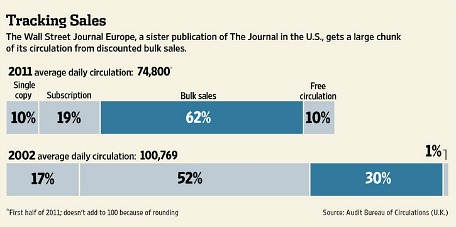
Individually paid circulation has collapsed at the WSJE in the last decade, as this makes vivid. Where newsstand sales and subscriptions used to account for 69 percent of its total circulation, they comprise just 29 percent now. The rest is junk circulation.
And that happened while the paper’s overall circ has tumbled by a quarter. Brutal.
Has America ever needed a media defender more than now? Help us by joining CJR today.