Dean Baker bizarrely dismisses the role Wall Street chicanery had in inflating the bubble:
It Was the Housing Bubble: Not the Damn CDOs
But has been made abundantly clear, CDOs were critical part of the housing bubble, especially in 2004-2007. Wall Street created false demand for housing loans by creating these complex securities and convincing rubes that they had no or little risk. That vastly increased money for housing lending. Baker somewhat acknowledges this:
This story has nothing directly to do with CDOs. Insofar as CDOs and other games helped to drive the bubble beyond the levels it would have otherwise attained then they made the crash worse than it otherwise would have been, but the CDOs were not directly the problem. It was the bubble.
But it’s just wrong to downplay securitization’s role in the bubble.
— Speaking of securities inflating the bubble, Felix Salmon talks to my pal Moe Tkacik about Magnetar and is on board with why it’s such a Big Story.
I’m not going to even attempt to get into all the nooks and crannies and conspiracy theories which surround Magnetar, but I think, after talking to Moe at some length, that I have a much better grasp of the very big picture than I did after reading the ProPublica report…
From a systemic perspective, Magnetar had a much bigger effect — and a much worse effect — than Paulson. That’s what makes people like Moe and Yves Smith angry. (Much of what Moe learned she got from Yves and her book.) Magnetar was in many ways the engine which was responsible for many of the worst losses from New York to Dusseldorf. Those losses didn’t directly become Magnetar profits, because Magnetar was long equity and generally hedged in a way that Paulson and Burry weren’t. But they did end up helping to cause the biggest recession in living memory.
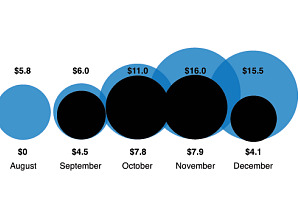
I’m going to step up for ProPublica here. Its story very clearly showed how Magnetar nearly singlehandedly kept the bubble going at a critical juncture when everyone else was bailing. Indeed, that’s what I took away from the story, and it was in the lede:
In late 2005, the booming U.S. housing market seemed to be slowing. The Federal Reserve had begun raising interest rates. Subprime mortgage company shares were falling. Investors began to balk at buying complex mortgage securities. The housing bubble, which had propelled a historic growth in home prices, seemed poised to deflate. And if it had, the great financial crisis of 2008, which produced the Great Recession of 2008-09, might have come sooner and been less severe.
At just that moment, a few savvy financial engineers at a suburban Chicago hedge fund helped revive the Wall Street money machine, spawning billions of dollars of securities ultimately backed by home mortgages.
And it had this graphic (click for the full thing):
— If the press hasn’t figured out yet that the rise of cloud computing raises serious privacy issues, Facebook is doing its best to show why. Valleywag’s Ryan Tate, who’s done an excellent job following this issue, reports on a new move by Facebook to unilaterally strip its users of their privacy.
CEO Mark Zuckerberg just announced at Facebook’s annual “F8” developer conference that it’s allowing the outside websites with which it shares user data to hold on to said data. Previously, the partners were supposed to dispose of the information within 24 hours…
Earlier this month, in fact, Facebook took away the option to hide profile data like interests, “likes,” work, education, current city and hometown. The Electronic Frontier Foundation raised a red flag about the change, writing, “The new connections features benefit Facebook and its business partners, with little benefit to you. But what are you going to do about it? “
- 1
- 2

This is how I read Dean Baker's comment about the housing bubble being more significant than the CDOs: the housing bubble was more significant because the fundamentals of the housing market had been out of whack for years; Alan Greenspan and Ben Bernanke both were in position to pierce the bubble at an earlier, smaller stage by raising interest rates, which would have resulted in less catastrophic damage than the blowout in 2008, but instead they chose to ignore the data and let the party party on, recklessly.
I'm not an economist, I just read them on the internet, so I cannot say for certain that that is exactly what happened or if that is exactly what DB means. But I've been reading his blog since the height of the housing bubble and I perceive his major message to be that the collapse of the housing market was totally predictable and totally preventable; we have systems in place to manage such market distortions but highly esteemed professional experts, whose entire reasons for being are to manage the nation's economy towards stability and prosperity, completely failed at their jobs. The CDO's might be gasoline poured on the fire but the kindling was laid by mismanagement of the economy.
I cannot read DB's mind but I'm thinking his other criticism about the attention being lavished on CDO's is that it's yet another distraction from the real story of incompetence at a high level. If you focus on an obscure, hard to understand, complicated, rogue financial product, than blame is shifted from controllable forces of "we could have known but did nothing" to uncontrollable forces of "see, how could we have possibly known it was so secret and so complicated no one could have understood or done anything to stop it". But that's not the real story. The real story is profoundly bad management of controllable forces.
And the other story is that all of the red lights were flashing and sirens blaring but the media and most Americans do not understand economics, or even their own personal finances, well enough to recognize a housing bubble expanding and blowing up right before our own eyes. And that's why we have experts like the Federal Reserve to keep it under control. And if the experts are not doing their jobs, then the press should do its job and make sure we're all informed.
But that's not what happened. Instead a hedge fund came in and saw what was happening, read the data, recognized the gross imbalance of the fundamentals, made a bet and won big. If Magnetar could read that data well enough, then surely the Fed and other high level policy makers should have also been able to comprehend...and take corrective actions. But they did not.
And that's why I think I understand why DB still says the housing bubble was more important than the CDO's.
#1 Posted by MB, CJR on Thu 22 Apr 2010 at 10:05 AM
What I think Dean is getting at is that the growth in the economy over the last several decades is not supported by fundamentals, such as a rising middle class who's wages have increased with inflation and thus supported sustainable demand, but on bubble economics, where financiers look for areas which are new, not well understood, and/or less regulated in order to play little get-rich-quick schemes and to drive herds of middle class dupes into parting with what little assets they have.
The people who manage markets have become less adept at creating actual growth and more adept at creating the perception of growth. By manipulating these perceptions, they create bubbles and con people.
The real estate bubble is only the latest scam in which CDO's played an enabling role.
The real problem is the American economy cannot experience real growth when wealth is being concentrated upwards and wages + job stability are growing weaker. And wages + job stability cannot increase while the global labor market lags so far behind the American one. Not without a big increase in the social safety net.
Which is why Krugman says, when comparing European growth and stability:
http://krugman.blogs.nytimes.com/2009/04/16/reconsidering-a-miracle/
"In preparation for some recent teaching, I went back to something that was a hot topic not long ago, and will be again if and when the crisis ends: the apparent lag of European productivity since 1995. One recent, seemingly authoritative study is van Ark et al; and I noticed something that gave me pause.
In their paper, van Ark etc. identify the service sector as the main source of America’s pullaway — which is the standard argument. Within services, roughly half they attribute to distribution — roughly speaking, the Wal-Mart effect. OK.
But the other half is a surge in US productivity in financial and business services, not matched in Europe. And all I can say is, whoa!
First of all, how do we even measure output of financial services? If I read this BEA paper correctly, we more or less use “checks cashed” — or, more broadly, the number of transactions undertaken. This may be the best we can do, but it’s a pretty weak measure of actual work done by the financial system.
And given recent events, are we even sure that the expansion of the financial system was doing anything productive at all?
In short, how much of the apparent US productivity miracle, a miracle not shared by Europe, was a statistical illusion created by our bloated finance industry?
Dean Baker has argued for some time that, properly measured, the productivity gap between America and Europe never happened. I’m becoming more sympathetic to his point of view."
In this view, CDO's are a symptom of the greater problem, that the economy has become more obsessed with profitable perceptions than fundamental realities and this has resulted in recurring instability.
And there is also the problem of the efficient market theory which leads economists and regulators into the belief that bubbles and fraud do not really exist and therefore do not need regulatory intervention.
Justin Fox talks about this:
http://video.economist.com/?&fr_story=c29b170b1c03cb48eb45d4f65910aff2962d2f5a&autoplay=true&skin=oneclip&rf=ev
#2 Posted by Thimbles, CJR on Thu 22 Apr 2010 at 01:43 PM
I agree about the structural problems in the economy, believe me. But you can't dismiss the critical role of securitization (and credit-default swaps) in causing the housing bubble and making it worse. See this chart:
http://www.econbrowser.com/archives/2008/04/Hooper_securitization_apr_08.gif
You wouldn't have had all these subprime loans without the fantasy that carving them up into MBS and CDOs eliminated or reduced the risk of the loan.
#3 Posted by Ryan Chittum, CJR on Thu 22 Apr 2010 at 02:16 PM
I don't disagrees with you, and I don't think Dean Baker does either. But his emphasis is on the economic profession, and the journalism and regulators which are informed by it, which has become blind to bubbles, risk, and fraud -regardless of the data they have in their possession, because of the dominance of neoclassical economic thought:
http://www.nytimes.com/2009/09/06/magazine/06Economic-t.html
" ...but as memories of the Depression faded, economists fell back in love with the old, idealized vision of an economy in which rational individuals interact in perfect markets, this time gussied up with fancy equations. The renewed romance with the idealized market was, to be sure, partly a response to shifting political winds, partly a response to financial incentives. But while sabbaticals at the Hoover Institution and job opportunities on Wall Street are nothing to sneeze at, the central cause of the profession’s failure was the desire for an all-encompassing, intellectually elegant approach that also gave economists a chance to show off their mathematical prowess.
Unfortunately, this romanticized and sanitized vision of the economy led most economists to ignore all the things that can go wrong. They turned a blind eye to the limitations of human rationality that often lead to bubbles and busts; to the problems of institutions that run amok; to the imperfections of markets — especially financial markets — that can cause the economy’s operating system to undergo sudden, unpredictable crashes; and to the dangers created when regulators don’t believe in regulation."
Or as William Black puts it in regards to what he terms "theoclassical economics":
http://neweconomicperspectives.blogspot.com/2009/12/bernanke-believes-monodisciplinary.html
"The arrogance and the bias of a monodisciplinary and theoclassical economist's assurance that his field exclusively holds the answers is staggering. Let us be clear: Greenspan, Bernanke, Geithner, and Parkinson share many characteristics. They are all theoclassical zealots that ignored other fields, and other perspectives within their own discipline. They share an intense anti-regulatory bias. They are all naïve about fraud. None of them understood "how these institutions are interconnected and integrated into the financial system and the economy." They were all abject failures at regulatory policy. The Fed's anti-regulatory creed was so destructive precisely because it never understood banks, banking, criminology, and finance.
But Bernanke's claim that an economist brings unique strengths to supervision is false on another substantive dimension. Greenspan, Bernanke, Geithner, and Parkinson did not simply miss systemic risk. They all missed garden-variety fraud and other forms of credit risk at individual banks. If they had identified and prevented those frauds and undue credit risks there would have been no systemic risk. Without the fraudulent underlying mortgage loans there would not have been a severe housing bubble, mass delinquencies, and the "underlying" that supposedly "backed" the toxic collateralized debt obligations (CDOs). This was an easy crisis to prevent. If the old rules on underwriting had been kept in force and enforced there would have been no crisis. It was the theoclassical economists that claimed that the toxic product was really manna and that the toxic derivatives spread the manna optimally. "
The problem with government regulators like Bernanke isn't just regulatory capture by hidden bribes (like Rubin got from Citibank after he left government) or intellectual capture by constant cocktails within the wall street culture (like Geinther gets with Pete Peterson and his Wall Street crowd), it's also ideological capture in which p
#4 Posted by Thimbles, CJR on Thu 22 Apr 2010 at 06:45 PM
I really don’t think securitization per se or even CDO's should be demonized. They can be a very effective way of distributing risk. Look at what happened in Texas in the 1980's before securitization - basically every local bank went into bankruptcy. If risk-spreading measures are regulated and administered properly (the key problem here) they can be a powerful tool to hedge risk by spreading it across geographic and political boundaries.
I agree Facebook needs way more scrutiny. And if they are evil we’ll need to invent another word to describe Google.
Of course, the US could always follow China’s playbook and just ban Facebook entirely.
#5 Posted by JLD, CJR on Thu 22 Apr 2010 at 07:55 PM
A housing bubble is impossible for the following reasons
1. Median house prices have gone up every year since the War of 1812
2. Nobody has ever lost money in Real Estate
3. Due to wacky enviromentalists there is no more land to build on and no more homes can be built
4. A major influx of illegal immigrants is driving up demand
5. Each Real Estate investor lives in his investment. For example, if a 100 unit condominium development is built, the owner lives in all 100 units. Speculation is impossible unlike the stock market where a bubble can be created.
6. Since the founding of this nation, nobody has ever speculated in Real Estate.
7. Due to rising prices, you must buy now. If you do not buy a house today, before breakfast if possibel, you will be forever priced out of the market.
8. A house is the very summit of human existence. If you do not buy a house, you are a Commie, a terrorist, and an enemy of America and our great way of life.
9. And finally, what is impossible cannot happen. Everybody on CNBC assured me that a housing bubble was impossible. Therefore, there was and is no housing bubble and never will be.
#6 Posted by Clyde Ankle, CJR on Sat 24 Apr 2010 at 02:08 PM