Sign up for the daily CJR newsletter.

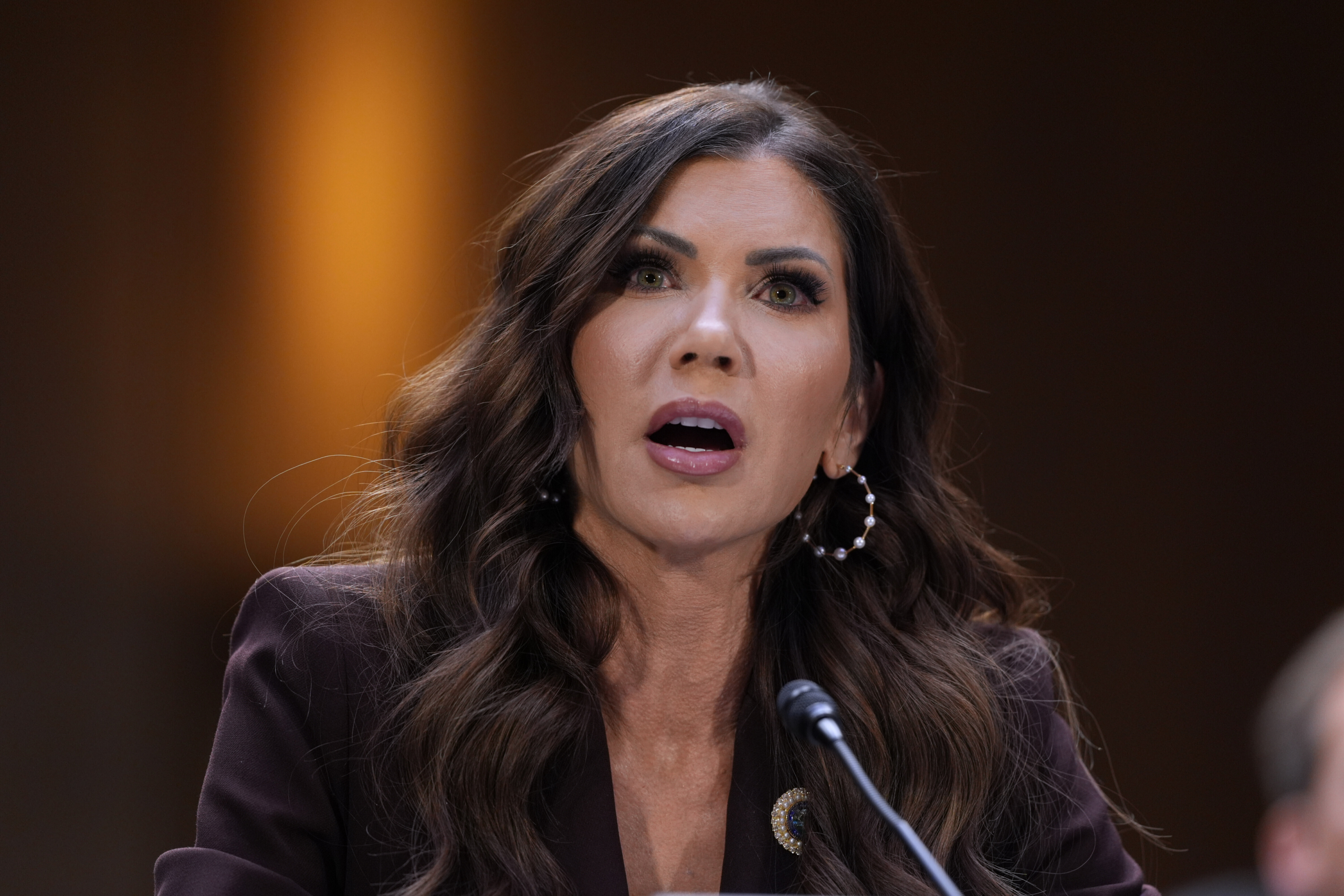
When Donald Trump unceremoniously fired Kristi Noem as secretary of homeland security last week, many observers noted that the key factor in her ouster was pointed questioning from John Kennedy, the senator from Louisiana, about a 220-million-dollar advertising campaign and Noem’s claim that Trump approved it. “I was stunned when Noem answered categorically that the president approved every single bit of it,” Kennedy said of the exchange on Fox News. “Later that day, I got a call from President Trump. He was mad as a mama wasp.”
What many may not have realized was that the substance of Kennedy’s questions drew heavily from an excellent report from ProPublica by Justin Elliott, Joshua Kaplan, and Alex Mierjeski. It was a striking example of something that happens more than the public sees: rigorous investigative reporting often arms lawmakers with facts that help them hold officials to account.
The story, published by ProPublica in November, revealed that the bulk of the contracts for the ad budget went to a mysterious Delaware business entity, created just days before it was awarded the deal. The work was then subcontracted to the Strategy Group, a Republican consulting firm with deep ties to Noem and her inner circle. The firm’s CEO, Ben Yoho, is married to Tricia McLaughlin, Noem’s former spokesperson (you can read more about McLaughlin from CJR’s Amos Barshad here); Corey Lewandowski, Noem’s top adviser and rumored paramour, has long worked with the Strategy Group. Noem and her team bypassed the normal bidding process by invoking the “national emergency” at the border.
At the center of the campaign was a cinematic spot that featured Noem on horseback at Mount Rushmore, in western riding gear, a cowboy hat, and her trademark Real Housewives glam. The classic American imagery and sweeping vistas made it appear more like a campaign ad for a possible Noem presidential run in 2028 than a public service announcement. Fun fact: the ads cost more than all but one of the films nominated for Best Picture at the Oscars this year.
ProPublica is not done covering Noem, now relegated to the rather specious position of “Special Envoy for the Shield of the Americas.” Just a day before Noem was dismissed, the newsroom dug into whether she was truthful in her testimony to the Senate Judiciary Committee about Lewandowski’s role in approving DHS contracts. I’m told to expect further investigation.

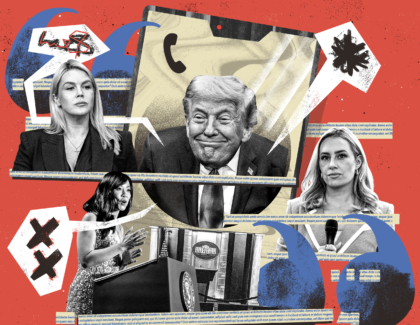
On Monday, after a turbulent morning in the markets and as oil prices soared, Trump redirected the narrative, taking a series of calls with reporters. “I have a plan for everything, okay?” Trump told the New York Post in a brief phone interview. “I have a plan for everything. You’ll be very happy.” He went further with Weijia Jiang, the senior White House correspondent for CBS News, telling her, “I think the war is very complete, pretty much.”
Soon, the market rallied and oil prices fell. Of course, the message shifted a few hours later, when he was asked at a press conference to confirm his comments. Was the war, in fact, complete? “No, but soon. I think soon. Very soon,” he said. “It’s the beginning of building a new country.” Three hours later, Trump shifted his tone again, posting on social media: “If Iran does anything that stops the flow of Oil within the Strait of Hormuz, they will be hit by the United States of America TWENTY TIMES HARDER than they have been hit thus far.” By Tuesday, we were back to market volatility and vacillating oil prices. After a day like that, it’s worth asking whether Trump’s comments really clarify anything at all.
I put the question to Margaret Sullivan, the media critic who writes American Crisis on Substack. “For the individual reporters it’s catnip because you’ve got the president taking your call or you’ve got the president calling you and saying all kinds of things,” she said. “These calls, I think, can be very consequential, but that doesn’t necessarily mean that they are useful or true.”
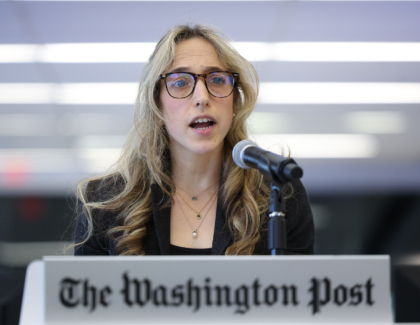
If you’ve lost track of all the reporters Trump has been fielding calls from since the Iran operation kicked off, you’re not the only one. Here is a non-exhaustive list: Jiang’s CBS colleague Robert Costa; ABC News’s Rachel Scott, Jon Karl, and Mary Bruce; Axios’s Barak Ravid, to whom he’s spoken at least four times; the New York Post’s Steven Nelson; CNN’s Jake Tapper; Politico’s Dasha Burns; MS NOW’s Mychael Schnell and Laura Barrón-López; the New York Times’ Zolan Kanno-Youngs; and the Washington Post’s Natalie Allison.
In theory, the point of getting the president’s comment is straightforward: he is the commander in chief, so what he says about a military operation is inherently newsworthy. The problem, as Kathleen Culver, the director of the UW-Madison School of Journalism and Mass Communication, told me, is that reporters often rush to frame these calls as news alerts, immediately posting Trump’s comments to social media before taking the time to place them in context—or to disregard them as falsehoods. “There are some who are doing much more of a breaking news approach, and treating the call itself as if it’s news, when the news is the war, and Trump is a source of information for that war.”
That doesn’t mean the comments have no value. They can still reveal how the president wants the situation framed, which itself is news. But the real journalistic work isn’t just relaying the quote; it’s placing it in context, comparing it with prior statements, and testing it against what’s actually happening, even if that means slowing down.
Amid the ongoing Epstein coverage, an investigation from Mitchell Black and Marilyn W. Thompson for the Post and Courier stands out. They examine the story of the unidentified South Carolina woman who told the FBI she was sexually abused by Jeffrey Epstein as a teenager on Hilton Head Island and alleged that Trump forced her to perform a sex act on him in the 1980s.
Their fact-checking corroborates several key elements from her account using public records, including her mother’s legal entanglements, details about an Epstein associate from Ohio, and other background information. But her allegations against Trump remain unverified, and the White House has denied the claims, calling them “baseless accusations from decades ago.” The piece paints a portrait of a woman whose life was profoundly disrupted after the alleged abuse, marked by struggles with substance abuse, legal trouble, and personal turmoil.
What sets this reporting apart is its approach: the Epstein files aren’t treated as a story in themselves, but as a starting point for careful, evidence-driven reporting.
Hat tip to Bill Grueskin for the Post and Courier story. If you have a suggestion for this column, please send it to laurelsanddarts@cjr.org. We can’t acknowledge all submissions, but we will mention you if we use your idea. For more on Laurels and Darts, please click here. To receive this and other CJR newsletters in your inbox, please click here.
Correction: This post has been updated to correct a misspelling.
Has America ever needed a media defender more than now? Help us by joining CJR today.